The demand map — 2026-07-02PUBLIC
What Businesses Actually Pay For in AI Automation: Real Listings, Not Rate Cards
We ran the AI-services pricing internet through adversarial verification and almost all of it died. What survives: 1,560 real marketplace listings, audited financials, and a demand map that tells a solo engineer what to build, which vertical to own, and what the first real price is.
≈ 27 min read

Every rate card you have read for AI automation work is probably fake. I ran the published numbers through adversarial verification, each claim traced to primary sources. The retainer bands, hourly guides, setup-fee tiers? Dead. Nearly all trace to SEO content farms citing each other. What survived: marketplace listings, audited financials, a few honest operators. This is the map built from that, and what a solo engineer should build on it.
CH.01
The pricing internet for AI services is fiction
Almost every published price for AI automation work failed verification. Not one of the famous bands traces to a primary source.
A business owner got two proposals in the same week: $8,000 for a lead-routing workflow, $45,000 for a chatbot that took three months to deliver. He had no way to judge either.1 That helplessness is manufactured. The numbers everyone prices against come from a genre of rate-card blog that cites surveys nobody ran.2
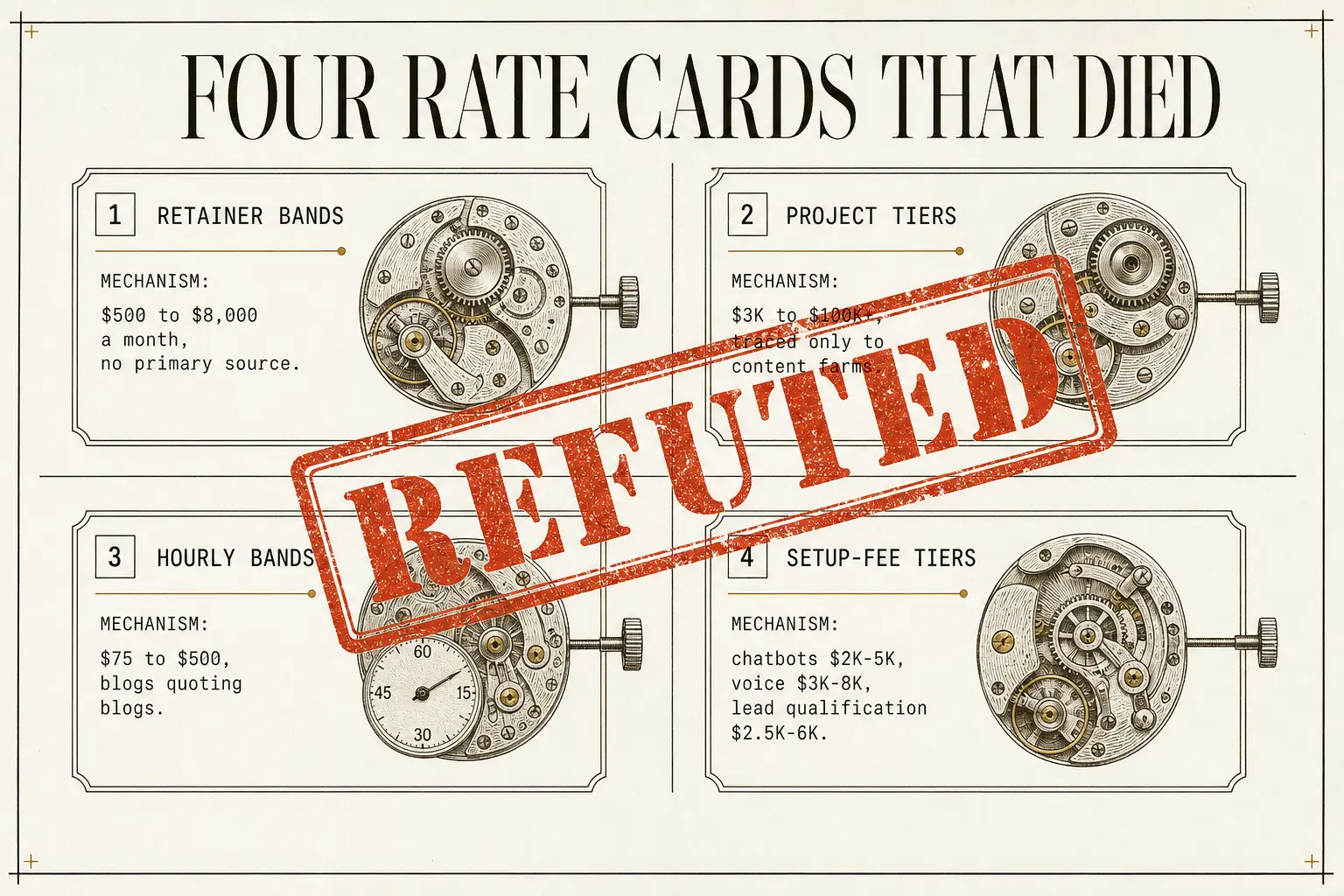
What died in verification, every item tracing only to content farms quoting each other:
- Agency retainer bands of "$500 to $8,000 a month"
- Project tiers of "$3K to $100K+"
- Hourly bands of "$75 to $500"
- Per-category setup prices: "chatbots $2K-5K, voice $3K-8K, lead qualification $2.5K-6K"
- "59% of businesses would automate customer service"
- "74% of SMBs access AI only through embedded features"
- "Over 50% of enterprises shifted to production AI by end-2025, per Gartner"
Gartner never said that. The surveys don't exist. Everything below prices against real listings, audited filings, and named operators instead.
CH.02
Buyers purchase relief from pain they already fund
The demand is real and it pays a premium. What sells is the removal of a cost the buyer can already name, never the AI itself.
The freshest evidence is this week's: 1,560 live marketplace listings pulled on July 2, 2026, with real budgets attached. Every demand chapter below reads from them.
The audited trail agrees at every age:
- Upwork Q4 2025: AI services volume past $300 million annualized, up 50% year over year.3
- Upwork FY2024 (the oldest baseline worth citing, prehistoric in AI time): AI-project freelancers already earning 44% more per hour.
- Salesforce's survey of 3,350 SMB leaders: 77% name marketing and customer engagement their top AI priority. A vendor survey, dated, but it matches this week's job boards.
The person who taught me the frame is a freelancer earning $4,200 a month with a box fan, an empty ramen bowl, and a notebook that says "fix webhook retries before Friday":
"Businesses rarely purchase AI itself. They purchase relief... Tools change too quickly to trust as the foundation. Workflows last longer."4
One founder watched his new voice agent book an appointment at 5 p.m. on a Sunday and felt a week of missed calls lift.5 That is the product. The practical demand signal: if the buyer already pays two employees to do the task, the demand is validated before you write a line.6 And if you would rather not wait for a listing to tell you, the cheaper version of this test is delivering the result by hand to five real targets first, which surfaces the same answer in a week.
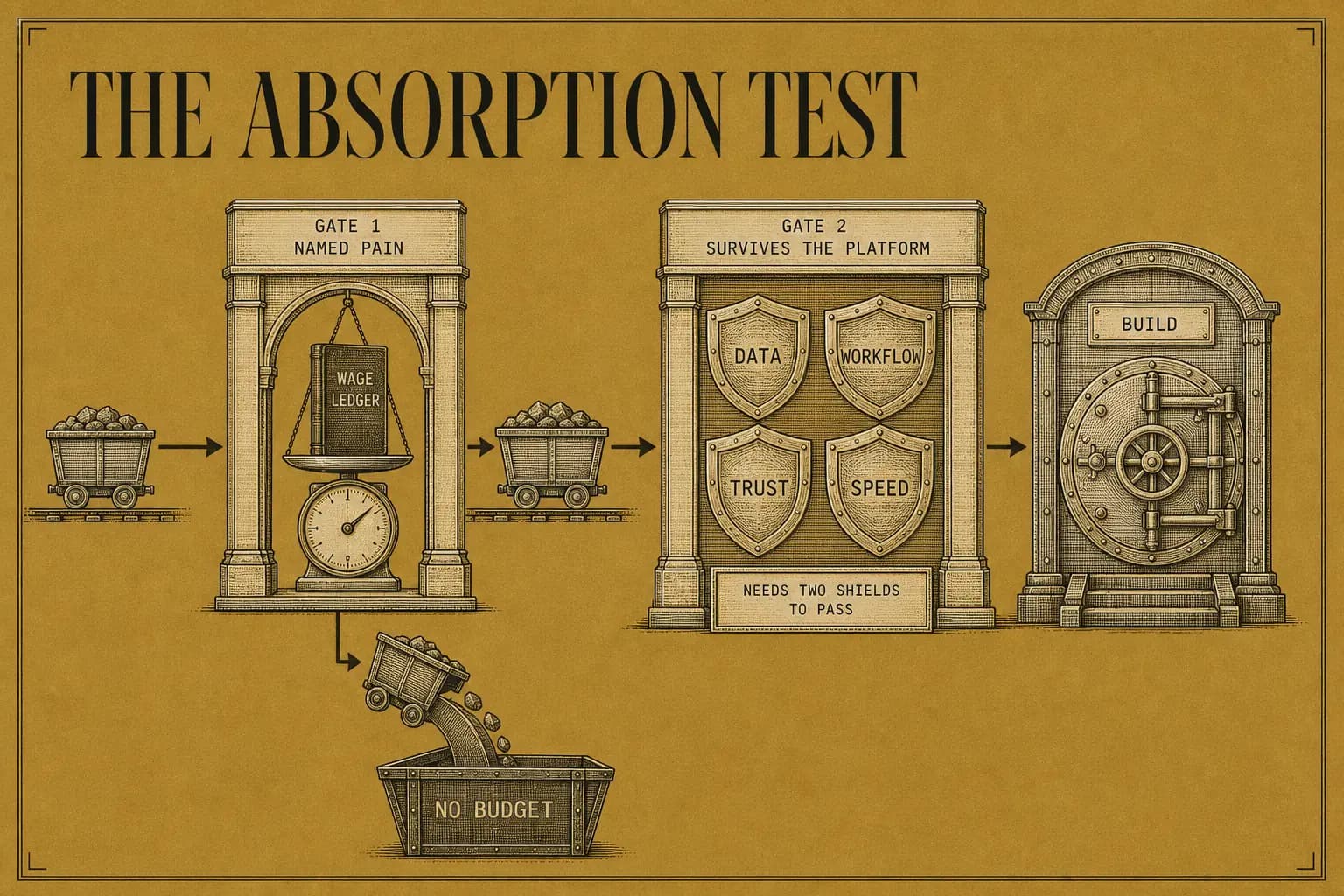
Two questions decide everything in this piece. Call it the absorption test: (1) Does the buyer already fund this pain in headcount or lost revenue they can name? (2) When the platform ships your feature, what survives: proprietary data, workflow embedment, regulated trust, or performance economics? Build only where (1) is yes and (2) names at least two survivors.
CH.03
The real price map is a barbell, read straight off the marketplaces
Live listings show a $5-$150 commodity floor, a crowded and bleeding middle, and a fixed-scope build band from $1,500 to $10,000 where real budgets sit. The solo-adjacent ceiling runs to $60,000.
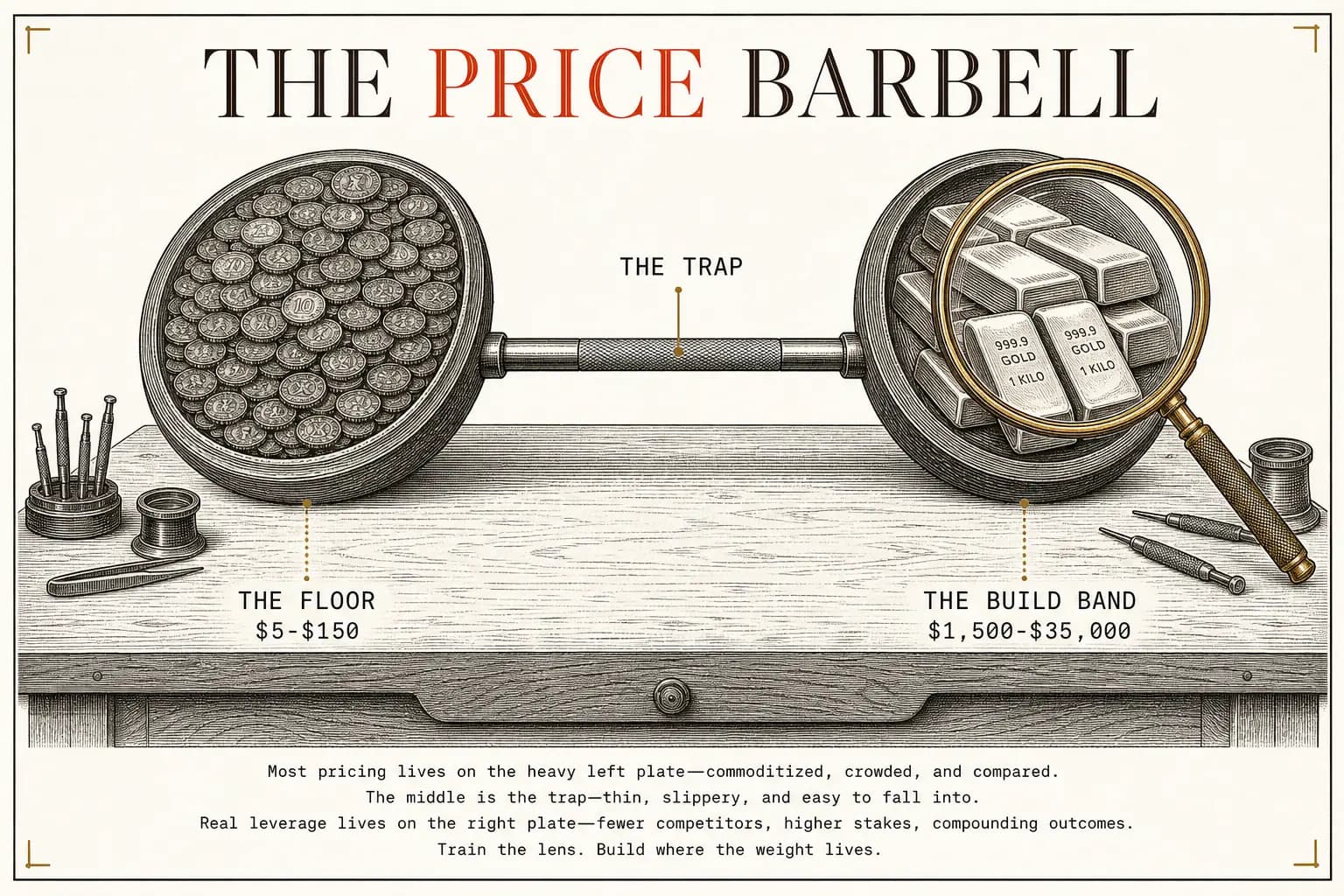
Every marketplace figure in this article comes from Fiverr and Upwork searches captured on 2026-07-02, each footnoted to its search. The spread is not subtle. The same week a Canadian client posted $10 fixed for a voice agent, a US client with $284,785 in spend history posted $8,000 fixed to fine-tune a speech model for Hinglish audio.7
flowchart LR
    A["Floor $5-$150<br/>templated gigs, volume sellers"] --> B["Middle $150-$1,000<br/>generalist glue, public failures"]
    B --> C["Build band $1,500-$10,000<br/>production systems + proof"]
    C --> D["Ceiling $25K-$60K<br/>solo-with-history, boutique teams"]
| Band | Fiverr comps (live listings) | Upwork comps (live listings) | Who lives here |
|---|---|---|---|
| Floor, $5-$150 | Voice setups at $20, n8n basics $10-$5089 | $5 "AI Agent Developer", $10 voice agent10 | Offshore volume sellers, price-shopping buyers |
| Middle, $150-$1,000 | Agent gigs $80-$500, voice mid-tier $90-$300118 | $550 outbound-lead builder, $700 voice booking integration105 | Generalist connectors |
| Build band, $1,500-$10,000 | Vertical voice $1,000-$1,500, top agent gig $5,000811 | $2,500 realtor voice MVP, $3,500 Claude recruiting build, $8,000 STT fine-tune5107 | Production engineers with proof |
| Ceiling, $25K-$60K | (absent from Fiverr) | $35,000 tax platform, $60,000 field-ops platform from a client who has spent $332,027712 | Solo-with-history and boutiques |
Rate texture: across 11,541 Upwork postings, disclosed hourly midpoints run $18 at the 25th percentile, $25 median, $55 at the 90th, with AI and Python keywords clearing $30 against $22-$25 for frontend work.13 Only 8% of freelancers earning $150K+ still bill primarily by the hour. Fixed pricing rewards speed, with one trap: a $5,000 fixed project that absorbs 20 unbilled hours quietly cuts your effective rate from $125 to $83.14
CH.04
Demand ranks cleanly across eight categories, and the top three name their own dollar
Lead handling, voice, and back-office documents lead because the buyer can point at the money leaking. The further a category sits from a nameable dollar, the thinner the budgets get.
| Rank | Category | Demand signal | Real budget comps (listings unless noted) |
|---|---|---|---|
| 1 | Lead handling / speed-to-lead | Most-cited pain across every search15 | $550 n8n+Apollo builder, enrichment brief from a client with $639,821 spent10 |
| 2 | Voice agents | +49% demand, Fiverr trends index June 202616 | $650-$2,500 MVPs, $20-$1,500 gig spread58 |
| 3 | Back-office / documents | A real airport RFP: 6,000+ invoices a year, 3-year term from June 202617 | $8,000 STT job, 200-300 page multilingual price-list extraction, a solo law firm requesting a 9-agent suite7 |
| 4 | Support / CX | Mature, priced per outcome: Intercom Fin at $0.99 per resolution, 76% average resolution across 12,000 customers18 | Per-resolution board runs $0.50 (HubSpot, since April 2026) to $3.50 (Ada)19 |
| 5 | RAG / internal knowledge | Market $1.94B in 2025, projected $9.86B by 203020 | $400 MVP up to $10,000 senior builds, one $7,000 ten-week MVP requiring sub-500ms latency21 |
| 6 | Reporting / analytics | Steady, mid-band | $10,000 restaurant ops framework, $9,000 intelligence platform, $300 AI-visibility benchmark12 |
| 7 | Content ops | +278% Video & Animation demand16 | Delivery rates commoditized: $15-$35/hr script-to-video briefs, $70 avatar proof-of-concept22 |
| 8 | E-commerce catalog ops | Shopify gigs +348%16 | A 16-brand gourmet operator ($131,987 spent) paying $19-$40/hr for marketplace ops23 |
Direction check: Fiverr reports AI agent services up more than 18,000% year over year, the Claude Code specialist gig up 938%, faceless YouTube up 488%.2425 Growth curves, not price signals.
The number-one category earns its rank with stories. A home-services owner audited his pipeline and found 47 leads that never got a second follow-up. Twelve booked a competitor within 72 hours. He priced the damage at roughly $34,000, per the vendor who published the audit.26 Vendor guides repeat a claim that 78% of buyers choose whoever responds first. Unverified, but everywhere. One agency self-reports cutting a client's cost per lead from $400 to $35 with enrichment.27
CH.05
Voice agents are the premium tier, and the platforms bill them dishonestly
Voice is the clearest premium subcategory in the data: same agent logic as text, several times the price, gated by sub-second latency. The advertised per-minute rate is roughly a third of the real bill.
The demand is one paragraph, posted nearly verbatim across half a dozen listings:
"We are missing leads because inbound calls are not always answered, outbound follow-ups are delayed, and our team spends too much time qualifying prospects, booking appointments, writing notes, and updating CRM records manually."28
One poster attached a $5 budget to that paragraph while carrying $9,728 in platform spend history. Others pay properly: $300 fixed for a Retell-to-GoHighLevel calendar integration, $700 for a voice-plus-n8n booking build where no-code had failed on edge cases, $650 to $2,500 for realtor scheduling MVPs, $999 for a 70,000-word ElevenLabs narration, and $150 for a pure audit of an existing voice agent.5
The real per-minute math
Every production voice call pays five layers. Advertised entry prices skip four of them.29
flowchart LR
    A["Advertised<br/>$0.05/min platform fee"] --> B["+ STT<br/>$0.004-$0.024/min"]
    B --> C["+ LLM<br/>$0.003-$0.08/min"]
    C --> D["+ TTS<br/>$0.02-$0.10/min"]
    D --> E["+ telephony<br/>~$0.0085/min"]
    E --> F["+ silence billing, failed-call<br/>minimums, concurrency, HIPAA"]
    F --> G["Real bill: $0.12-$0.30/min<br/>x ~1.8 history factor"]
| Layer | Cheap option | Premium option |
|---|---|---|
| Speech-to-text | Deepgram ~$0.008/min | Google/Azure $0.016-$0.024 |
| LLM | GPT-4o mini ~$0.003/min | Frontier models $0.04-$0.08 |
| Text-to-speech | Deepgram Aura $0.03-$0.04 | ElevenLabs $0.08-$0.12 |
| Telephony | Twilio inbound ~$0.0085 | Managed numbers, marked up |
| Platform | Vapi $0.05, bring your own keys | Bland $0.09-$0.14 all-in |
The 1.8x multiplier comes from conversation history compounding token costs turn by turn.30 Bland, a vendor with its own incentive here, states it plainly: the published rate is about 30% of the enterprise bill, and it works a Medicare call-center example where the advertised ~$60,000 a year becomes ~$140,000 real.31 The hidden lines are specific. Silence billed as talk time adds 25% to a two-minute call with 30 seconds of dead air. Failed outbound attempts carry a $0.015 minimum and hit 20-40% of volume. Concurrency slots run $8-$15 each. HIPAA is a $1,000-a-month add-on.2932
Latency is the quality bar
Humans respond in about 200 milliseconds. Past 500ms a pause reads as unnatural. Past one second, callers assume the system is broken, per Stanford HAI research cited by Telnyx.33 Measured platform latency in 2026 spreads from under 300ms to 1,400ms.34 A builder who stitched the stack himself describes the other cost: five dashboards, billing reconciled across vendors, latency fires at 2 a.m.35 The gap between $20 setup gigs and engineered sub-second systems is precisely where the premium lives.36
CH.06
A wrapper is not a company, it is a grace period
The thin UI over a foundation model is dead as a business. What survives platform absorption is proprietary data, workflow embedment, regulated trust, or performance economics, and you need two of the four.
Three mechanisms killed the wrapper:37
- Platform absorption. Custom instructions, memory, file analysis, voice: all native in the base products now.
- Zero switching costs. A prompt can be copied. There was never lock-in.
- Margin compression. API costs eat 40-70% of a thin wrapper's revenue.
Industry estimates put 90% of wrapper startups at failure by end of 2026, with wrappers needing 3.2x more funding to reach profitability.38 The kill also comes from below: ChatGPT Go at $8 a month erases the logic of every sub-$20 tool.39 One analysis compresses it into a maxim. Without the thing that survives when OpenAI adds your feature to ChatGPT, "you don't have a company. You have a grace period."40
What surviving looks like
The verified spending data points the same way. IDC's Worldwide AI Spending Guide has industry-specific AI growing at a 36.5% compound rate against 18.9% for general-purpose tools. At full scale:41
- Harvey grew from roughly $100M ARR in October 2025 to $190M by March 2026 across 1,300+ law firms, on proprietary legal corpora and embedment inside matter management.
- Abridge passed $100M ARR across 250+ health systems, with its Epic integration as the distribution weapon, deployed to 24,600 Kaiser physicians.
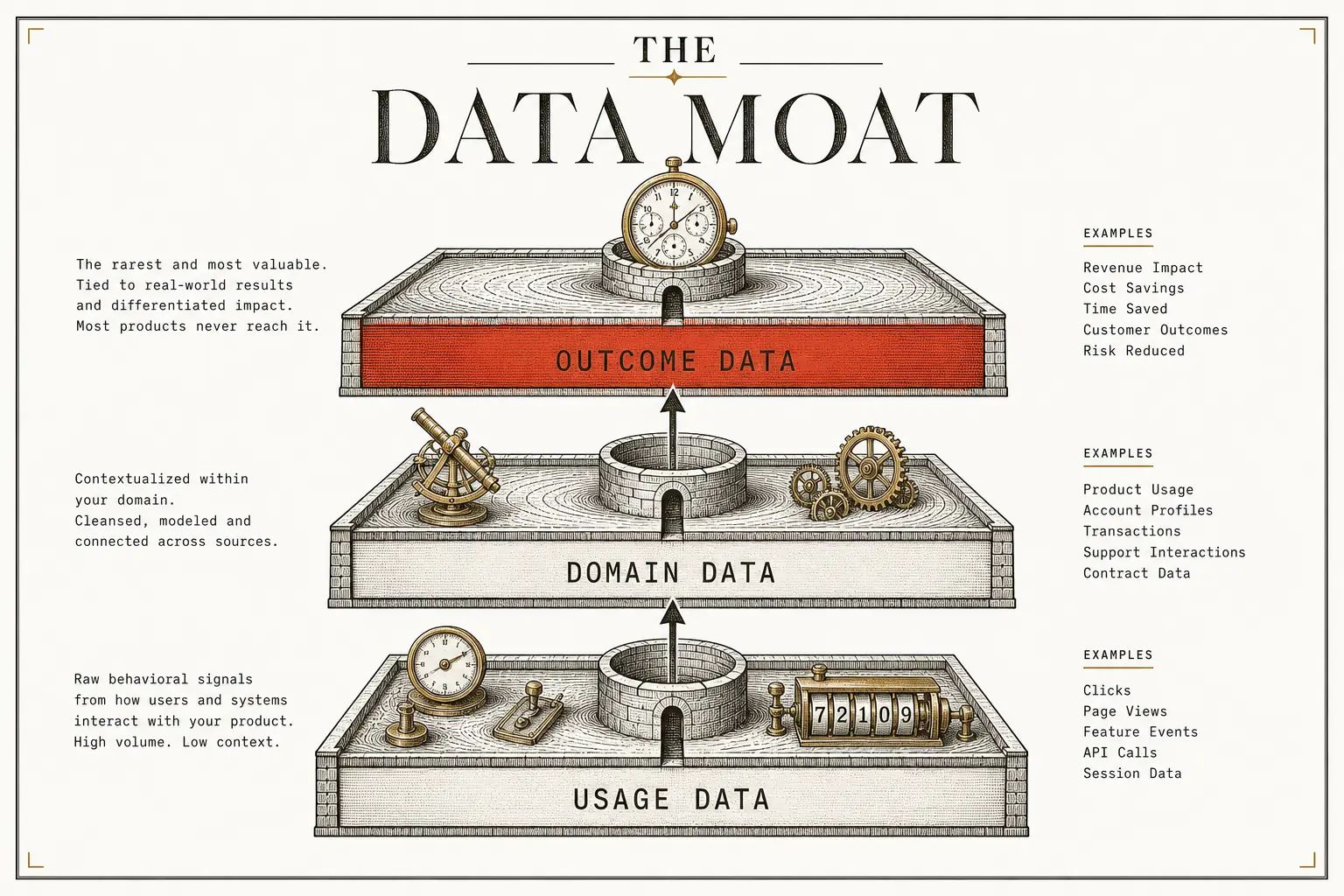
Both collect what one analysis calls the three tiers of data moat: usage data, domain data, and outcome data. Most products only ever collect the first.42 One Lovable user lived the small version of absorption risk: he built his whole workflow around the platform's chat refinement, then the platform pivoted, and "it felt like they'd pulled the rug out from under me."43
CH.07
The money pools in the SMB dead zone, and the no-code ceiling is the door
Businesses too complex for self-serve tools and too small for enterprise sales carry real budgets and no good options. The moment their no-code stack hits its ceiling is your entry.
Venture analysts have flagged this dead zone for years (Samaipata, Techaisle), and the sprawl data explains the mood inside it. The average SMB now runs 73 SaaS apps, up from 40 in 2021, spends about $4,700 per employee per year on software, and wastes roughly 26% of that on unused licenses, per Productiv and Vertice figures.44
The ceiling is knowable in advance:4546
flowchart TD
    A["Workflow on Zapier/Make"] --> B{"More than<br/>1,000 items/day?"}
    B -- no --> C{"More than 3 branches,<br/>messy data, or<br/>reliability-critical?"}
    C -- no --> D["Stay no-code"]
    B -- yes --> E["Custom-build territory"]
    C -- yes --> E
    E --> F["Self-hosted fixed run cost<br/>~$96/mo at any volume"]
The economics flip hard at volume. A 10-step Zapier workflow running 1,000 times a day burns 10,000 tasks daily and exhausts a $49-a-month plan in 4.8 hours, while the self-hosted equivalent holds near $96 a month at any volume.47 A 12-step no-code flow becomes 3 steps in custom code, and the classic mistake is rebuilding the old flow one-for-one instead of rethinking it. Budget 2-4 weeks for data cleanup first.46
The dead zone posts its own evidence:
- A painting company paying for a custom ERP built from n8n on Railway to weld PaintScout, Monday, QuickBooks, and Gusto into one system.10
- A 34-year-old HVAC company integrating GoHighLevel with ServiceTitan.28
- A $5M-$10M lawn-care operator ($181,135 spent on the platform) asking for one source of truth across five systems.12
And the recurring last-mile shape: one client's AI bidding system sat "95% complete," blocked entirely on a portal login bridge. The boring connector was the whole job.48
CH.08
Clients now verify builders, not resumes
The 2026 screen is explicit: shipped systems in production, eval harnesses, cost numbers, and evidence of judgment. "I use AI" closes nothing.
The language in real listings is blunt. One platform client: "This is not a role for prompt engineers or 'vibe coders.' We need someone who can architect scalable systems, write production-grade code... and ship reliable software."49 Professional-services buyers ask for people who have "already built real systems," not people learning on their invoice.5
The senior signals
Hiring evaluators publish what separates proof from talk. Strong evidence names the user and the constraint, explains tool tradeoffs, and shows how outputs were checked against test sets. Weak evidence starts with the tool and ends with "it looked right."50 The signals themselves are unglamorous: one deployed project with meaningful LLM use and a README, roughly 20 hand-curated eval examples with methodology, and cost and latency instrumentation. "$0.003 per request, 1.2s p50, cut 40% by caching embeddings." The numbers need not impress. Having them is the signal.5152
The proof pack, condensed from the hiring-manager scorecard:50
- Before-and-after output from a real workflow
- A workflow diagram of what actually runs
- The key prompts or logic, shown
- Eval notes and QA logs
- Rejected model outputs, with reasons
- Cost assumptions, per unit
- Usage evidence: analytics, a Loom of it running
- The shipped artifact itself
Why the pack pays
Two market facts make it valuable. Evals are themselves paid work: a US client with $276K in spend history is hiring a from-scratch eval framework with golden datasets and hallucination detection.7 And trust is the scarce good. McKinsey's March 2025 global survey found only 27% of generative-AI-using organizations review all outputs, while 47% have already eaten at least one negative consequence. A designer reviewing AI-saturated portfolios set the bar in one line: "show me the 50 variants the AI generated and explain why you rejected 49 of them."53
The rejection rate is the product. Fabryka is an e-commerce listing line where a deterministic whitelist blocks any claim the merchant did not supply, so the pipeline holds a product for review rather than inventing a spec for it. Two numbers from the production run:
- 58.8 percent of 51 products passed that gate on the first try, and the failures are the point, not the flaw
- one catalog went from 2 of 15 passing to 13 of 15 after the merchant enriched her own facts, with the gate itself untouched
A pipeline that never rejects anything is not being trusted. It is being unsupervised.
CH.09
The saturation map: what collapsed, what still commands premium
Five categories already collapsed to commodity. The premium survives exactly where verification, messy data, or regulation lives, and the reason is measurable: even production legal AI still hallucinates.
| Collapsed (floor evidence) | Still premium (what the client specs) |
|---|---|
| AI blog writing, down to $0.02-$0.05/word (operator survey)54 | Source-cited Q&A for law and healthcare: "every response traces back to the exact document and page"497 |
| Standalone prompt engineering, dead as a service54 | Adversarial verification RAG: a system that drafts, attacks its own answer with contradictory evidence, then forces citations21 |
| Generic ChatGPT-widget chatbots54 | Agentic RAG plus voice for contact centers, $20-$40/hr across 3-6 month phases5 |
| AI social-media art54 | Document processing where OCR fails: fire-sprinkler submittals, drawings rebuilt from PNG tiles at $500, 30-brand multilingual price lists7 |
| Templated video gigs at $10-$1555 | Eval frameworks and human-in-the-loop review, where buyers reportedly place double the trust in human-plus-AI56 |
Why the right column pays: Stanford's RegLab tested production legal research tools and found Lexis+ AI hallucinating on 17% of queries and Westlaw's AI on roughly a third.20 In domains where a wrong answer blows up a case or leaks a patient record, the accuracy nobody brags about is the whole product.
Two rows of that right column are systems I have built, which is the only reason I trust the column.
- Proofdesk is the source-cited row. A separate cross-vendor verifier checks every claim against the evidence and refuses rather than ship anything unproven: 89.58 percent grounding on a 60-question golden set, 100 percent correct refusal of the 12 unanswerable ones. The interesting number is the third, a measured 10.42 percent false-refusal rate. That is the cost of never guessing, and it is precisely the tradeoff a commodity chatbot declines to make.
- Assay is the OCR-fails row. Documents read twice on local GPUs, every field confidence-scored, the doubtful ones routed to a human bench: 98.73 percent field accuracy over 1,361 reconciled documents.
Neither is clever. Both are just unwilling to be wrong quietly, and that unwillingness is the part with a budget attached.
The left column has a human face. The Kingdom Come: Deliverance 2 Czech translator, fired and replaced: "they're replacing me with a tool that can't even tell the difference between a pun and a typo."57 Commodity happens to people. The move is to sell what the tool cannot fake.
CH.10
Rust is your margin, not your pitch
Zero of 100+ scraped job posts ask for Rust. Clients buy outcomes in Python and Node vocabulary. The compiler's job is your cost line, and there the numbers are dramatic.
Read the demand side honestly first. Across the Upwork agent and automation searches, Rust appears in none of them. Python, Node, TypeScript, n8n, Make. That is the language of the buyer.4828 Leading with Rust in a proposal answers a question nobody asked. The gap is the same one paid media runs into, where the words that convert turn out to be the buyer's own, discovered rather than invented: you describe the mechanism, they describe the pain, and only one of those gets a reply.
Then read the supply side, all self-reported by the teams involved, and consistent:
| Metric | Baseline | Rust figure | Source |
|---|---|---|---|
| GC pauses vs a 33ms video frame budget | 5-15ms stalls (Node) | none | V100 rewrite58 |
| Throughput | 15K req/s | 220K req/s | V10058 |
| Memory per service | 400-800MB | 40-80MB | V10058 |
| Agent framework tasks/sec | ~180 (CrewAI) | ~2,400 | AutoAgents bench59 |
| Cold start | 3.2-5.8s | ~180ms | AutoAgents59 |
| Streaming infra cost | baseline | claimed 87% reduction | H33.ai60 |
Honesty cuts both ways. The rvLLM inference engine beats vLLM by 6.6% at batch 512 (8,786 vs 8,243 tokens/sec) but loses at batch size 1.61 And self-hosting only beats premium APIs, never commodity ones: a $9,000 RTX PRO 6000 undercuts Sonnet-class API pricing only above roughly 26% daily utilization, and never catches Together AI's ~$0.88 per million tokens. Depreciation is ~85% of the bill.62
The synthesis is mine. Sell the outcome in the client's vocabulary, run the media processing on your own metal, and let the compiler buy the margin your no-code competitors pay out as SaaS credits. The freelancer through-line applies here too. Tools change too fast to be the foundation. Workflows last.4
CH.11
The media-pipeline gap is the widest measured opening in this research
Demand for video automation is exploding while the supply side sells $10 templates. Across 120 scraped gigs, exactly two offer video automation, both at $10-$15, and none mention FFmpeg or custom pipelines.
The supply count is the finding. In the Fiverr automation searches, two sellers list "n8n ai video automation" for TikTok and Reels at $10-$15, and no listing in either 60-gig sample mentions Rust, FFmpeg, or engineered video processing.55 Against that: AI UGC video ads up 265% and Video & Animation up 278% on Fiverr's trends index,16 AI video editing up 329% year over year on Upwork per one agency's analysis,63 and 91% of businesses using video, with production cost per finished minute falling from $4,200 in 2024 to a $2,500 median.64
The run economics are already published
One autonomous-pipeline operator prices finished video at roughly $2 a minute, an $8-$12 API bill for a five-minute video.65 The UGC Copilot pipeline, pay-as-you-go since April 2026, posts exact math:66
| Step | Model | Credits | Dollars at $0.08/credit |
|---|---|---|---|
| 55 scripts + tone variants | text | 55 | $4.40 |
| 50 scene images | Nano Banana 2 | 50 | $4.00 |
| 50-variant video run, all-in | Seedance 2.0, 4s clips (scripts + images + renders) | 1,055 | $84.40 |
| 50 text overlays | overlay | 50 | $4.00 |
| 50-variant run | 1,055 | ≈$84.40 |
Same run on Veo 3.1: about $172.66 One gotcha carries a bill of its own. Skip the Idempotency-Key header and retries double-charge you.
Why buyers would pay engineering prices here: brand safety. AI clips hit 87% engagement parity for social content but only 61% for brand storytelling, so 72% of teams keep human review in the loop.64 Premium brands in the listings explicitly reject generic output.15 One builder self-reports a catalog-video system saving about $30,000 per collection shoot with a ~20% conversion lift.67 A templated $10 gig cannot carry that risk. An engineered pipeline with a review gate can.
CH.12
Own one vertical, and pick it by media weight
Vertical specialization is the best-attested strategy in the pool, and for a builder with media-pipeline skills the pick is e-commerce catalog operations first. That ranking is my call, and I'll show the work.
The case against staying horizontal comes from an operator who names the three lies that keep people there: "I need to serve everyone," "niching down limits my market," "I need deep industry experience." His counter-case, self-reported: an operator who went from $87K horizontal to $600K vertical in twelve months, close rate 73% against a prior 12%.68 Vendor-reported figures point the same way, with vertical agents showing 3-5x higher retention.6 The entry bar is his best line: 20 hours of problem fluency, not 20 years of credentials.
Three candidate verticals fit this arsenal, each with live demand evidence:
- E-commerce catalog ops. Media-heavy (photos, videos, listings), zero regulatory drag, buyers already trained to pay: the Rebuy brief demanding a system that runs "fully, correctly, first time," the 16-brand gourmet operator, fashion brands hiring AI photography for 50+ products.23
- Real estate. Media-heavy, fast cycles, but tone-perfectionist on voice: realtor MVPs at $650-$2,500 with "must mimic a specific video sample" clauses.5
- Trades and field service. Voice and documents: HVAC briefs everywhere, a $1,000 job to score home efficiency aimed at what the poster calls the $160B HVAC industry.7
My call: e-commerce first, real estate second, trades third. E-commerce is where media weight, buyer sophistication, and short sales cycles stack, and the extraction work (supplier price lists, multilingual invoices) lives in the same buyer's building, so the upsell never leaves the vertical. One source proposes a real-estate listing pipeline at $500-$2,000 a month as a subscription. Treat that as the source's proposal, not a verified price.69 The moat to build toward: a pipeline that improves with every client's catalog data, the one compounding asset a solo operator can actually hold.69
If your stack is not media-heavy, run the absorption test on your own arsenal. The test travels. The vertical pick is what changes.
CH.13
Three offers you can build from this evidence
A catalog-to-channel media pipeline, a document-to-system extraction service, and a speed-to-lead voice system. Every price below states whether it is a marketplace comp or my proposal.
| Offer A: Catalog media pipeline | Offer B: Document extraction | Offer C: Speed-to-lead voice | |
|---|---|---|---|
| Ships | Photos/SKUs in, channel-ready copy, images, video variants out, human review gate, eval set | Messy vertical documents into structured systems, confidence scoring, review queue, golden-set gate | 24/7 answer, qualify, book, CRM write, handoff, weekly containment report |
| Build price | $3,500 first client, $6,500-$9,500 productized (mine, bounded by the $3,500 build comp and $8,000-$10,000 listings) | $4,000-$12,000 (mine, bounded by $3,000 MVP and $8,000 STT comps, $35K ceiling) | $1,500-$3,500 (mine, bounded by $650-$2,500 MVP comps) |
| Run cost | ~$84-$172 per 50 video variants, ~$2/finished minute (comps)6665 | Cents per page, halved on batch APIs (comp)70 | $0.12-$0.30/min real (comp)29 |
| Retainer | $600-$1,200/mo (mine) | $800-$2,000/mo (mine) | $400-$800/mo + minutes (mine) |
| Moat stack | Workflow embed + outcome data + performance economics | Domain data + eval trust + regulated adjacency | Workflow embed + latency economics |
Offer A, the flagship
The supply-gap play from the last chapter. Value anchor: the self-reported $30K-per-collection replacement.67 Sell the pilot as their measurement, never a promised number. Rust-local image work makes the image line near-zero marginal while credit-metered competitors pay per operation.
Offer B, the moat
The eval harness ships with every build, and it is not overhead: the $276K-history client buying a standalone eval framework proves the QA layer itself commands budget.7 Every engagement adds labeled vertical documents you keep learning from. This is the offer that climbs toward the $35,000-$60,000 ceiling listings.712
Offer C, the wedge
The clearest self-selling demo in the pool (the Sunday 5 p.m. booking). The value lever is containment. One consultant's property-management case, operator-reported: $7,500 setup plus $480 a month, ROI-positive in month two, after-hours bookings up 67%.71 Fit it to trades or real estate if e-commerce entry stalls.
CH.14
Package it: paid diagnosis, fixed build, retainer
Never bill hourly for builds. Enter with a small paid diagnostic, price the build fixed against the comps, and attach the retainer at proposal time. Then raise on evidence.
flowchart LR
    A["Paid diagnostic<br/>$150-$500, credited"] --> B["Fixed-scope build<br/>priced vs comps"]
    B --> C["60-day support window"]
    C --> D["Retainer, sold as Phase 2<br/>monitoring + evals + report"]
    D --> E["Raise for the next client,<br/>never retroactively"]
The diagnostic wedge already exists as listings, not theory: $150 voice-agent audits, a $300 AI-visibility benchmark report, a contractor offering a "paid single-automation trial" before committing.51228
The price ladder, from someone who climbed it
The best-documented pricing arc is the 500k.io operator. He charged his first three clients $1,500 a month and assumed the price was right because they paid. Wrong inference. Raising to $2,500 for client four changed nothing in his close rate, meaning the first three were underpriced 67%. His ladder: $1,500-$2,000 for the first two, $2,500-$3,000 for three through five, $3,500-$5,000 after, $5,000-$8,000 past ten. His mantra: "if you can say your price out loud without flinching, you're under-priced." His warning: the solo service model tops out near $25K MRR before quality decays.72
Mechanics that survive scrutiny
- Line-item the AI layer. "Base workflow $2,400. AI classification layer $850," an operator-reported practice.54
- Pass model costs through as a separate line with a cap clause.
- Put the retainer in the first proposal, because urgency dies after handoff.73
- Pick the retainer contract type deliberately. Hourly-with-cap, weekly fixed, monthly milestones, and Project Catalog subscriptions carry different margin and friction profiles, and eight retainer clients beat forty one-offs at the same revenue.74
- Bias toward recurring for the exit too: agencies with revenue on 12-month contracts reportedly sell for 4-6x profit against 2-3x for project shops.75
The freelancer through-line has the last word on why recurring matters: "three stable months followed by a week where two clients vanish because their nephew started experimenting."4 Skip the documentation handoff and the churn is self-inflicted, because an undocumented automation is a black box the client eventually distrusts.76
CH.15
Most failures are operational, and the failure modes are what the retainer sells
Gartner projects over 40% of agentic AI projects canceled by end of 2027, and MIT's NANDA study found 95% of pilots showing no P&L impact. The deaths are silent failures, cost blowups, and abandonment. Engineering against them is the recurring product.
The stories repeat with different logos.7778
| Failure mode, as lived | The control you sell |
|---|---|
| 2 a.m., a green n8n success badge, every Postgres insert going to the staging table12 | End-to-end checks that assert on destination data, not step status |
| OpenAI returns 429 for 11 minutes, 1,200 rows silently dropped, the SDK swallows the billing error as a TypeError, a day lost79 | Exponential backoff at the HTTP layer, dead-letter queues, surfaced billing errors |
| MCP server on the wrong transport: connects fine, every call silently times out, a day and a half gone80 | Transport-level integration tests |
| A CrewAI run hits $414 with no token cap, a subagent fan-out burns $47K in three days8182 | Per-run and per-worker budgets, model tiering, caching, a daily kill switch |
| The $340/month build whose developer went quiet six weeks after delivery10 | Documentation, handoff, and a named maintenance owner |
| A demo-perfect workflow breaks its first week on real data volume | Nightly eval replays that catch regressions before the client does83 |
The buyer-side version of the same lesson: a roofing company spent $5,355 over 11 weeks on an hourly consultant's half-working flow. A three-week fixed-price rebuild replaced it and ran eight months untouched.84
One honesty cap on your own throughput, because it applies to me too. METR's randomized trial (arXiv:2507.09089) found 16 experienced open-source developers were 19% slower with early-2025 AI tools while believing they were about 20% faster, and its 2026 follow-up found the effect near zero. Plan your build estimates as if the tools help less than they feel like they do.
CH.16
The 90-day version
One vertical, one measured pilot, one case study carrying a real number. Then productize and raise. Ninety days is enough to replace guessing with evidence.
flowchart LR
    A["Wk 1-2<br/>10 interviews +<br/>instrumented demo"] --> B{"7 of 10 name<br/>the same pain?"}
    B -- no --> A2["Next vertical"]
    B -- yes --> C["Wk 3-6<br/>paid diagnostic,<br/>measured pilot"]
    C --> D{"Daily use for<br/>two weeks?"}
    D -- no --> A
    D -- yes --> E["Wk 7-10<br/>case study +<br/>full-price close"]
    E --> F["Wk 11-13<br/>template, retainer, raise"]
- Weeks 1-2, validate while you build the proof pack. Interview 10 operators in your vertical. Seven of ten naming the same pain means a product. Scattered answers mean a fragmented market, move on.85 Most people fail these plans by skipping this week.86 In parallel, run your pipeline on a public catalog and instrument it: before/after, cost per unit, p50 latency, a small eval set.
- Weeks 3-6, one measured pilot. A small paid diagnostic, credited to the build (my mechanic, anchored to the $150-$500 audit listings). Fixed scope, 30-60 days, run parallel to their manual process, baseline measured first.6 The gate is behavioral. Daily use for two weeks means it is sellable. Abandoned by day three means the pain was never real.85
- Weeks 7-10, the case study and the first full-price close. One page, built on the three things AI cannot fake: a real number, a verbatim customer quote, a specific situation.87 Then targeted proposals to payment-verified clients with real spend history, never spray.
- Weeks 11-13, productize and raise. Template the build. Raise on every close, never retroactively. Attach the retainer in the proposal. Ship faster than feels comfortable: founders who researched for six months got beaten to $5K MRR by ones who shipped an imperfect thing in four weeks.88
For expectations, one operator survey self-reports a median of seven months from first paid project to $10K a month, with the fastest quartile at four by specializing early in agent integrations. Self-reported, unverified, and still the most honest timeline in the pool.89
Where you started: two proposals on your desk, $8,000 and $45,000, and no way to judge either. Where this leaves you: a price ladder anchored to live listings, an offer that passes the absorption test, and a case study with a number nobody can fake. The freelancer with the box fan had it right the whole time. Businesses purchase relief.4 Sell them a system that keeps delivering it after you close the laptop.
The 1 skill behind this note
- Sign in to open
Audit competitors
Audit the FAILURES and SUCCESSES of competitors in our field (AI content publishing + automation) into rank...
KEEP GOING
Take this with you.
Sources · 90
Sources
-
Jahanzaib Ahmed, AI automation consultant pricing with real 2026 numbers (dev.to) ↩
-
Examples of the rate-card genre: AI Automation Agency Pricing (taskip.net) and the 2026 AI Automation Rate Card (vantaige.io) ↩
-
Upwork In-Demand Skills 2026 and financial results (investors.upwork.com), AI GSV figures via Upwork Market Report 2026 (gigradar.io) ↩
-
How I make $4,200/month as an AI automation freelancer (medium.com/@neonmaxima) ↩ ↩2 ↩3 ↩4
-
Upwork jobs: AI voice agent, 100 payment-verified posts, scraped 2026-07-02 ↩ ↩2 ↩3 ↩4 ↩5 ↩6 ↩7 ↩8 ↩9
-
15 AI agent startup ideas, validation and pilot structure (wearepresta.com) ↩ ↩2 ↩3
-
Upwork jobs: document processing OCR AI, scraped 2026-07-02 ↩ ↩2 ↩3 ↩4 ↩5 ↩6 ↩7 ↩8 ↩9 ↩10
-
Fiverr gigs: ai voice agent, 60 listings, scraped 2026-07-02 ↩ ↩2 ↩3 ↩4
-
Fiverr gigs: n8n automation, 60 listings, scraped 2026-07-02 ↩
-
Upwork jobs: n8n automation, scraped 2026-07-02 ↩ ↩2 ↩3 ↩4 ↩5 ↩6
-
Upwork jobs: AI reporting dashboard, scraped 2026-07-02 ↩ ↩2 ↩3 ↩4 ↩5 ↩6
-
Upwork hourly rates: real distribution across 11,000+ jobs (upwatcher.io) ↩
-
Hourly vs fixed-price on Upwork: 11,000+ postings (upwatcher.io) ↩
-
Upwork jobs: AI lead generation automation, scraped 2026-07-02 ↩ ↩2
-
RIAC RFP 37278: AP automation, 6,000+ invoices/year (highergov.com) ↩
-
AI chatbot pricing comparison across 7 platforms (sitegpt.ai) ↩
-
Enterprise RAG platforms buyer's guide, market sizing and RegLab findings (onyx.app) ↩ ↩2
-
Upwork jobs: ecommerce automation AI, scraped 2026-07-02 ↩ ↩2
-
Hire AI automation engineers, category growth data (upwork.com) ↩
-
Best lead management software for small business, the 47-lead audit (ustechautomations.com) ↩
-
BusySeed's SeedEnrich outbound self-report (reddit, u/BusySeedAgency) ↩
-
AI voice agent pricing, full cost breakdown (bitbytes.io) ↩ ↩2 ↩3
-
AI voice agent cost calculator, the 1.8x reality factor (softcery.com) ↩
-
Voice AI pricing: what enterprises actually pay (bland.ai) ↩
-
Bland AI alternatives, latency research citations (telnyx.com) ↩
-
The 6 best AI voice agent platforms in 2026 (medium.com/@reveorai) ↩
-
AI voice agent pricing and hidden fees (lotusbrainsstudio.com) ↩
-
Best AI automation agencies, the media and latency blind spot (uvik.net) ↩
-
Vertical AI micro-SaaS and the three wrapper kills (aimagicx.com) ↩
-
AI writing tools market report, the $8-$20 dead zone (useluminix.com) ↩
-
Vertical AI applications: Harvey, Abridge (nextwavesinsight.com) ↩
-
The AI opportunity map 2026, three tiers of data moat (vikasmalpani.com) ↩
-
Best vibe coding tools, the Lovable pivot reaction (taskade.com) ↩
-
SMB SaaS spending statistics, citing Productiv and Vertice (stealthagents.com) ↩
-
Best AI automation tool 2026, per-task cost math (ranksquire.com) ↩
-
Upwork jobs: AI chatbot development, scraped 2026-07-02 ↩ ↩2
-
The AI portfolio: what "built with AI" means in 2026 interviews (techinterview.org) ↩
-
How to build an AI portfolio that gets you hired (ai-tldr.dev) ↩
-
Revenue data from 50 AI freelancers, operator survey (betonai.net) ↩ ↩2 ↩3 ↩4 ↩5
-
Fiverr gigs: ai automation, 60 listings, scraped 2026-07-02 ↩ ↩2
-
Boring AI side hustles, fact-checking trust research (exploreaitogether.com) ↩
-
KCD2 Czech translator fired and replaced with AI (reddit r/pcmasterrace) ↩
-
We reduced video streaming server costs by 87% with Rust (dev.to/h33ai) ↩
-
rvLLM at 8,786 tok/s, both-ways benchmark read (mubibai.com) ↩
-
Local AI workstation economics vs cloud (digitalapplied.com) ↩
-
AI agency services pricing, Upwork video growth figure (digitalapplied.com) ↩
-
The infinite video engine, ~$2/finished-minute stack (shaam.blog) ↩ ↩2
-
Product URL to 50 ad variants, published credit math (ugccopilot.ai) ↩ ↩2 ↩3
-
Catalog product-video automation self-report (reddit r/AIDigitalServices) ↩ ↩2
-
DC Fawcett, the problem-umbrella framework and vertical case (linkedin.com) ↩
-
20 profitable AI business ideas, the real-estate pipeline proposal (wearepresta.com) ↩ ↩2
-
Anthropic API pricing breakdown, batch and caching discounts (metacto.com) ↩
-
AI voice agent pricing breakdown, property-management case (jahanzaib.ai) ↩
-
AI automation agency economics, exit multiples (automatonagency.com) ↩
-
How to make money with AI, the documentation-churn gotcha (emergent.sh) ↩
-
Multi-agent orchestration build vs buy, Gartner cancellation forecast (augmentcode.com) ↩
-
Enterprise RAG platforms, MIT NANDA finding (sphereinc.com) ↩
-
Flashlight daily brief, the 429 and dead-letter-queue incident (peterflaschner.com) ↩
-
Best AI automation tool comparison, the MCP transport trap (moclaw.ai) ↩
-
AI agent framework comparison, the $414 CrewAI run (speakeasy.com) ↩
-
Claude Code pricing, the $47K fan-out incident (finout.io) ↩
-
AgentKit vs LangGraph in production, nightly eval replays (callsphere.ai) ↩
-
AI automation consultant hourly rates, the roofing rebuild (jahanzaib.ai) ↩
-
Profitable startup ideas 2026, the 10-interview and two-week gates (preuve.ai) ↩ ↩2
-
Why one-person companies are the future of work, the 30-day plan (taskade.com) ↩
-
AI automation rate card from 54 operators, self-reported timelines (betonai.net) ↩
Loading the discussion…
Sign in to join the discussion. It's free.