Platform deep dive — 2026-06-27PUBLIC
LinkedIn for technical founders in 2026: turning B2B posts into qualified leads
LinkedIn in 2026 rewards depth, not volume. Dwell time, saves, and real comment threads decide reach, while bare external-link posts lose most of theirs. For a solo technical founder, the win is one PDF carousel plus a few deep text posts cut from each field note, a lean newsletter, and small, personalized outbound. Never automation.
≈ 16 min read
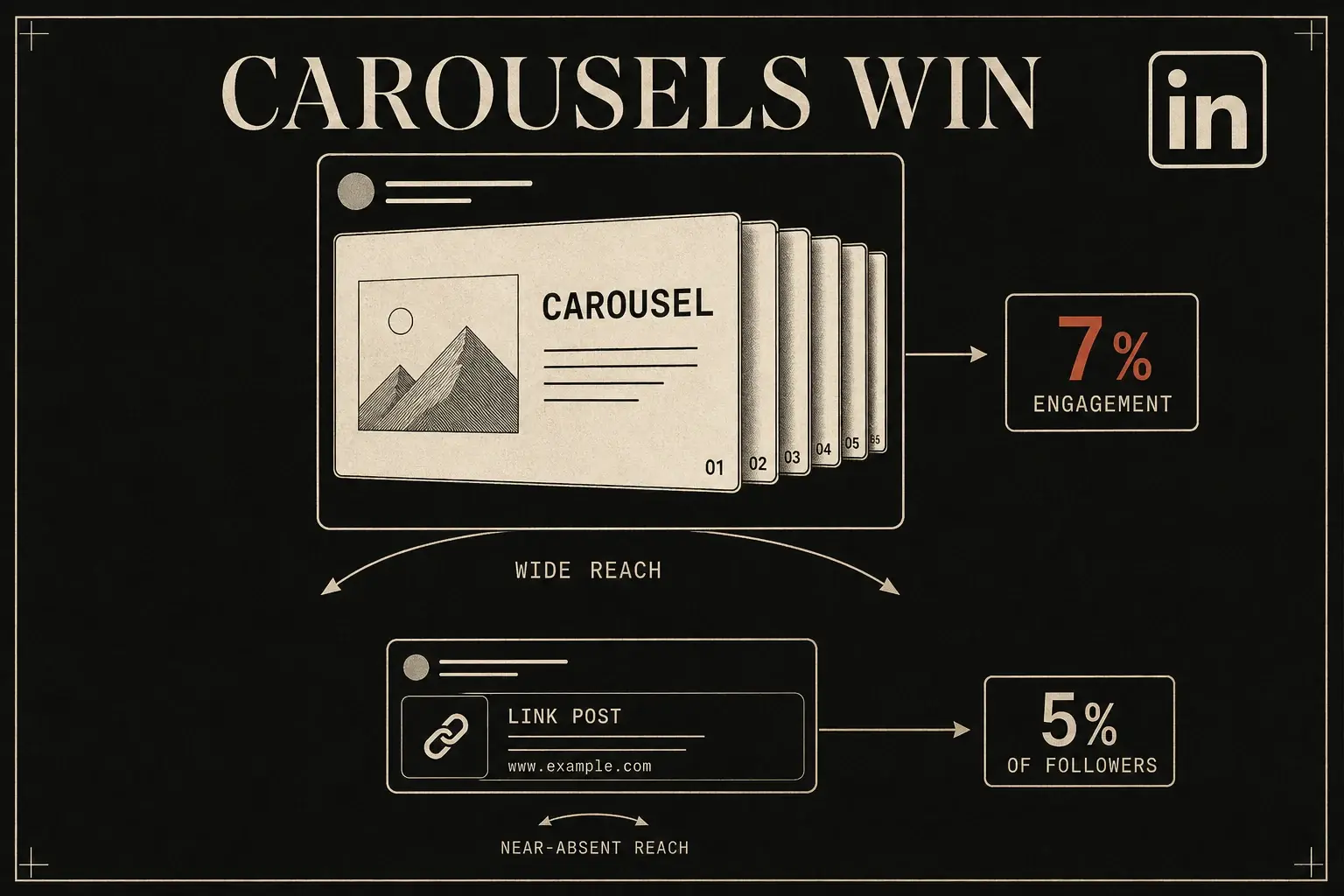
The most common way a technical founder wastes LinkedIn is to do the honest thing: finish a hard piece of writing, post "New field note on agentic workflows 👉 [link]," and watch it reach maybe forty people. The work was real. The post was a tollbooth. And LinkedIn, in 2026, charges that tollbooth most of your reach for the privilege of trying to send people away.
flowchart LR
  N["Field note:<br/>real technical depth"] --> L["Posted as caption + external link"]
  N --> D["Cut into native depth:<br/>carousel + deep posts"]
  L --> B["Reach throttled,<br/>readers sent off-platform"]
  D --> A["Reach amplified:<br/>dwell, saves, threads"]
  A --> Q["Qualified B2B leads"]
That's the whole problem in one diagram. You have the rarest thing on the platform, real technical depth, and you keep packaging it in the one format the algorithm is built to bury. This note flips that: cut each long note into the formats LinkedIn pushes, and turn that attention into qualified B2B leads. In the cross-platform picture, LinkedIn is the lead machine, where buyers vet vendors.
CH.01
Why does LinkedIn reward depth over volume now?
The 2026 feed rewards depth over volume. Call it a depth score (the article's model, not a named LinkedIn metric): what moves you is how deeply one person engages, seconds spent reading, slides completed, saves, and the length of the comment thread, not how many quick likes you collect. Heavy technical content is an advantage here, not a handicap, as long as you stop packaging it as teasers.
LinkedIn quietly stopped chasing virality and started chasing attention quality. One caveat frames this whole note: LinkedIn does not publish its ranking, so the mechanics below are inferred from operator testing and analyst breakdowns, not documented fact. Treat them as the field's working model. The reported dwell thresholds:
- Held 30–60+ seconds: the post gets classified as high-value and expanded to more feeds.
- Skimmed in 2–3 seconds: it gets buried.
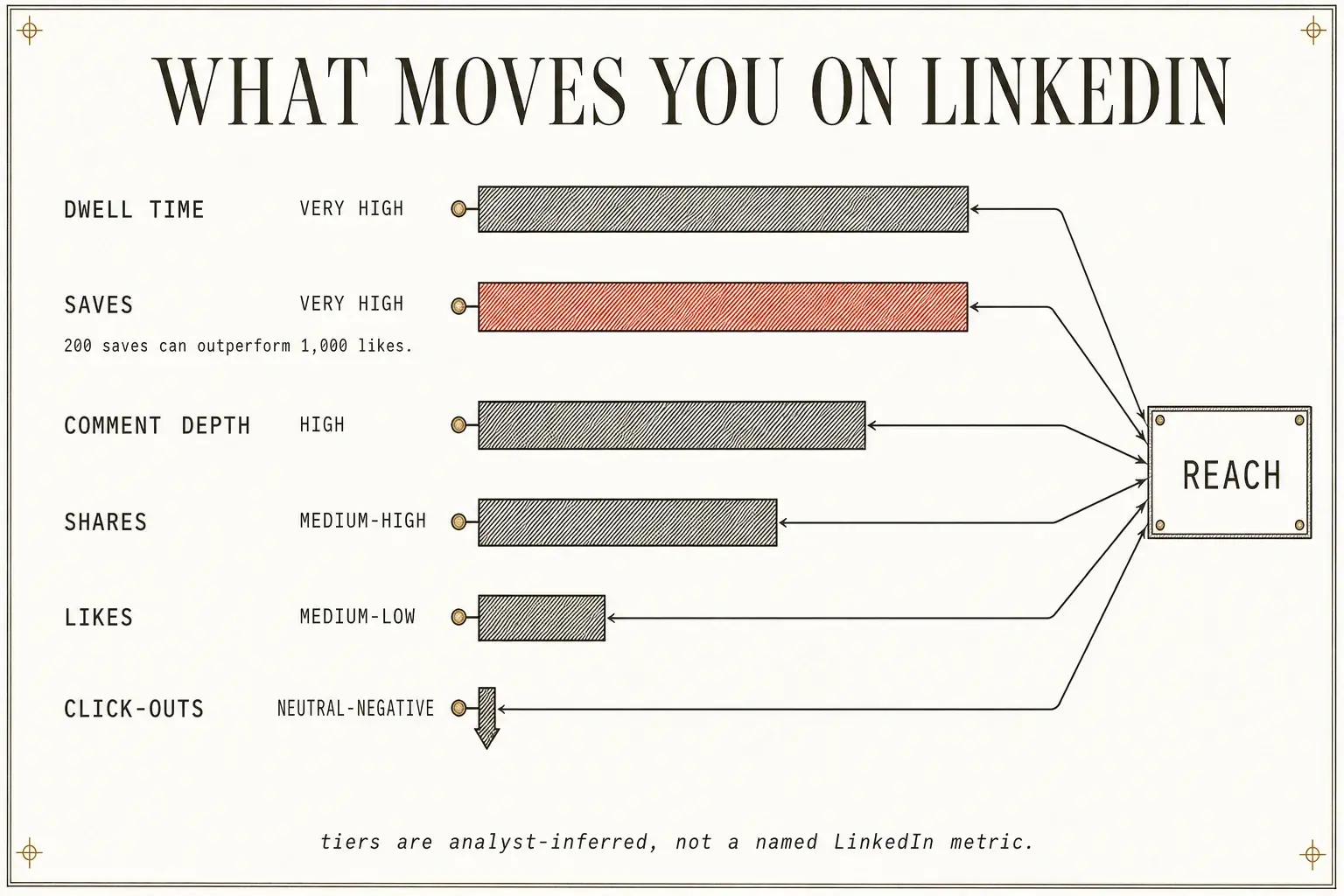
The signals that move you now are concrete enough to act on:
| Signal | Weight in 2026 | What it actually means |
|---|---|---|
| Dwell time / completion | Very high | 30–60+ seconds reading, or a near-full carousel view, triggers wider distribution |
| Saves | Very high | 200 saves can outperform 1,000 likes on reach. An 8%+ save rate can tip a post into viral distribution |
| Comment depth | High | Long, multi-turn threads get ~5× the amplification of shallow "Great post!" replies |
| Shares | Medium–high | Extend reach to new networks, but weighted below saves and comments |
| Likes / reactions | Medium–low | Still counted, far less than the above |
| Click-outs | Neutral → negative | Fine when the post has depth. Punished when the post is just a link |
Two numbers anchor the whole strategy. First, document carousels sit at the top of the engagement stack at around 7% average engagement. Second, the first 60–90 minutes after you post is the window where saves and substantive comments decide whether the post travels. Everything downstream, your formats, your cadence, where you put a link, is an attempt to win on dwell, saves, and comment depth, and to win them early.
The platform now treats one person reading your whole carousel as worth far more than ten people tapping like. Write for the one.
CH.02
What actually gets your reach throttled?
LinkedIn shipped aggressive distribution filters in 2025–26 that suppress four specific behaviors: bursts of 100+ connection invites a week, engagement pods, engagement bait, and repetitive AI-sounding text. Bare external-link posts get hit separately with a steep reach cut (the concrete figure is in the links chapter below). Trip the classifiers and you land in "soft jail": a sudden, sharp drop in impressions and profile views.
This matters more for a solo operator than for a brand, because the "growth hacks" still floating around are now the exact patterns that get throttled. The flagged list, specifically:
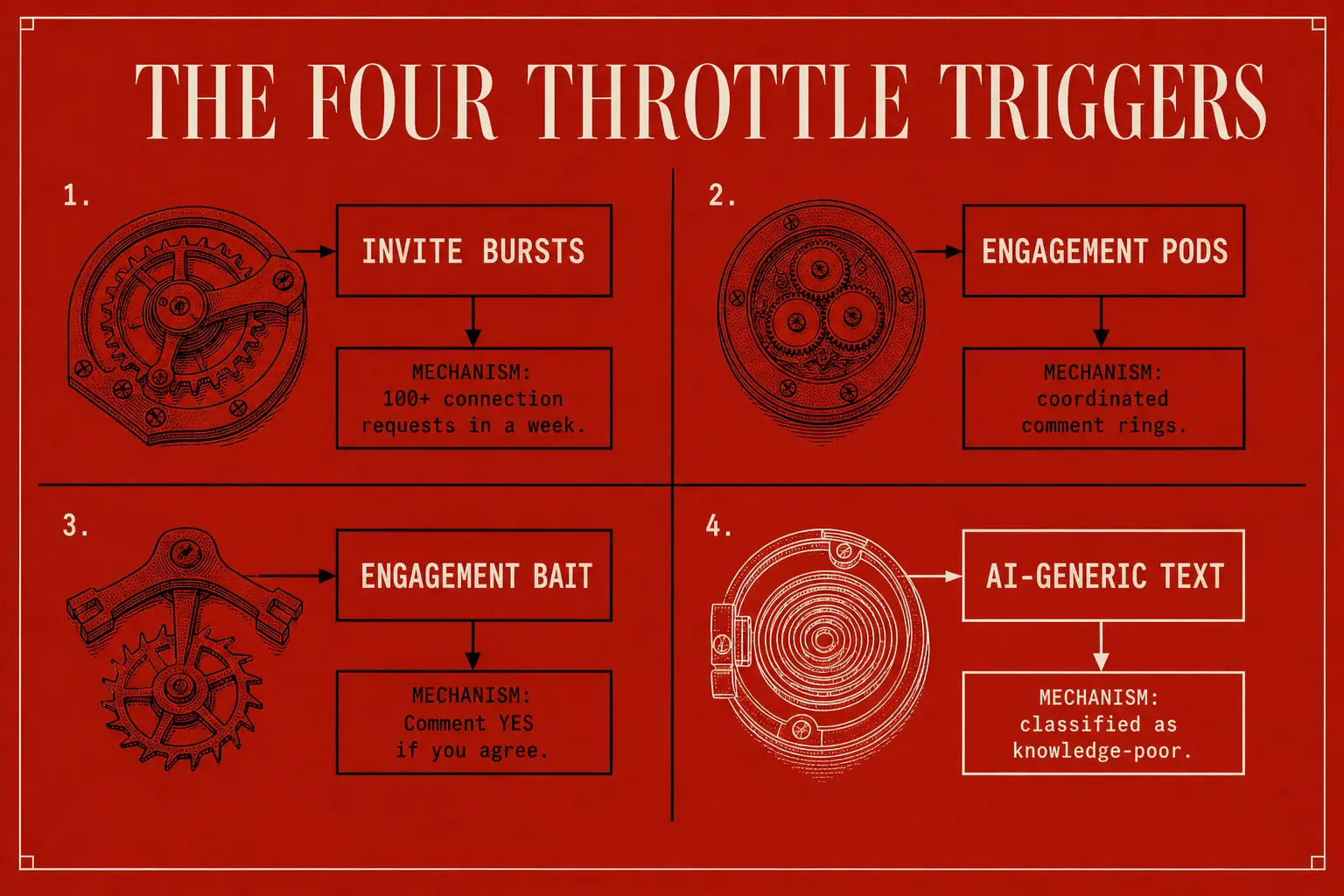
- Invite bursts: 100+ connection requests in a week reads as automation and suppresses the account.
- Engagement pods: coordinated "Great post!" comment rings are detected and penalized.
- Engagement bait: "Comment YES if you agree" is named directly as a suppressed pattern.
- AI-generic text: low-depth content that matches common AI-generation patterns gets classified as "knowledge-poor" and its distribution is limited.
- Thin link posts: caption-plus-link with no standalone value takes the steepest reach cut.
The uncomfortable part: the filters that punish everyone else are the ones that protect you. Your real build logs, failure post-mortems, and architecture sketches pass the "knowledge-rich" test by default. They're the opposite of generic. The discipline isn't to game the algorithm. It's to refuse the shortcuts that flag you, and let depth do the work.
CH.03
How do you turn your profile into a landing page that converts?
Stop treating your profile as a CV and build it as a landing page: a headline that names ROLE + ICP + outcome, a banner that states your offer, an About of 6–10 lines with one CTA, and a Featured section limited to 1–2 links. Founder case studies report 27–35% lifts in profile-view-to-connection after a photo, banner, and headline overhaul. It's a one-time 2–3 hours and it's algorithm-safe.
Every post you write sends traffic to one place, your profile, and most profiles leak it. Fix the leak once:
- Headline: the formula multiple 2025 guides converge on is role + who you help + the outcome. Worked example from the research: "Independent AI Automation Engineer | Helping B2B SaaS teams ship agentic workflows without hiring an ML team." It tells a visitor in one line whether they're your buyer.
- Banner: a simple visual with one line of offer ("Agentic automation for B2B products"), your URL, and a subtle CTA like "Book a 30-min workflow audit." Not abstract art.
- About: 6–10 lines, three parts (who you are, what you do, why it matters) and exactly one CTA. Longer is not better here.
- Featured: two slots, no more, to avoid choice overload: slot one a lead magnet (e.g. an "Automation Blueprint for B2B SaaS"), slot two your strongest case-note ("How I cut a client's manual ops with an agentic workflow"), an optional third for the newsletter or a booking link.
- UTMs: tag every profile and Featured link so you can actually attribute which posts drove the traffic.
The principle behind the 1–2 link rule is the paradox of choice: every extra option lowers the odds someone takes any of them. Point everyone at one destination.
CH.04
Which formats should a technical founder actually post?
The PDF document carousel is the single best format for technical content in 2026. It reaches 2.5–4× what a text post does and tops the engagement stack at ~7%, because its slide-by-slide structure manufactures exactly the dwell time and completion the algorithm now prizes. Build around carousels, support with deep text posts, add short native video, and skip polls.
One creator's 30-day test, posting the same message in four formats, makes the gap vivid (treat it as one creator's self-reported single test, not a benchmark):
| Format | Engagement (same content, 30-day test) | Use it for |
|---|---|---|
| Document carousel (PDF) | 12.4% | The core asset: frameworks, architectures, checklists, post-mortems |
| Native video (<60s) | 5.1% | Trust and conversation, a 30–60s screen-share of one diagram or DAG |
| Text-only | 2.8% | Narrative, a failure story, a design decision, an opinion |
| Single image | 1.9% | Rarely, it underperforms everything above |
The broader reported benchmarks line up: across large post samples, carousels average roughly 6–7%, with the best carousel segments reaching far higher and around 3.7× the engagement of text-only. Short native video under 60 seconds gets about 53% more engagement than longer video and draws roughly 5× more conversations than a static post, though its reach is more variable than a carousel's. Long text posts above 1,300 characters earn about 18% more engagement than short updates. Polls and single images are in decline. The poll novelty has worn off.
Here's the part that makes this sustainable for one person. Each long note maps to a fixed asset set:
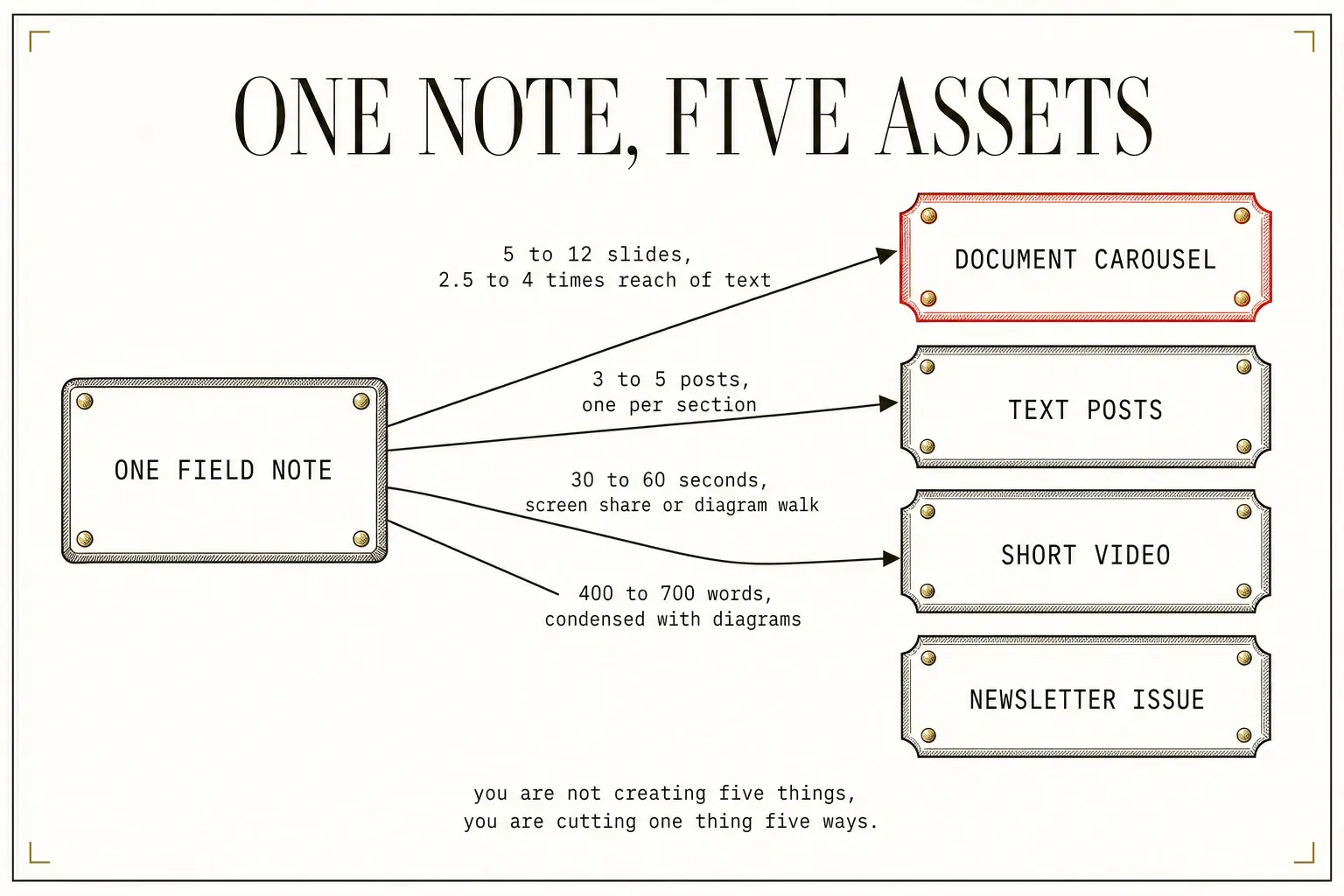
- One carousel: pull a single framework, checklist, or architecture from the note and break it across 5–12 slides.
- 3–5 short text posts: one per section: the failure story, the before/after, the design decision, the gotcha.
- One 30–60s video: a screen recording walking through one diagram, n8n flow, or agent-orchestration pattern.
You're not creating five things. You're cutting one thing five ways, which is what makes a content team's output reachable by a solo engineer with limited hours.
CH.05
How should you build the carousel itself?
Design it mobile-first at 1080×1080, one idea per slide, 5–12 slides, on a fixed skeleton: hook → context/stakes → 3–6 core insight slides → edge cases → a soft CTA. The edge-case slides ("what I'd do differently," "failure modes you'll hit") are the highest-save real estate, and saves are your strongest reach lever.
The structure that performs is repeatable enough to template:
- Hook slide: the problem or outcome in one or two lines, large type, no clutter. "Our agents kept hallucinating tasks. Here's the monitoring pattern that stopped it."
- Context / stakes: who it's for (B2B SaaS, ops leads) and what's at risk (downtime, manual toil).
- Core slides (3–6): one idea each: problem → approach → trade-off → result, carried by an architecture diagram, a sequence diagram, a pseudo-Python snippet, or a single number. Before/after and "wrong vs right" framings perform best.
- Edge cases / deep-dive: "what I'd do differently next time," "failure modes," observability tips. High save value.
- CTA slide: a soft "Save this for your next automation build," then the traffic line: "Full build log with diagrams and configs on pravda.systems, link in the first comment."
The hooks that travel, adapted to this niche, follow a few templates: the outcome hook ("We cut manual onboarding time by [N]% with one agentic workflow. Here's the architecture"), the contrarian/failure hook ("Everyone wires agents like this. It's why your workflows keep silently failing"), and the checklist hook ("Before you ship an agentic workflow to prod, run this 7-step check"). Build the carousel around the thing someone would save, a framework or checklist, not a linear summary of the article.
CH.06
Where do the links go without killing your reach?
Most of your posts should carry no link at all. The reach cost is real and large: by reported benchmarks, link-in-body posts reach only about a quarter of what no-link posts do (roughly 5% of followers versus ~20%). When a click genuinely matters, the deciding factor is the post's standalone value, not where the link sits, so make the post a complete mini-lesson first, then place the link by how badly you need the click.
LinkedIn's own product leaders have said the algorithm doesn't automatically penalize a link in the body if the post stands on its own. The penalty targets thin caption-plus-link posts that exist only to push people off-platform. Independent tests on comment-vs-body link placement are mixed, sometimes the comment helps, sometimes it's a wash. The honest read: placement is a minor lever, value is the major one.
So the working rule:
- Default: no link. Teach fully in the post. Invite a conversation. This is most of your output.
- Critical click (a launch, a lead magnet): link in the body, accept the reach trade-off, and make sure the post reads as complete without the click.
- Useful but not critical: link in the first comment, and edit the post to say "Link in first comment for the full build log," which softens the reach drop a little.
The trap to avoid entirely is treating LinkedIn as a pure traffic pump. Trust that the people who care most will click, and that the ones who don't still saw the depth, saved it, and now know your name.
CH.07
Should you run a LinkedIn newsletter or write articles?
Run a newsletter. Treat articles as the rare exception. Newsletters are reportedly the platform's fastest-growing format, with subscriber counts up sharply year-over-year, and they out-engage images and polls. They auto-notify subscribers and give you a native "subscribe" CTA on your profile. Articles win only at one thing: long-tail Google discovery.
The two are not interchangeable:
| LinkedIn newsletter | LinkedIn article | |
|---|---|---|
| Best at | Reach, subscriber retention, audience-building | Search indexing, long-tail Google discovery |
| Feed reach | High, auto-notifies every subscriber | Low, often 0.3–0.6× a text post |
| Use it as | Your native syndication layer for each field note | A few durable, evergreen pillar pieces |
| Cadence | 400–700-word condensed note + 1–2 diagrams + soft CTA | Occasional reference assets, not core distribution |
For you, the newsletter is where each long pravda.systems note gets a condensed, native home: a 400–700-word field brief with a diagram or two and a soft CTA to the full note or the lead magnet. Reserve articles for one or two indexable pillar pieces ("Agentic Automation for B2B SaaS: 2026 Field Guide") that you want discoverable in search, and accept that they won't carry your feed reach.
CH.08
What lead-gen actually works, and what gets you flagged?
Value-first mechanics work. Pitch-first and bait-first mechanics get suppressed or get you disconnected. The proven stack is a single strong lead magnet promoted through Featured and the newsletter, sparing use of natural "comment X" CTAs, and low-volume personalized outbound. One reported newsletter-led funnel drove $200K+ in Q1 inbound revenue, including a $50K contract.
Four mechanics, each with its safe form:
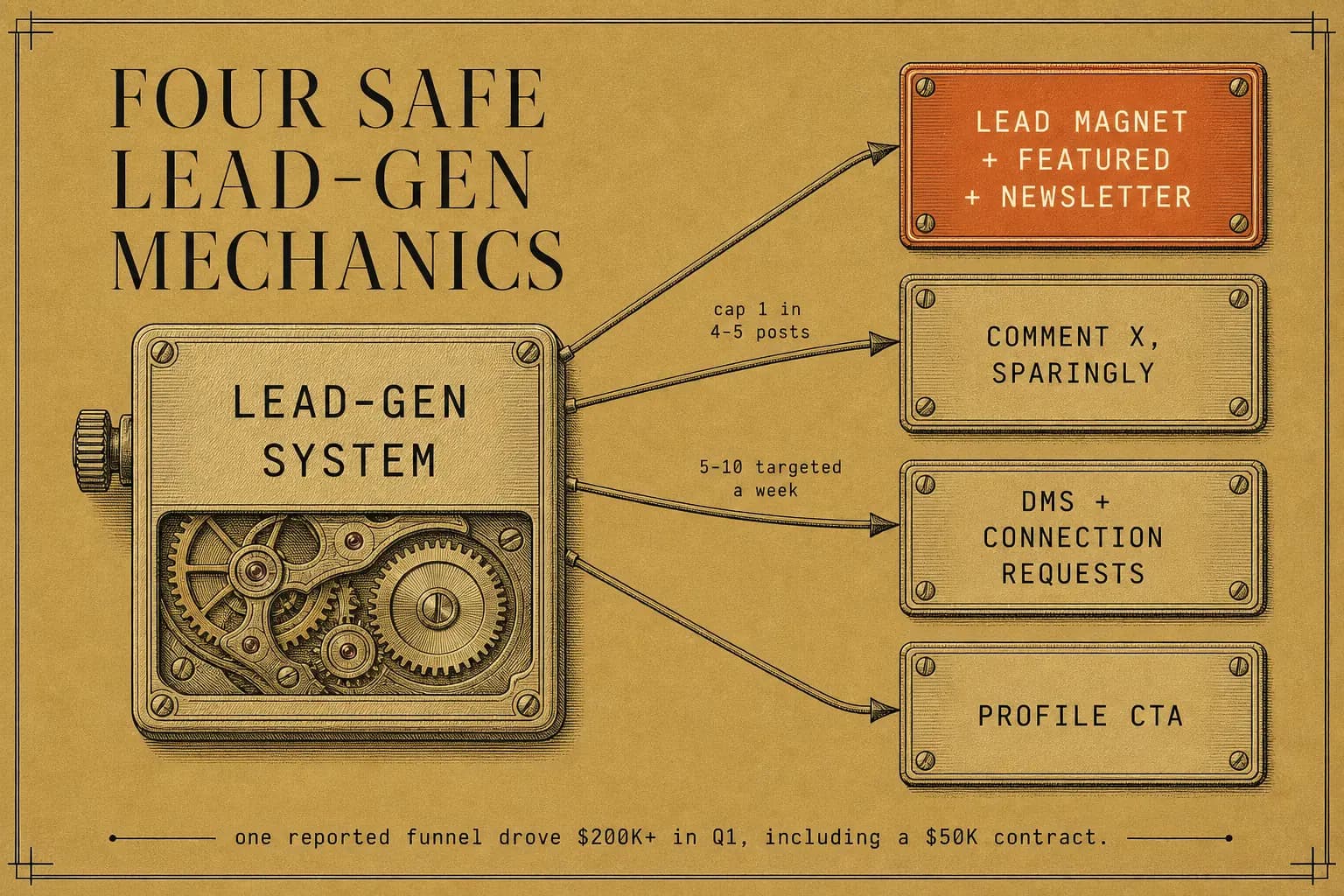
Lead magnet + Featured + newsletter
One genuinely useful technical asset, an "Agentic Automation OS Blueprint for B2B," pinned in Featured, mentioned in the newsletter, and previewed in the occasional carousel. Value first, pitch never. Effort: medium upfront, then low. Impact: high. Algorithm-safe.
"Comment X to get it," sparingly
Generic engagement bait ("Comment YES for the PDF") is the suppressed pattern from the throttle list, but a specific CTA tied to real value still works: "If you want the full DAG and configs, comment OS and I'll send the repo." Cap it at roughly 1 in 4–5 posts. Effort: low. Impact: moderate hand-raise spikes. Conditionally safe.
DMs and connection requests, the actual sales motion
This is the actual pipeline, and the one place volume gets you blocked. The sequence that stays human:
- Warm up first: leave 1–3 genuine comments on the prospect's posts (real reactions, never "Great post"), then reference that in the note.
- Keep the invite under 250 characters: name, the specific reference, why you're connecting, and no pitch.
- After they accept: send a short "good to be connected," share a relevant field note or diagram, and ask a question. Never open with "15-minute call?"
- Cap the volume: roughly 5–10 targeted requests on three days a week, 10–20 minutes a day, far under the invite limits.
The numbers that justify the patience, by reported benchmarks: automation-heavy outreach lands around 20% acceptance and single-digit reply, while personalized, context-rich invites realistically hit 30–50% acceptance on well-targeted ICPs. Effort: low and ongoing. Impact: this is the actual pipeline. Algorithm-safe only if the messaging stays human.
Profile CTA
Set the main profile button to a UTM'd newsletter or lead-magnet landing page rather than a generic homepage. A reported 2025 example saw subscriber growth in the single-digit-percent range over four weeks at a strong open rate when LinkedIn was the main acquisition source. Effort: one-time. Impact: a steady trickle of the right subscribers. Algorithm-safe.
The line that keeps you safe: automate the finding, never the messaging. Auto-DM blasts and instant pitches are now a primary reason people disconnect and block.
CH.09
How often should you post, and when?
Three to five quality posts a week beats daily posting. Overposting low-quality content drags your average engagement and trains the algorithm to deprioritize you. Start at three: two text, one carousel. Add a video and a newsletter issue once the base is sustainable. Post during your ICP's working hours. Timing is a minor lever, quality dominates.
The cadence math for a solo operator is about 3–5 hours of content work a week, no more. Consistency over volume is the consensus across 2025 strategy breakdowns, and the 2026 benchmark data backs the downside: shallow high-frequency posting actively lowers your per-post performance. Two minor levers, in priority order:
- Timing is the smaller one: weekday business hours (roughly 8–11am in your audience's time zones) slightly outperform late nights, but don't optimize the clock before you optimize the post.
- The first hour is the bigger one: block 30–60 minutes after each post to be in the comments. Deep early threads matter far more than the posting hour.
CH.10
Is it safe to post your full notes natively?
Yes. Publishing your full notes natively on LinkedIn after they're live on your own site is algorithm-safe and strategically good. LinkedIn prioritizes native, knowledge-rich content and does not penalize you for publishing the same work on your site first. It cares about dwell time and relevance, not SEO-style originality. Site first, then more native surface area on LinkedIn.
There's no duplicate-content tax to fear here:
- No originality penalty: republishing a note as a long native post or newsletter issue, after the canonical version is up on pravda.systems, is common and accepted practice. The platform treats its own newsletters and articles as distribution, not as the canonical source.
- The only real cost is producing the LinkedIn cut, which is exactly what the one-note-five-ways system above is built to absorb: the LinkedIn version becomes a light post-processing step on writing you've already done.
CH.11
The 30-day operating plan
Week 1, build the landing page and ship a baseline. Weeks 2–3, find your rhythm and add the lead magnet, then video. Week 4, audit what worked and double down. Budget ~5–7 hours a week. After 30 days you'll have ~12–15 posts, 4 newsletter issues, one lead magnet, and a small network of ICP-relevant connections.
| Week | Build | Content (posts) | Outbound |
|---|---|---|---|
| 1: Foundation | Profile overhaul (photo, headline, banner, About, Featured, UTMs), launch the newsletter, schedule Issue #1 from a strong existing note | 3: an ICP/"who I help" text post, a workflow carousel, an implementation-story text post (no link) | 5–10 targeted requests on 3 days, each after a real comment |
| 2: Rhythm + lead magnet | Package a useful note into a 4–6 page PDF blueprint | 3: two field-lesson text posts, one carousel previewing 3 of 6 blueprint checks ("comment BLUEPRINT"), Newsletter #2 | Continue 5–10/3 days. DM the blueprint to commenters with a non-pitch follow-up |
| 3: Add video | First 30–60s screen-share of a real orchestration tied to a business outcome | 4: two text, one carousel, one video, weighted toward what worked in weeks 1–2, Newsletter #3 "build log" | Continue. Start 1–2 light-consult conversations with people you've traded comments with |
| 4: Calibrate | Audit profile views, acceptance, DM threads, engagement, subs, name your 2–3 best post archetypes | 3–4 posts on your winning archetypes, one aimed squarely at your primary ICP, Newsletter #4 stating your current offer | Steady outreach, refine the messages that became real conversations. Run one controlled test: a high-value link-in-body post vs a comparable no-link post |
CH.12
The per-post checklist
Before you publish, run eight checks. They're the operational form of everything above: ICP clarity, a real hook, one concrete detail, the right format, a deliberate link decision, one clean CTA, no flagged behavior, and a plan to work the first hour of comments.
- ICP clarity: does this speak to a specific buyer and a real problem?
- Hook: do the first two lines frame a problem or a surprising outcome?
- Depth: is there at least one concrete detail (a number, a command, a diagram, a failure mode) so it passes the knowledge-rich filter? No generic AI-speak.
- Format: carousel for multi-step process or architecture, text for narrative or opinion.
- Link decision: does it need a link? Does the post stand without the click? Body for critical CTAs, first comment otherwise.
- CTA: exactly one: invite a perspective, ask a question, or (sparingly) offer a resource. No "like if you agree."
- Compliance: no tagging more than ~5 people, no pod-like behavior, no repetitive comments.
- Timing + follow-up: post in your ICP's working hours, then be in the comments for 30–60 minutes. Deep threads beat raw likes.
CH.13
What numbers should you expect?
Directionally, for a solo founder from near-zero in the first 30–90 days: ~3–5% engagement on text and ~5–8% on carousels is a strong signal. 30–50% acceptance on well-targeted invites is realistic. Expect tens, not thousands, of newsletter subscribers, targeting 50–150 highly qualified ones at 40%+ open rates.
| Metric | Realistic early target | Reference point |
|---|---|---|
| Text-post engagement | 3–5% | Platform avg for non-document formats sits lower |
| Carousel engagement | 5–8% | Documents average ~7%, native video ~5% |
| Connection acceptance | 30–50% on targeted ICPs | Automation-heavy outreach: ~20% acceptance, single-digit reply |
| Connections → DM exchange | 10–20% over 90 days | With value-first messaging |
| DM conversations → scoped call | 5–10% | The shape of a solo B2B services pipeline |
| Newsletter subscribers (first 30 days) | 50–150 qualified, 40%+ opens | Top 1% of newsletters have 100k+ subs. You won't, yet, and that's fine |
Treat these as the shape of the terrain, not a guarantee. They're 2025–26 benchmarks, and yours will vary with your niche and how sharp your content is. The point isn't to hit a number on a given post. It's that the machine compounds: after a month you have a stack of posts, four newsletter issues, a lead magnet, and a network that's actually full of buyers.
The throughline is almost unfair to you, in a good way. Most founders will keep hunting for the hack. You already have the thing every hack is trying to fake: specific build logs, real architectures, honest failures from work you actually did. Package that depth as carousels and deep posts, point everything at a profile built to convert, keep your outreach human and small, and let the people who needed exactly what you do find you in the act of asking.
The 3 skills behind this note
- Sign in to open
Write the X posts
Writes ONE source (a research run, the canonical article, or a raw file) into an X/Twitter-native SHORT-FOR...
- Sign in to open
Write the LinkedIn post
Turns ONE source (a research run, the canonical article, or raw notes) into a native LinkedIn package
- Sign in to open
Deep-research prompt
Turn a topic the user names into an optimized DEEP-RESEARCH PROMPT for Perplexity Pro (or ChatGPT Deep Rese...