Distribution & GEO — 2026-06-27PUBLIC
Where to publish in 2026: the platforms that turn technical writing into leads and AI citations
A channel-selection hub for technical writers in 2026: why duplicate-content fear is a myth at zero authority, how to publish everywhere with canonical tags pointing home, and the distinct tactics, cadence, and ban triggers for Reddit, Hacker News, GitHub, Dev.to, Hashnode, and Lobsters.
≈ 24 min read
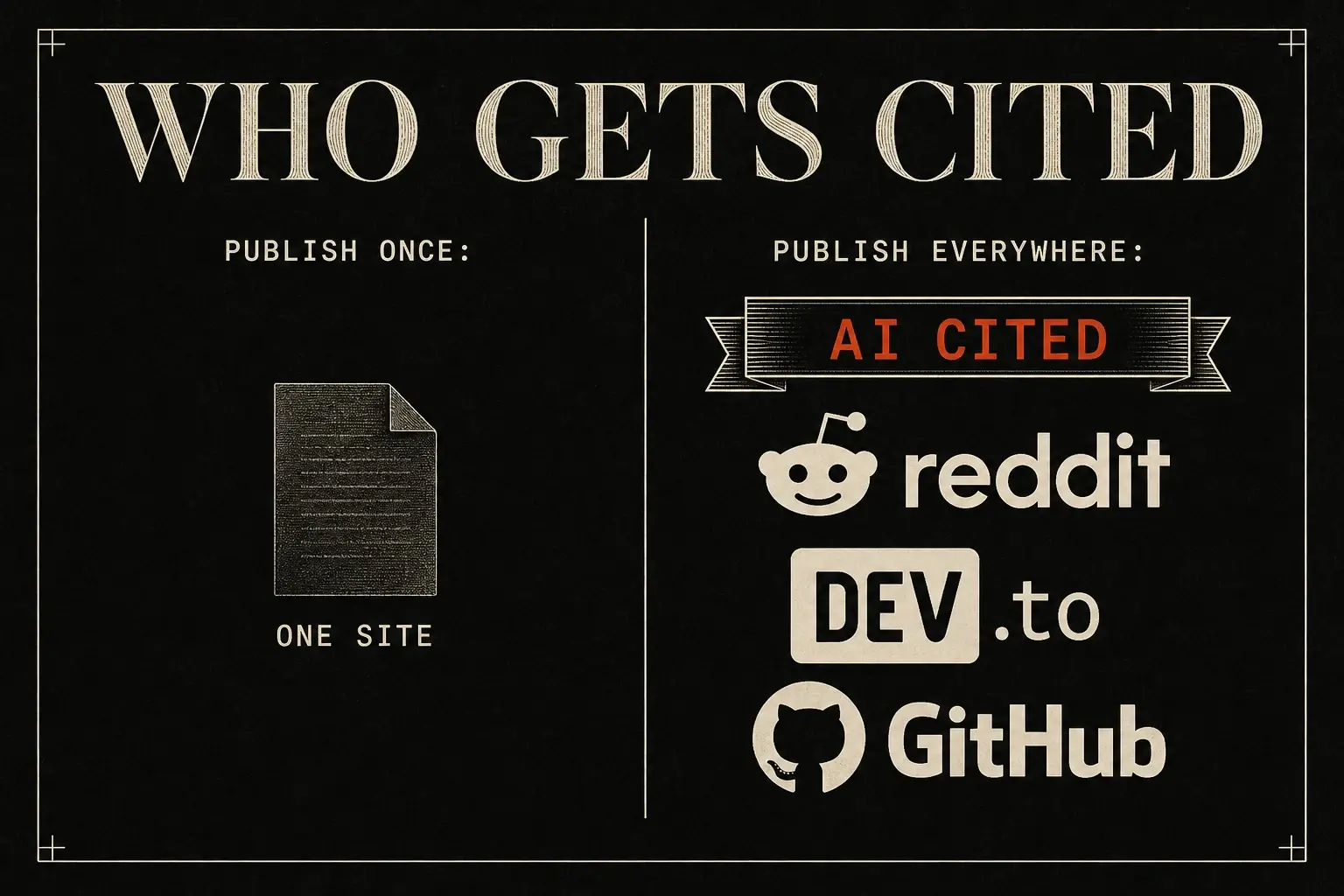
A technical founder spends a week on a careful 3,000-word breakdown, publishes one copy on their own site, and reaches four hundred people. Nobody cites it. That same week, a 250-word comment they could have left under someone's "what stack should I use for agentic outbound?" would have been lifted, nearly verbatim, into a ChatGPT answer read by thousands.
flowchart TD
    W["Your technical expertise"] --> A["One copy on your own site"]
    W --> B["The same point as a reply where engines read"]
    A --> A1["About 400 readers, nobody cites it"]
    B --> B1["Thousands reached, quoted in AI answers"]
Same expertise. Wildly different reach. The only difference is that one set of words lived on a domain nobody crawls for answers, and the other lived where the answer engines actually read. Most people writing technical content are quietly strangling their own reach, and they think it's the smart move. They publish one careful copy, sit on the rest, and guard against a duplicate-content penalty they read about once.
Flip it.
At the start you have no rankings to protect and no authority to dilute, so the caution that keeps big publishers careful is caution you haven't earned the right to feel yet. Your problem isn't that Medium might outrank you. Your problem is that no buyer and no answer engine knows you exist. The whole playbook below runs on one thesis, stated once here so it never has to be repeated per platform.
Publish the full piece everywhere that will have it, your name and a link home on every copy. Automate the fan-out where the artifact does the work. Set the free
rel=canonicaltag pointing back to your own site wherever a platform offers one. Then spend your scarce human hours only on the conversational channels, Reddit above all, then Hacker News, where the content has to take the form of a genuine reply, not a link drop. Your site is the home everything links back to. Everything else is a spoke that borrows someone else's audience and hands you back a little of your own.
CH.01
Won't publishing the same post everywhere get me penalized?
No. There is no duplicate-content penalty, and at your stage duplicating is how your site earns the authority to rank at all. Search engines don't punish copies, they pick one version to show and quietly filter the rest. That's canonicalization, and nothing gets penalized.
flowchart TD
    C["Your post, copied to many platforms"] --> E["Search engine sees duplicates"]
    E --> P["Picks one version to show"]
    E --> F["Filters the rest, no penalty"]
    P --> H["Canonical tag points the pick home"]
The only real risk is subtler: with no signal pointing to the original, a high-authority platform can become the version that ranks and gets cited, so the credit lands on the platform instead of you. But that requires you to have a ranking worth stealing. From zero, you don't. There's nothing to cannibalize. What you do have is the upside: every full copy on Medium, Dev.to, LinkedIn or Substack carries a link back to your site, and a link from a high-authority domain is a backlink, the raw material a new site needs to become rankable in the first place.
Early duplication isn't a leak in the bucket. It's the pump that fills it.
The rel=canonical tag is free insurance, not a fix for something dangerous. Set it where it's offered, post the full text where it isn't. The non-negotiable is the same either way: your name and a link home on every single copy, and publish on your own site first, even by an hour, so your version has been the original all along.
| Platform | Canonical tag? | What to do |
|---|---|---|
| Medium | Auto (Import tool) | Import the URL, it canonicalizes for you and even backdates the copy |
| Dev.to / Hashnode | Yes (canonical_url / Original URL field) |
Full copy, tag set to your note |
| No | Full copy or native version, it's barely indexed (login-gated), so post for the audience, not the ranking | |
| Substack | No | Full copy opening "first published at →" your link, it's an email channel, not a search surface |
| GitHub | N/A (READMEs link home) | Two curated repos whose READMEs link to your canonical notes |
| Reddit / X / HN / Lobsters | N/A | You're sharing a link or an answer, not hosting the text |
CH.02
Which platforms pay in leads, and which pay in AI citations?
The platforms that pay you in qualified buyers are mostly not the ones that pay you in AI citations. You need both columns, and they ask different things of you. For B2B, LinkedIn is the lead machine and X is the credibility engine.
They do different jobs. LinkedIn is where a decision-maker vets a vendor, X is where a founder builds a name and catches buyers in the act of asking for help. One converts, the other compounds. The deep playbooks for those two are their own pillars (LinkedIn for technical founders and the X growth system). This hub is about everywhere else you publish the same work, the channels that pay mostly in AI citations and durable backlinks.
| Platform | Pays you in | Effort | How it happens |
|---|---|---|---|
| Your site | Leads + citations | Medium | The canonical source, converts best |
| Leads | Medium | Profile, DMs, lead magnets, native newsletter | |
| X | Leads + reach | Medium | Replies to buyer-intent, DMs, build-in-public |
| GitHub | Citations + leads | Medium | READMEs engines cite, links to your services |
| Medium | Reach + citations | Low | Heavily crawled, canonical points home |
| Dev.to | Reach + citations | Medium | Indexed + aggregated into daily.dev |
| Hashnode | Reach + citations | Low (once automated) | A second high-authority echo, canonical home |
| Citations + reach | High | High-effort answers AI engines quote | |
| Hacker News | Citations + authority | High | Show HN / deep comments, scraped heavily |
| Lobsters | Credibility + a link | Medium | One editorial backlink, trust of senior engineers |
Leads cluster on LinkedIn and X. Citations cluster elsewhere. Plan for both.
CH.03
What do AI answer engines actually cite?
Engines quote a narrow, predictable set of surfaces, your own structured pages, Reddit threads, technical docs and GitHub, YouTube transcripts, weighted toward recent, multi-sourced, concretely-stated claims. If you want to be the answer when a buyer asks Perplexity or ChatGPT who to hire, you write for those surfaces, not for follower counts.
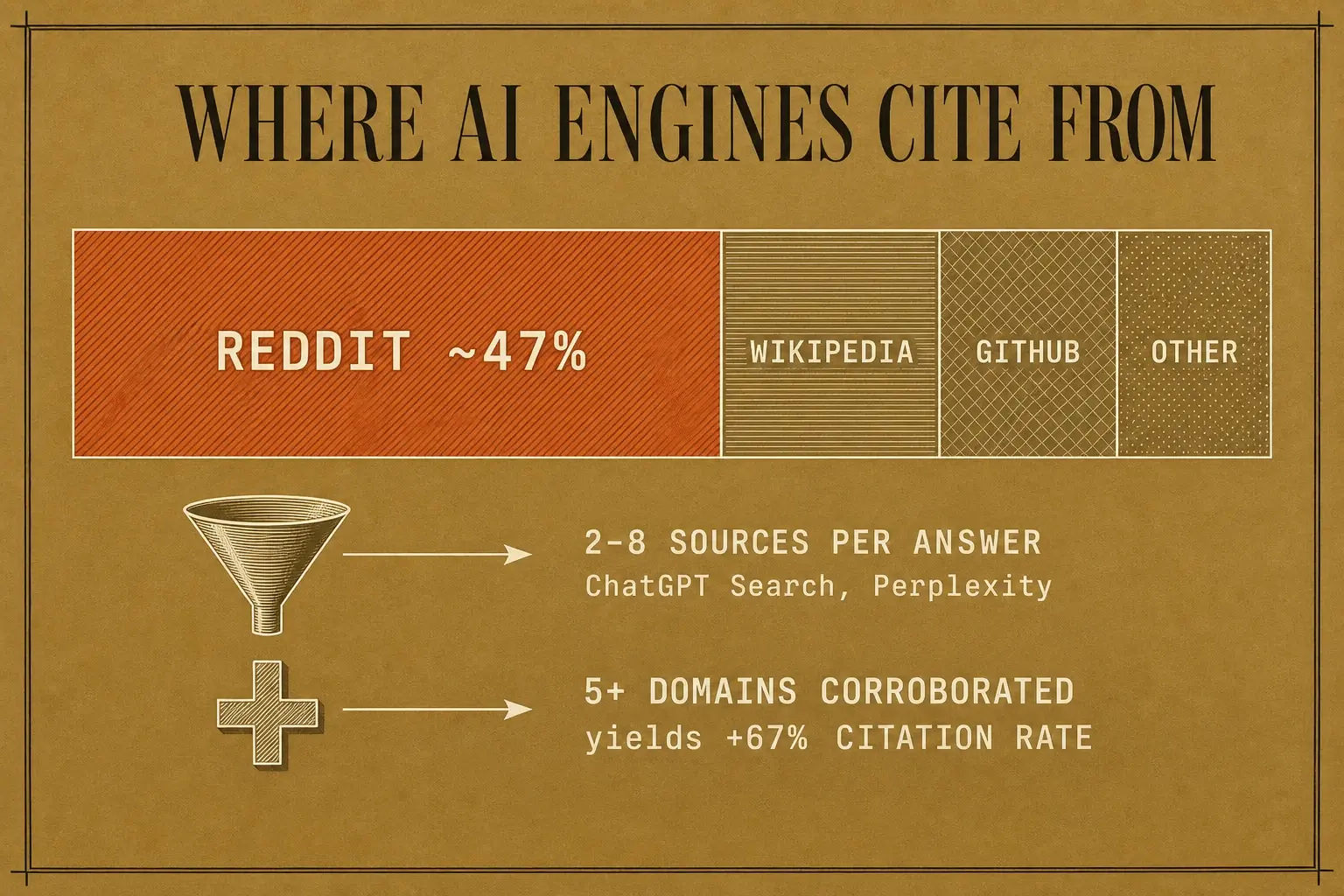
The specifics, as reported, are unusually actionable:
- Reddit is the heavyweight. By one analysis, around 47% of Perplexity's top-10 cited sources are Reddit threads. By another, reddit.com is often ~40% of citations across LLM responses generally, ahead of Wikipedia and Google. Both are reported third-party counts, not ours.
- Recency is a real signal. Perplexity is reported to boost content updated within the last 30–90 days, so a note you refresh quarterly beats a better one gone stale.
- Corroboration multiplies citations. Claims appearing across 5+ domains reportedly earn about 67% more citations than single-source ones, one more reason the same work belongs on Medium, Dev.to, and GitHub, each with a link home.
- The bar is brutally high. ChatGPT Search and Perplexity reportedly name only 2–8 sources per answer, and AI citations concentrate in roughly 50 top domains. There's no long tail to hide in. You're competing for a top-eight slot.
That's the whole case for being on more surfaces, more recently, with your name attached. (For the on-page mechanics, answer capsules, llms.txt, structured data, freshness discipline, see the companion note, How to get cited by AI answer engines in 2026.)
CH.04
What do you automate, and what stays in your hands?
Build a publishing robot for the platforms where the artifact does the work. Keep your hands on the two where it's a conversation. Automating the conversation is how you get banned.
Publishing is the cheap half. One markdown note → pushed as a full copy to Medium (import + canonical) and Dev.to/Hashnode (canonical_url), plus a README entry in a curated GitHub repo that links back. The marginal cost is near zero, which is the real answer to "why not use all of them." Engagement is the half a script can't touch, but it can be made smart instead of endless.
flowchart LR
    S["Apify watcher scans your niche"] --> Q["Buying-intent posts, e.g. need an n8n consultant"]
    Q --> D["Ten real opportunities a day, draft answer attached"]
    D --> R["You send the reply in your own voice"]
The trap on X is scrolling for hours hoping to catch a buyer. The fix is a watcher, an Apify search that scans your niche for buying-intent posts ("need an n8n consultant", "multi-agent infra help") and surfaces ten real opportunities a day with a draft answer attached. The finding is automated, the reply is yours, in your own voice. Reddit gets the same treatment: monitor a handful of subreddits for questions you can genuinely answer.
| Automate it? | Your time? | |
|---|---|---|
| Site, Medium, Dev.to, Hashnode | Yes, full copy + canonical from one markdown source | No, just publish |
| GitHub | Yes, push a README that links to the canonical note (a link, not a full copy) | No, just publish |
| Reddit, X | No, auto-posting is spam and gets you banned | Yes, answers and replies are the content |
| Any platform | none | Reply to people who engage with you, that's where a comment becomes a DM becomes a client |
Pull "engagement" apart and only one piece is a waste of time. Vanity engagement, liking strangers' posts to be seen, is useless everywhere, algorithms reward what your content does (dwell, replies, saves), not what you do to someone else's. Discovery engagement on Reddit and X, a genuinely useful answer inside someone else's thread, isn't vanity, it's content delivered where the audience already is, and it's the unit AI engines quote. Replying to people who engage with you is cheap and it's sales. So: publish wide, engage narrow, never spend a minute on likes-for-likes.
CH.05
The fan-out, end to end
Publish on your site first, fan out the full copies within a day, post native to LinkedIn and X the same week, then keep answering on Reddit and X. One note, many surfaces, your name on all of them.
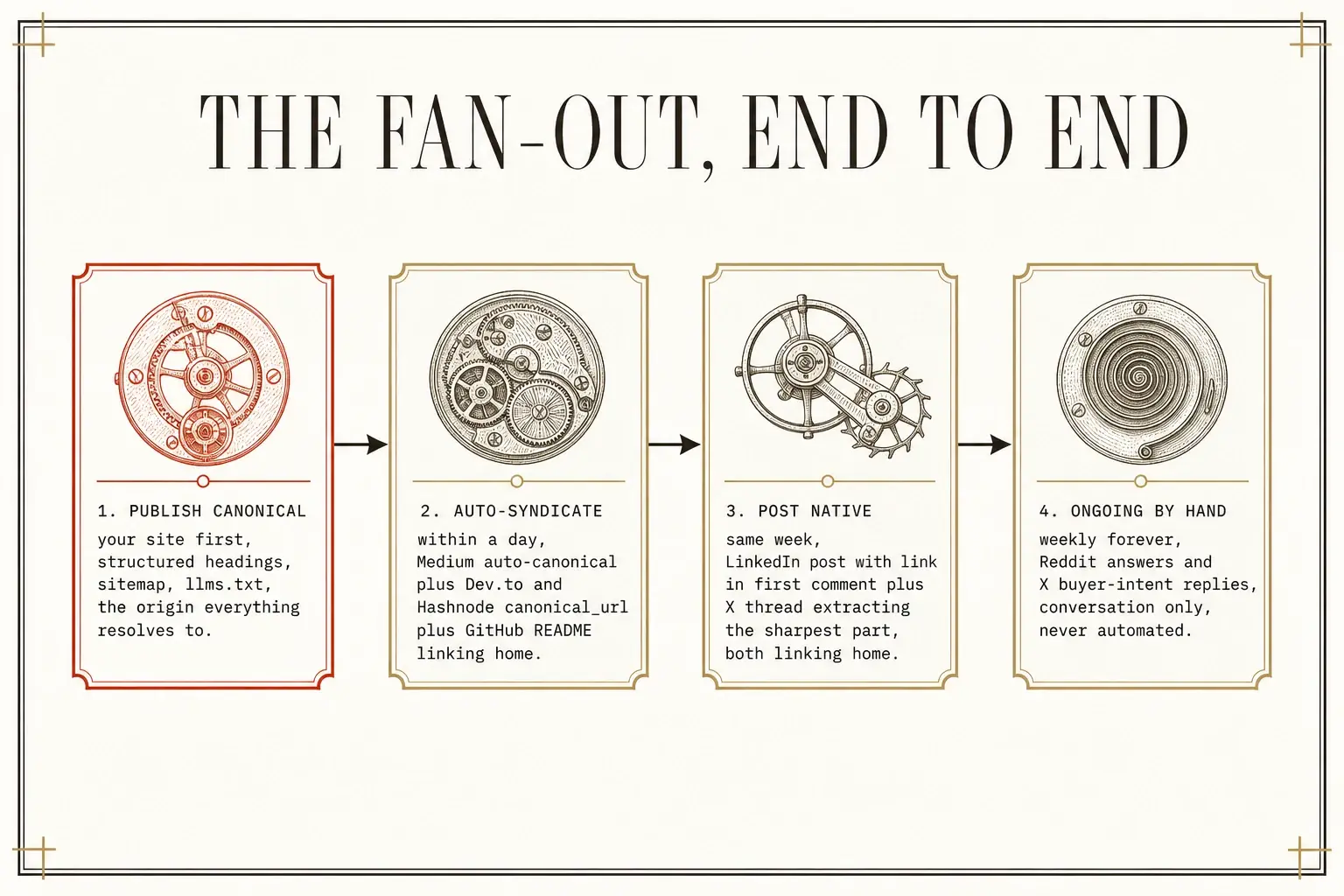
- Publish canonical on your site, structured headings, tables, internal links, in the sitemap and
llms.txt. Goes live first, everything resolves here. - Within a day, auto-syndicate the full copies, Medium (import, auto-canonical) and Dev.to/Hashnode (
canonical_urlset), plus a README entry in a curated GitHub repo that links back. These are the corroborating domains that drive the citation lift. - The same week, post native, a LinkedIn post (link in the first comment so the algorithm doesn't throttle reach) and an X thread that extracts the sharpest part, both linking home.
- Ongoing, by hand, answer real questions in your two chosen subreddits and reply to buyer-intent on X, linking your note only when it genuinely helps. Reply to everyone who engages.
Run it weekly. The single post never matters, the machine does. After a month you've stacked four canonical notes, a string of canonical-safe copies feeding your authority, some GitHub artifacts, and early trust in a subreddit or two.
CH.06
Reddit: the channel that pays in both citations and buyers
Reddit is the single most-cited domain in AI answers, and the surprise is that comments get cited more than posts. Models extract answer blocks from inside threads, not the headline, so the unit that gets you quoted isn't a viral post, it's a specific, well-structured reply. Reddit's high-karma outbound links (the ≥3-upvote filter) were used to seed OpenAI's original WebText corpus, and Reddit remains a primary training and live-citation source across ChatGPT, Perplexity, and Google AI Overviews.
One excellent, well-upvoted answer on Reddit can be more AI-visible than a long blog post on your own domain.
The catch: communities enforce a value-to-promotion norm and ban accounts that just self-promote. Six communities cover the AI-automation buyer, and each has its own promo tolerance, breaking it is how you get banned.
| Subreddit | Size | Self-promo rule | Ban risk |
|---|---|---|---|
| r/AI_Agents | ~380k+ | Links in comments only, 1-in-10, needs ~1 month of activity before you post | Moderate / high effort |
| r/AiAutomations | ~60k | Explicit "no self-promotion", field notes, not funnels | High if you sell |
| r/automation | ~216k | Allowed under 9:1, mods filter anything that reads like marketing (aim 19:1) | Moderate |
| r/n8n | ~50k (~200k+ across variants) | Self-promo only in the weekly thread, workflow posts must include code | High if you lead-gen |
| r/SaaS | ~700k | One self-promo every 60 days, including comment plugs | High if you ignore the cooldown |
| r/IndieHackers | ~98k–140k | One self-promo via SHOW IH flair, framed for feedback | Moderate |
What operators say the 2026 algorithm rewards (Reddit doesn't publish its ranking, so read this as the field's consensus, not documented fact): upvote velocity in the first 30–60 minutes (the signal most operators name first, so post when your audience is awake), comment velocity and depth (nested, longer replies outrank shallow ones), dwell time, saves up / hides down, text over link posts, and account trust (older accounts with cross-sub karma get leeway, some subs gate AI topics behind a karma minimum like 100+). Your reach is decided in the first hour by humans replying, so the post has to invite a reply and you have to be there to answer.
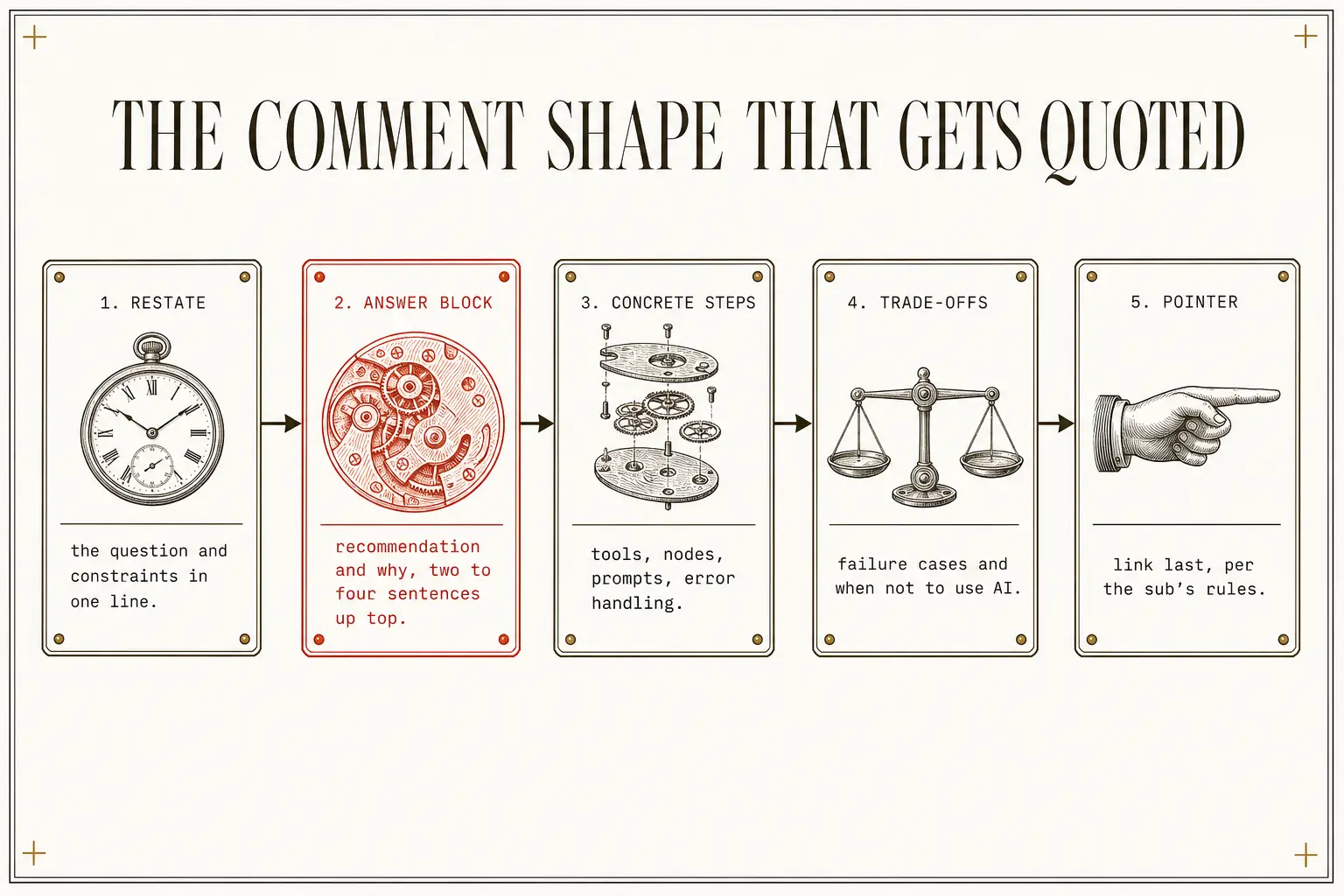
The comment shape that gets quoted (medium-length, 150–400 words, packed with specifics, is the shape operators report getting cited most):
- Restate the question and constraints in one line, makes the comment self-contained.
- Lead with the answer block: 2–4 sentences, recommendation and why, up top.
- Concrete steps or architecture: tools, nodes, prompts, error handling.
- Trade-offs and failure cases, including when not to use AI. Balanced takes get quoted at the same rate as glowing ones.
- Optional pointer: "more detail in [link]," per the sub's rules.
Repurpose, don't paste. Turn one long piece into a single 700–900 word text post per target sub, plus three to five 200–400 word comment capsules to drop under relevant questions. Text posts reportedly drive meaningfully more comments than the equivalent link post, and comments are what rank you. Place any link last, after ~95% of the value, and make your profile the stable funnel ("link in profile"). Build trust in phases:
- Warm-up (first 30 days): pure non-promo comments to clear the ~100-karma / 30-day gates.
- Establish, then sustained: keep links to your own domain at ≤5–10% of all contributions.
Monitor read-only, use the Data API or a tool like GummySearch or a Notifier-style service to watch for keyword hits ("agents for CRM," "replace Zapier with agents"), an n8n template exists that pulls posts, drafts a comment with AI, and sends it to Slack for manual review. The moment the comment leaves your hands automatically, you're in ban territory. Reddit has tightened API access in recent years and actively hunts AI-driven bots, so automate the finding, keep the writing human.
Three patterns worth stealing, all creator-reported, so treat the figures as shape, not audited fact:
- Buffer's founder shared an open revenue dashboard in r/entrepreneur instead of pitching and it ran up thousands of upvotes.
- Zapier's "resident expert" play put team members as the most helpful commenters across 20+ subs with 300–500 word comments that mentioned the product only when relevant.
- A B2B infrastructure company reportedly turned reproduction steps and mitigation playbooks posted during major outages in r/DevOps into a real pipeline of sales-qualified opportunities.
The pattern: be the most useful person in the thread, time it to active pain, and let interested readers DM you.
The red lines that get you banned:
- ignoring explicit self-promo rules
- being a single-purpose promo account
- automating posting/voting
- cross-posting the same copy to many subs
- fake Q&A or sockpuppets
- linking to paid funnels where forbidden
- low-effort AI-generated content in strict subs
The throughline: Reddit punishes extraction and rewards contribution. Most founders won't have the patience for the warm-up, which is exactly why the slot is open.
CH.07
Hacker News: launch rarely, live in the thread
Every story starts in /new at one point and has to claw out, it needs roughly five upvotes to escape the "new" sandbox, then a time-decay formula (about (points − 1) / (hours + 2)^1.8) fights gravity. Escape comes down to how many of your early readers actually upvote, not how many people you drag to the page. The audience is a few thousand senior engineers and founders, the exact people you want as clients, and the surest way to get pushed out of that room is to act like you want its attention. Solicit upvotes or run a vote ring and your comments quietly start rendering [dead].
A Show HN is only for something people can run, a tool, library, runnable demo. Everything else (an essay, benchmark, post-mortem) goes up as a plain link with a neutral title.
| Move | Effort | When it fits |
|---|---|---|
| Show HN (runnable) | High | A minimal open-source slice of your system, an orchestration library, a workflow kit |
| Plain link (deep note) | Medium | A new pattern, a benchmark, a real post-mortem, front page only if the insight is genuinely new |
| Ask HN (real question) | Medium | A genuine design dilemma, link your note in the comments where it helps |
| Commenting | Ongoing | The long game, answer hard threads, link rarely |
Run every candidate through five gates before you think the word "submit":
- Would a senior engineer learn something concrete?
- Is there a real, arguable delta (new pattern, benchmark, hard post-mortem)?
- Is the tone non-promotional (drop "fastest," "best," "first")?
- Is it specific enough to fight about?
- Can you block three to six hours to sit in the thread after it goes live?
Miss any of the first four, or skip the time for the fifth, and it isn't an HN post. Realistically maybe three to five of your notes will ever clear that bar, treat that scarcity as the discipline.
flowchart TD
    A["Post Tuesday to Thursday, 6 to 8 Pacific"] --> B["Put your story in the first comment"]
    B --> C["Work the thread the first two hours"]
    C --> D["About 5 upvotes to escape the new sandbox"]
    D --> E["Time-decay ranking takes over"]
For a launch: title plainly (Show HN: <name> – <flat description>, no "AI-powered," no "10x"), post a weekday morning US time, Tuesday–Thursday, ~06–08 Pacific / 09–11 Eastern, and put your story in the first comment, a 200–300 word memo covering what it does, why you built it, what's technically hard, and what feedback you want. Then work the thread for the first two hours (when ranking velocity is decided): answer with the actual config, the actual failure mode, take criticism head-on, link almost never.
The workable seeding is narrow: it's fine to post "just shipped a Show HN about my agentic system" with the link on X once the thread already has organic traction. You're pointing your real audience at something interesting, not manufacturing votes, the signal HN cares about is whether the votes came from people who'd have found it anyway.
Promote roughly one part in nine:
- at least ten substantial comments on others' threads per self-post
- one or two self-posts a quarter
- warm up for four to six weeks first (10–20 thoughtful comments, a couple of non-self submissions) so you arrive as a person who's been around
On SEO, be sober: HN nofollows its outbound links, so don't bank on raw PageRank from the thread itself (the discussion pages do get indexed and scraped heavily, which is the part that matters here). The payoff is indirect, a front-page thread gets picked up by blogs and newsletters that link dofollow, it builds your name as an entity, and HN is scraped heavily enough to be a high-signal read for the answer engines. An HN launch is an authority spike, not a lever you pull on a schedule.
CH.08
GitHub: each repo is a technical landing page
AI answer engines treat GitHub as one of their most trusted technical sources, they parse your README, Discussions, issues, and release notes to decide what a project is and whether to cite it. They favor content that's specific, recent, and originates a technique, and because they also lean on traditional search rankings, your GitHub SEO cascades straight into AI visibility. You optimize once. So treat each repo as a technical landing page with one search intent, not a folder where code goes to be forgotten.
GitHub and Google both rank a repo mostly on three text fields:
- its name
- its About description
- its README
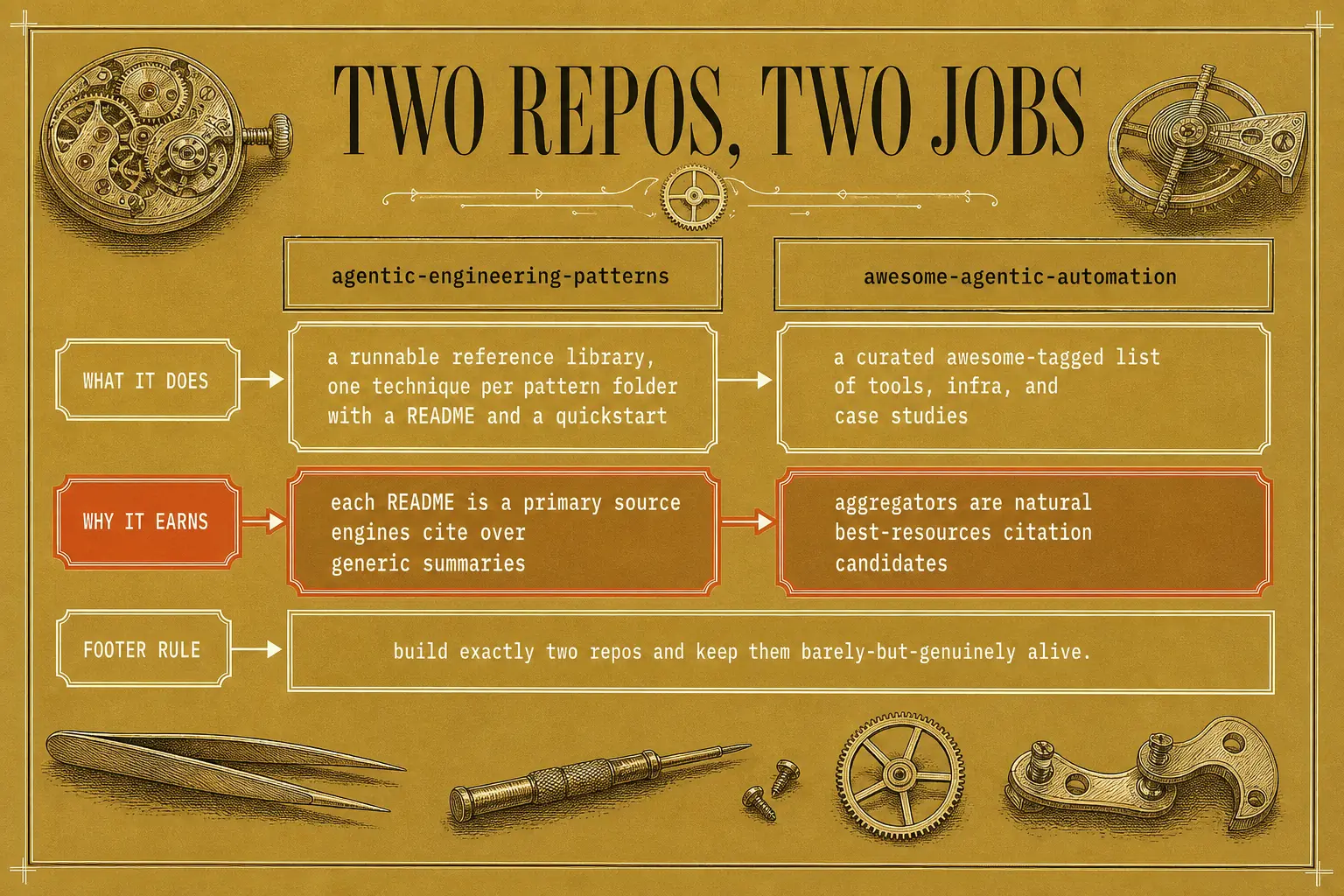
plus engagement signals like stars and forks. Most "X github" searches land on topic pages, won by repos with 6–10 well-chosen topics and one primary keyword each (in the name, About, README H1, and first paragraph). Build exactly two repos and keep them barely-but-genuinely alive:
| Repo | What it does | Why it earns |
|---|---|---|
agentic-engineering-patterns |
A runnable reference library, each /patterns/<name>/ folder originates one technique with a README (what it solves / when to use it), a sequence sketch, a copy-paste Quickstart, and a "deeper dive" link to your canonical note |
Each pattern is a primary source engines prefer over generic summaries, the README earns the citation, the link earns the visit |
awesome-agentic-automation |
A curated awesome-tagged list (every entry gets a one-liner, not a bare link) covering patterns, orchestration tools, infra, case studies |
Aggregators are natural "best resources" citation candidates and the easiest thing to get shared on Reddit, HN, and X |
A README that converts answers four questions fast, what it does, who it's for, how to run it, where to go deeper, then makes exactly one restrained ask. The rest is craft:
- Keyword-rich but natural in the H1 and first paragraph.
- A Quickstart that reaches first success in one command.
- At least one table or list naming concrete tools (n8n, CrewAI, and peers, the chunks engines quote most easily).
- Meaningful alt text on diagrams.
- A single "Work with me" section, never a wall of CTAs.
Google is GitHub's top referrer, so an external push to a repo drives backlinks and faster indexing.
Issues and Discussions feed the funnel too: pin issues titled "Workflow review requests" or "Tell me your agentic automation problem," reference them from the README, and add labels like advice / architecture-review / integration-request that quietly signal you take consulting-flavored questions. When a pattern recurs across issues, write it up in the patterns repo and link back, fresh primary content the engines like, from one inbound thread.
Skip a GitHub Pages docs site for now, your README plus your own site already hand engines plenty, and Pages adds a third place to keep in sync. What kills a repo:
- clever-but-vague names (
lab,playground) - keyword soup
- a README that's an unstructured brain-dump
- over-marketing
- going stale
- fragmenting effort across six half-baked repos instead of two strong ones
CH.09
Dev.to: full text, canonical, four tags
One forgotten line of frontmatter is the whole game here. Dev.to carries a domain rating reported around 90, so a copy with no canonical signal loses to it, you write the original and get filed as the duplicate. The fix is documented and trivial: add canonical_url: https://pravda.systems/blog/slug to the frontmatter and Dev.to emits a <link rel="canonical"> pointing home (the canonical target must be a real, indexable page, not a 404, not noindex). Blog-first, full cross-post, canonical set. Post without it and Dev.to usually becomes the original by default.
flowchart TD
    A["One markdown file with canonical_url"] --> B["Publish 8 to 10 AM US Eastern"]
    B --> C["Reactions and comments in the first 1 to 2 hours"]
    C --> D["Post tips into the Relevant feed"]
    D --> E["daily.dev picks it up at its traction threshold"]
What Dev.to rewards is early engagement, reactions and real comments in the first 1–2 hours tip a post into the "Relevant" feed, and a post that lands silent gets buried no matter how good it is. Publish into the window that works, roughly 8–10 AM US Eastern (the largest English traffic block), or an 8 PM Beijing window for Asia, then immediately share the Dev.to URL where your dev network already is, and hand-reply to comments for the first hour or two. "Post and abandon" is the named mistake.
The hard constraints:
- exactly four tags, lowercase, each must already exist on Dev.to, ~20-character limit, tag one a broad bucket (
ai,automation), tags two through four narrowing it - post the full article for almost everything (a thin teaser starves the post and readers feel it), length runs roughly 1,200–2,500 words, up to 3,000 for hands-on pieces, split into a
series:if bigger - a
cover_imageat ~1000×420 measurably lifts feed clicks - you don't apply to daily.dev, it already sources from Dev.to and picks up a post once it crosses internal traction thresholds, so the same engagement work pays twice (the old "company source" onboarding path was discontinued, don't chase it)
- push one markdown file automatically via the Dev.to API (tools like publish-devto or blogpub read
canonical_urlfrom frontmatter) or RSS import with "mark RSS as canonical" checked - no direct money, links are
nofollow, there's no writer payment, the payout is developer reach and an "as seen on Dev.to / daily.dev" social-proof line
As of February 2026, Dev.to showed ~74.7K AI-driven visits in a month, ~57% from ChatGPT (per Similarweb), which makes it the stronger AI gateway today.
CH.10
Hashnode: a second echo, but only automated
Add Hashnode as a second, automated syndication channel behind Dev.to, never instead of it, and never by hand. The deciding factor is reach: by reported traffic estimates Dev.to pulls several times Hashnode's monthly visits, so posting to Hashnode manually buys a sliver of what the same hour on Dev.to would. Automation is what flips it from "not worth it" to "yes", once a script does the cross-post, one more high-authority domain echoing your work, canonical home, is pure upside.
Why it won't outrank you
Hashnode is actually less likely to steal your ranking than Dev.to: it's built around you owning your canonical (an "Original URL" field becomes the rel=canonical tag) and its lower domain authority means your own page stays the original that ranks. The one way to break this: mapping your main domain to Hashnode, which stands up a second primary domain competing with your site. Don't, post on the free yourname.hashnode.dev subdomain instead.
How the feed ranks
Its feed is relevance-ranked, not a viral machine:
- The levers are followed tags, author follows, comments, and recency (reactions are deliberately log-scaled, so chasing likes is a dead end, reply to comments within ~24 hours, since that feeds ranking).
- The native long-form article, ideally grouped into a series, is the whole format, there are no threads or short-form types, so don't chop your article up.
- Aim for a 2,000–4,000 word deep tutorial carried by 5–15 fenced code blocks (never screenshots of code) and a cover image, opening on the outcome, not a throat-clear.
- Use 3–6 tags mixing a high-reach dev bucket, a mid-sized topical (a few hundred to low-thousands of followers is the sweet spot, real audience but not infinite noise), and a long-tail or series tag. Agentic and automation content lands in the mainstream dev and automation tags, not the crowded crypto or Web3 corner.
- A realistic expectation for a well-tagged post is 500–3,000 views in the first 30 days.
Wire it once
The whole point is that it runs as one command, not a weekly chore: Hashnode exposes a GraphQL API, already wired into tooling like Postiz, Platoona, and an MCP "Hashnode skill," each with a documented canonical field. Build the pipeline once, markdown → Dev.to (canonical_url) → Hashnode (GraphQL, originalArticleURL) → done, and the marginal cost of the second platform drops to nearly nothing.
The citation math
Why bother at all, given the small traffic? The AI-citation math. Answer engines lean on high-authority, heavily-linked sources, ChatGPT alone reportedly drives ~78% of AI referral traffic, and Perplexity (reportedly up sharply year over year, into the tens of millions of users) always shows its citations. And AI-referred visits, though still small, convert far better than ordinary search: 11.4% versus 5.3% in one Similarweb study. Hashnode's own AI numbers aren't broken out and are almost certainly smaller than Dev.to's, but the job you're hiring it for is to be one more credible domain pointing its canonical back at you. The copies are evidence, your site is the source.
CH.11
Lobsters: the one room where broadcasting backfires
Lobsters is the single channel where "publish everywhere, your name on everything" is exactly the wrong move, and that hostility to broadcasting is what makes one post that lands here worth more than a hundred elsewhere. It's an invite-only, computing-only link aggregator with a deliberately tiny user base (low tens of thousands of accounts) and a small fraction of Hacker News's traffic, and it stays small on purpose. Every flag carries a public reason and the entire invitation tree is on display, so a week of using the place as a billboard becomes a permanent record attached to your name and to whoever vouched for you.
flowchart TD
    Q["Is the piece useful to a reader who never touches your product?"] -->|Yes| F["Fits: a resilient agentic workflow, queues, retries"]
    Q -->|No| X["Flagged: how our AI agency gets clients"]
The scope is narrow (programming, OSes, compilers, security, databases, infrastructure) and openly skeptical of AI hype, a vibecoding tag now catches most LLM-coding stories. Your engineering belongs, your marketing does not. The dividing line: is the piece still useful to a reader who will never touch your product? "How we designed a resilient agentic workflow: queueing, retries, idempotency, observability" fits. "How our AI agency gets clients" gets flagged.
You can't sign up, accounts come only from a member's invite, and the cleanest path is authorship: ship one or two flagship technical posts, seed them in broader channels, and if someone submits one to Lobsters, ask in the official chat with your real name and a link to the discussion. Then live with the constraints:
- First ~70 days: you can't send invites, flag, or submit brand-new "unseen" domains, so you literally cannot lead with your own site. Focus entirely on comments and others' links.
- Self-promotion stays under ~25% of your stories and comments, aim for at least 4–5 non-self contributions per self-submission. Clustering your first few links to your own blog gets called out, then moderated. Dodging the new-user rule with shorteners or alt domains is explicitly ban-worthy.
- The format is one URL, one title, an optional short comment, no images, tables, or threads, so the craft is the title (10–15 words, lead with the hard problem and a concrete number, "Serving a billion web requests with boring code," reported
2,400+ requests/sec) and a one-to-four-sentence comment. The article itself (1,500–3,000 words) has to reward the click and keep "request a demo" out of the first half. - Be present the first 2–4 hours, early comment quality carries the thread, and there's no second run (never re-submit the same piece).
The backlink is worth more than its traffic: earned, editorial, tightly topic-aligned, exactly the kind 2025–2026 SEO guidance says still moves the needle, and the kind AI systems read as portable evidence that a resource is worth citing. Nobody can state lobste.rs's exact Domain Rating or the precise weight of its link inside any AI system, so model it as a long-term authority asset, not a traffic spike. Lobsters is the rare room where you have to be a reader before you're allowed to be an author, and a public ledger records whether you earned it.
CH.12
Where not to spend your time
Publishing is cheap, so the only thing worth guarding is your attention. Three places drain it without paying you back (likes-for-likes, the vanity engagement from the automation chapter, is the fourth and the most obvious).
- Closed Slack / Discord / Skool as publishing channels. Their content is invisible to search engines and AI crawlers, nothing you post there is ever indexed or cited. They're for relationships and warm intros, not distribution. Don't mistake activity there for reach.
- A second full newsletter stack. You already have your site and a LinkedIn newsletter, standing up a parallel Beehiiv or Ghost operation fragments your effort for little citation gain. Pick one email-first platform and run only that.
- Deeply engaging in more than two communities at once. Publish everywhere. Be genuinely present in two. Spread your human hours thin and you're forgettable in ten places instead of trusted in two.
CH.13
The one rule
Publish the same work everywhere that will have it, your name and a link on every copy, that's how a new site earns the authority to rank and get cited. Set the free canonical tag where it's offered, publish on your own site first, and let a robot handle the spread to Medium, Dev.to, Hashnode, and GitHub. Then take the hours that saves you and spend them where the content is a conversation: the buyer on X who just described your exact service, the person on Reddit asking the question your note already answers, the skeptics on Hacker News and Lobsters who can smell a pitch from the first sentence and reward only the slow, useful, specific thing. Most people will keep hoarding their best work behind a caution they haven't earned. You won't, and in a year the engines and the buyers will both know your name, because it was on everything.
The 3 skills behind this note
- Sign in to open
Write the X posts
Writes ONE source (a research run, the canonical article, or a raw file) into an X/Twitter-native SHORT-FOR...
- Sign in to open
Write the LinkedIn post
Turns ONE source (a research run, the canonical article, or raw notes) into a native LinkedIn package
- Sign in to open
Deep-research prompt
Turn a topic the user names into an optimized DEEP-RESEARCH PROMPT for Perplexity Pro (or ChatGPT Deep Rese...