Growth playbook — 2026-06-23PUBLIC
How to Find Ad Angles That Convert: A Pain-Point Playbook
Post-ATT, the platform owns targeting, so the ad angle is your only real lever. Stop inventing angles and extract them: a triangulated, AI-assisted research loop that turns real customer pain into testable hooks.
≈ 51 min read
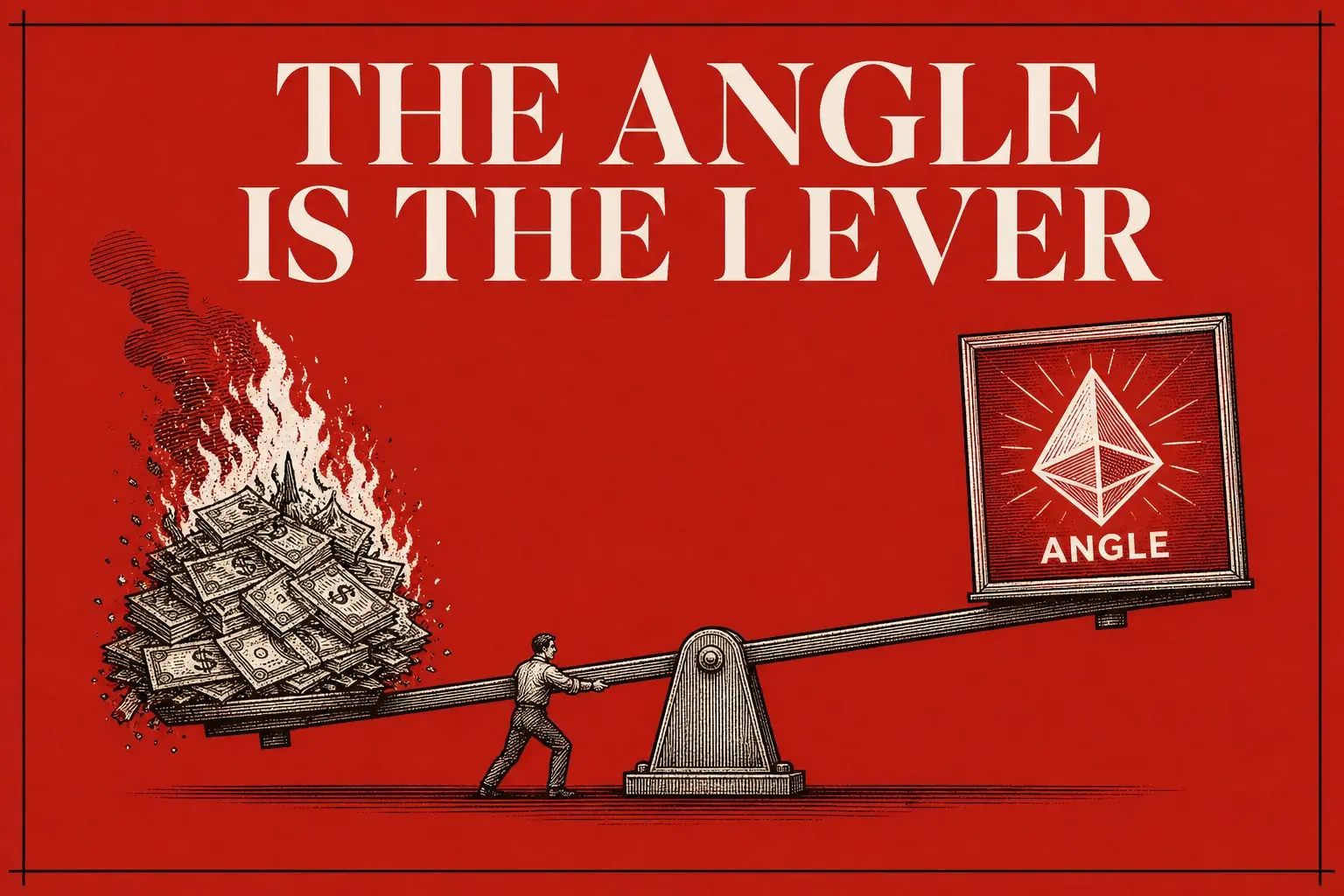
Six AI image generators, one live Shopify store. The pictures ran from fine to gorgeous. Image quality barely moved the click rate. The angle, the idea each ad sold, drove the whole result.1 That is the job in one number: you are not short on pretty creative, you are short on the right thing to say. And it is already written down, in reviews and threads you have not read. Here is how to mine it, with no code.
CH.01
The platform already picked your audience, so the creative angle is the only lever you still hold
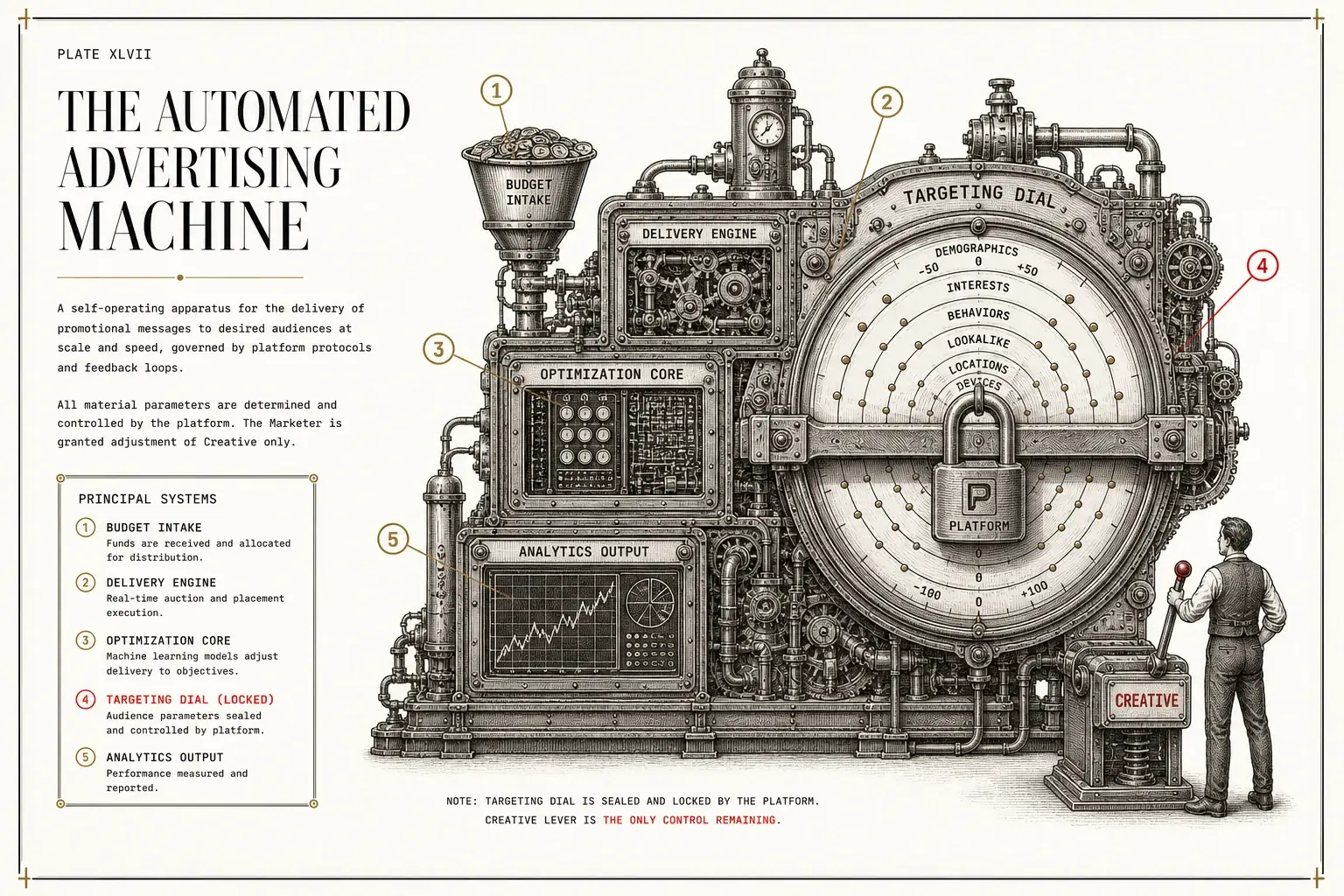
Stop optimizing targeting. Since Apple's privacy changes broke precise tracking, Meta, TikTok, and Google decide who sees your ad based on the ad itself. The creative angle is now the targeting, and the highest-payoff work in the job moved upstream, from picking audiences to finding the right thing to say.
Start with the words you will see all day.
- CPI is cost per install, what you pay for one download.
- CVR is conversion rate, the share of people who take the action you want.
- ROAS is return on ad spend, revenue divided by what you spent.
- Retention is how many users are still active after a number of days (D1, D7, D30).
- LTV is lifetime value, the total revenue a user produces before they leave.
- ATT is Apple's App Tracking Transparency, the pop-up that asks "Allow this app to track you?"
- SKAN (SKAdNetwork) is Apple's privacy-safe replacement for tracking. Instead of telling you which person installed, it sends back delayed, aggregated, anonymized signals.
Here is what that did. Opt-in to ATT is low, and the sources disagree on exactly how low. Adjust's Tiahn Wetzler put it at 35% of users shown the prompt in mid-2025. Singular and Purchasely measured a global "yes" rate of just 13.85% for apps that prompt right away.2 Either way, deterministic targeting is mostly gone, so the algorithm now optimizes on creative signal instead.
The numbers all point one direction.
- Meta's own research has creative driving roughly 56% of incremental app installs, more than targeting and bidding combined.3
- Nielsen and Google converge on creative explaining about 56% of performance, with a 3.2x spread between the best and worst creative at the same budget.4
- AppsFlyer's 2025 Creative Report analyzed 1.1 million video ads across 1,300 apps and found the top 2% of creatives capture 53% of gaming spend and 43% of non-gaming spend. Winner take most.5
- And the door slams fast: by the 3-second mark, roughly half of viewers have already scrolled past.6
| Targeting era (before ATT) | Creative era (now) |
|---|---|
| You hand-pick interests, ages, lookalikes | You hand the algorithm a budget, it finds the user |
| Narrow audiences mean control | Broad targeting plus differentiated creative beats 1% lookalikes7 |
| The ad is the wrapper | The ad is the targeting (creative ≈56% of installs)3 |
| Test more audiences | Test more angles. Audience testing is now secondary8 |
| More ad sets, more control | More ad sets, a fragmented signal the algorithm cannot learn from9 |
That last row is where most juniors quietly bleed money. Meta's Andromeda ranking system treats your audience inputs as suggestions, not gates, and rewards a dense pool of varied creatives. One operator consolidated 8 campaigns down to 2 and watched CPMs drop 20% and CPAs fall 35% within days. Not because the targeting improved. Because the algorithm finally had enough signal in one place to learn.9 Bid strategies plateau. Audiences saturate. Creative resets the auction.10 Your lever is the angle. The rest of this piece is how to stop guessing it.
CH.02
Stop inventing angles, because the words that convert are already written down
The reason your angles miss is that you are inventing them in a room. The highest-converting language is verbatim customer language, discovered rather than brainstormed, because the angle (the belief you change) carries 70 to 80% of paid-social performance, and a phrase a real person already said beats anything a copywriter dreams up.
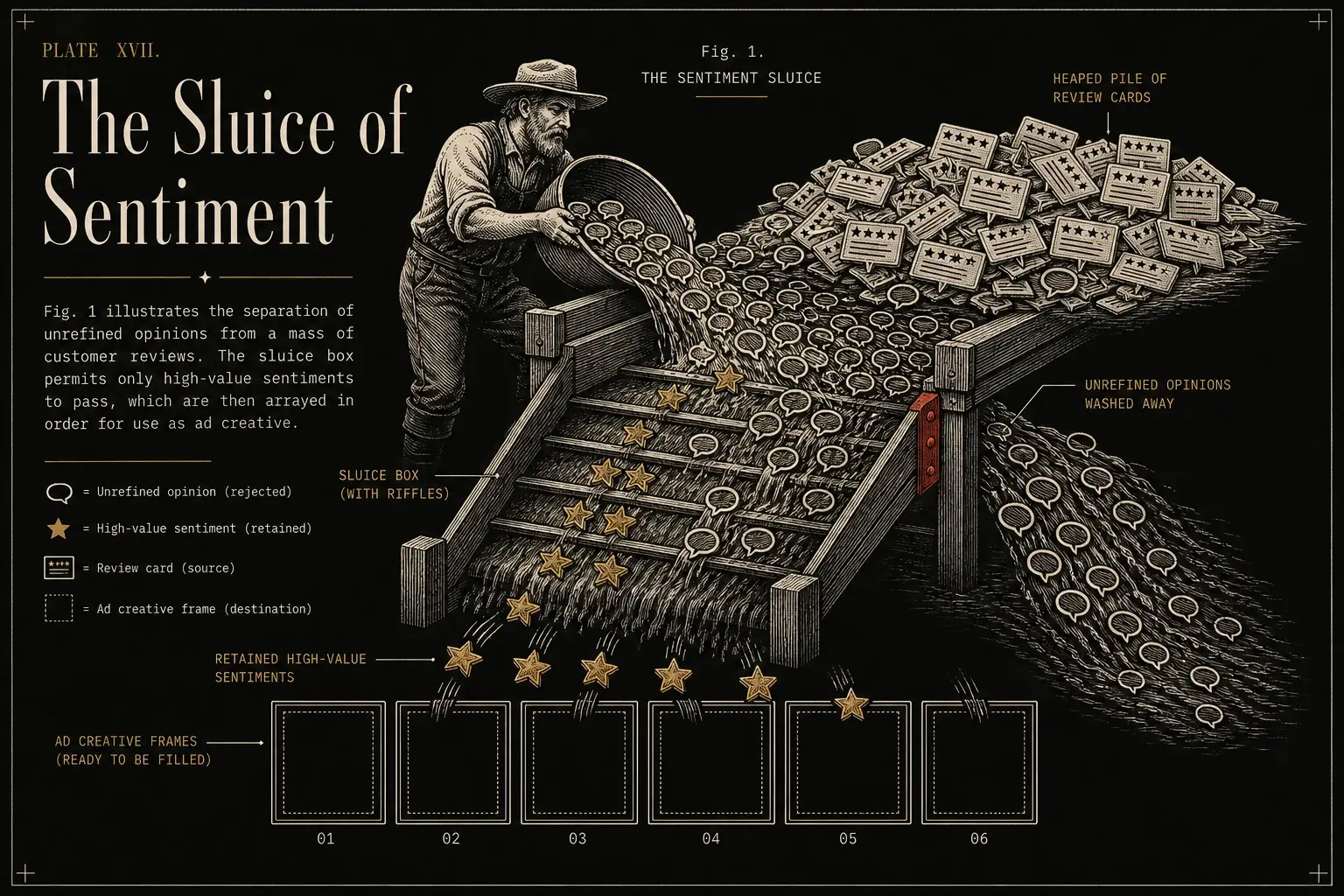
First, the word that organizes everything. Forget headlines and colors. A creative angle is the belief shift an ad creates: "this is different because the mechanism is different," or "this is for someone like me who has already failed at this before."11 The angle is the idea. The hook, visual, and copy are how you deliver it. And the angle, not the production polish, is where the money lives. Practitioners measuring Meta performance put 70 to 80% of the variation in results on the angle.11 That CreaScale store proved it. The angles moved the clicks. The image quality did not.1
So the real question is not "what angle should I make up?" It is "where is the angle already written?" The answer: in the customer's own words.
Meet Hannah Parvaz. At Curio, an audio-journalism app, she did not brainstorm hooks. She scheduled one-on-one customer interviews and listened for the word that kept repeating. A year of this kept surfacing one small word, "seem," and she followed it to the motivation underneath. The best hooks, she found, are discovered, not invented. Verbatim phrases real customers used before any marketer touched their thinking.12
That is the whole reframe. Here is why it works on a level deeper than "know your customer." There is a gap between how you describe the product and how your buyer describes their problem, and the click lives in that gap.
You write about "optimizing workflow efficiency." Your reader is sitting there thinking, "I am completely drowning, and nothing ever gets done." Same problem. Completely different language.13
The customer's words win because they carry the exact objection and desire, already loaded. The richest of those words are the ones people are a little ashamed to say out loud. The embarrassing complaints, not the polite ones, are where the best converting copy hides.14
This is not theory. Two brands prove it.
- SURI, a toothbrush brand, trained a custom GPT on more than 15,000 Trustpilot reviews to pull the exact words customers used, "gunk," "batteries," "sink gunk," and fueled dozens of three-second hooks from them. Five thousand units in week one, against a polished "clinical" competitor.15
- Urban Threads had paid $5,000 a month for static retargeting ads. A tool that simply scanned the customer reviews found a hidden selling point nobody had briefed, "deep pockets," auto-built ads around it, and lifted the Ad Relevance Score from Average to Above Average. It replaced the retainer.16
One discipline keeps this honest: do not trust one loud review. A pattern needs roughly 10 or more customers saying the same thing before you treat it as an angle instead of a fluke.17 Inventing is fast and feels creative. It is also why your tests come back flat.
The same gap shows up one level down, in what people will actually pay for: the listings that name a budget describe a cost the buyer can already point at, never the technology that removes it. Ad angle or service offer, you are looking for language somebody already used about their own problem.
CH.03
The chain that converts: raw pain, then angle, then hook, then testable concept
Every winning ad is a four-link chain you can build on purpose. A raw, verbatim pain point becomes an angle (the belief), becomes a hook (the first three seconds), becomes one or more testable concepts (the formats). Learn the chain and you manufacture candidate ads instead of waiting for inspiration.
Two more words first. A hook is the first two to three seconds of the ad, the part that decides whether anyone watches the rest. A creative concept is one complete, shootable execution of an angle (a UGC testimonial, a screen-recording demo, a before-and-after).
flowchart LR
  A["Raw pain (verbatim quote)"] --> B["Diagnose awareness and Force"]
  B --> C["Angle (the belief shift)"]
  C --> D["Hook (first 3s, 12 words max)"]
  D --> E["Testable concepts (formats to ship)"]
  E -->|test result| A
Watch it run on one pain. A real budgeting-app review: "I tried three budgeting apps and gave up. Setting them all up took hours and I never stuck with it."
| Link | What you do | Output |
|---|---|---|
| Raw pain | Pull the verbatim line | "took hours… I never stuck with it" |
| Diagnose | Problem-aware, terrified of quitting again | this person has tried and failed before |
| Angle | Turn the pain into a belief | "the budgeting app you'll actually stick with, set up in 2 minutes" |
| Hook | Compress to the trigger, 12 words max | "I quit 3 budgeting apps before this one" |
| Concepts | Same angle, three formats | (a) UGC testimonial on the quit line · (b) 2-minute-setup screen recording · (c) "switch from spreadsheets" comparison |
Notice the hook is not a benefit ("Budget easily"). It is the trigger moment, the thing that was true right before they searched. Triggers out-pull benefits because they are specific, and they self-select the exact person who lived them.
The taxonomy that makes this repeatable comes straight from customer feedback. Each kind of feedback maps one for one to a creative element.17
| Customer feedback | Becomes |
|---|---|
| A repeated pain | The hook |
| The desired outcome | The benefit |
| An objection overcome | The comparison or explainer |
| The unique language | The headline |
| The customer type | The targeting |
One brand's reviews translate the same way: a repeated benefit becomes the main angle, a specific phrase becomes the headline, a use case becomes the on-screen scene, an emotional payoff becomes the CTA mood.18
And the chain is portable. One product, many pains, many angles. Take creatine gummies:
- Gym-goers: performance
- Busy moms: energy, taste, convenience
- Students: focus while sleep-deprived
- Travellers: no white powder to explain at airport security
- Seniors: keeping muscle
Same product, six pains, six angles. Opening a new audience for one product is the single biggest lever you have.19
One last guardrail. The angle has to match what happens inside the app. A creative promising "lose 5kg in a month" converts better when the paywall appears after the first workout assessment, once the user has tasted what the ad promised.6 Promise something the app does not deliver in the first session and you buy installs that churn.
CH.04
Two old frameworks still earn their keep in 2026, and the persona deck does not
Do not drown in frameworks. Exactly two do the heavy lifting now, Jobs-to-be-Done (the switch interview) and Schwartz's 5 Stages of Awareness, because each one outputs creative directly. Pain-gain mapping is a one-time map. AARRR is a funnel diagnostic, not audience research. And the demographic persona deck is dead weight for targeting.
Here is the honest scorecard, with the load-bearing reason each one lives or dies.
| Framework | Verdict for mobile UA, 2026 | Why |
|---|---|---|
| Jobs-to-be-Done plus Forces of Progress | Keep. Highest value. | The only one that outputs a hook taxonomy directly (next chapter). People "hire" a product to make progress.20 Ten to fifteen interviews reveal the buying patterns.20 |
| Schwartz 5 Stages of Awareness | Keep. Essential. | The diagnostic for why a good angle still flops: message-to-awareness mismatch. The best axis for a test matrix. |
| Pain-gain mapping (Value Prop Canvas) | Keep, but as a one-time map. | Good for organizing research into a shareable picture once per product. It contains angles, it does not generate them. Do not re-run it every sprint. |
| AARRR / RARRA (Pirate Metrics) | Keep, but it is NOT audience research. | It tells you where you leak (acquisition vs activation vs retention), so it decides whether a creative sprint is even your bottleneck. A different job from "what to say." |
| Demographic personas (35 to 44, urban, female) | Outdated as a targeting tool. | In a broad-targeting world you literally cannot act on it. The algorithm ignores audience inputs. As Bob Moesta puts it, you would never see a 20-year-old driving a BMW if demographics actually predicted behavior.21 |
A note on Jobs-to-be-Done so you do not get lost. It has three schools, and conflating them is the common mistake.22 Clayton Christensen's is the famous story version. The McDonald's milkshake study found about 40% of milkshakes were bought before 8am by commuters "hiring" one to make a boring drive less dull. Years of surveys asking for thicker, sweeter, more flavors produced no growth until someone asked what job it was hired for.23 Tony Ulwick's is the heavy quantitative version (surveys scoring outcomes). For a junior UA marketer, you want the third, Bob Moesta's demand-side "switch interview," which is exactly the next chapter.
Run AARRR first, as a gate. If your D1 retention is below 25% or your D7 is below 10%, no angle will save you. You have a leaky bucket, and the fix is product, not ads.3 Once acquisition is genuinely the constraint, the research loop earns its keep.
CH.05
Match the message to the awareness stage, or set the money on fire
The most expensive mistake a junior makes is showing the right product to the wrong mindset. An awareness stage is how much the prospect already knows about their problem and your solution. Meta data shows creative matched to the correct stage converts two to three times better than generic messaging, and most budgets fight over the smallest slice of the market.
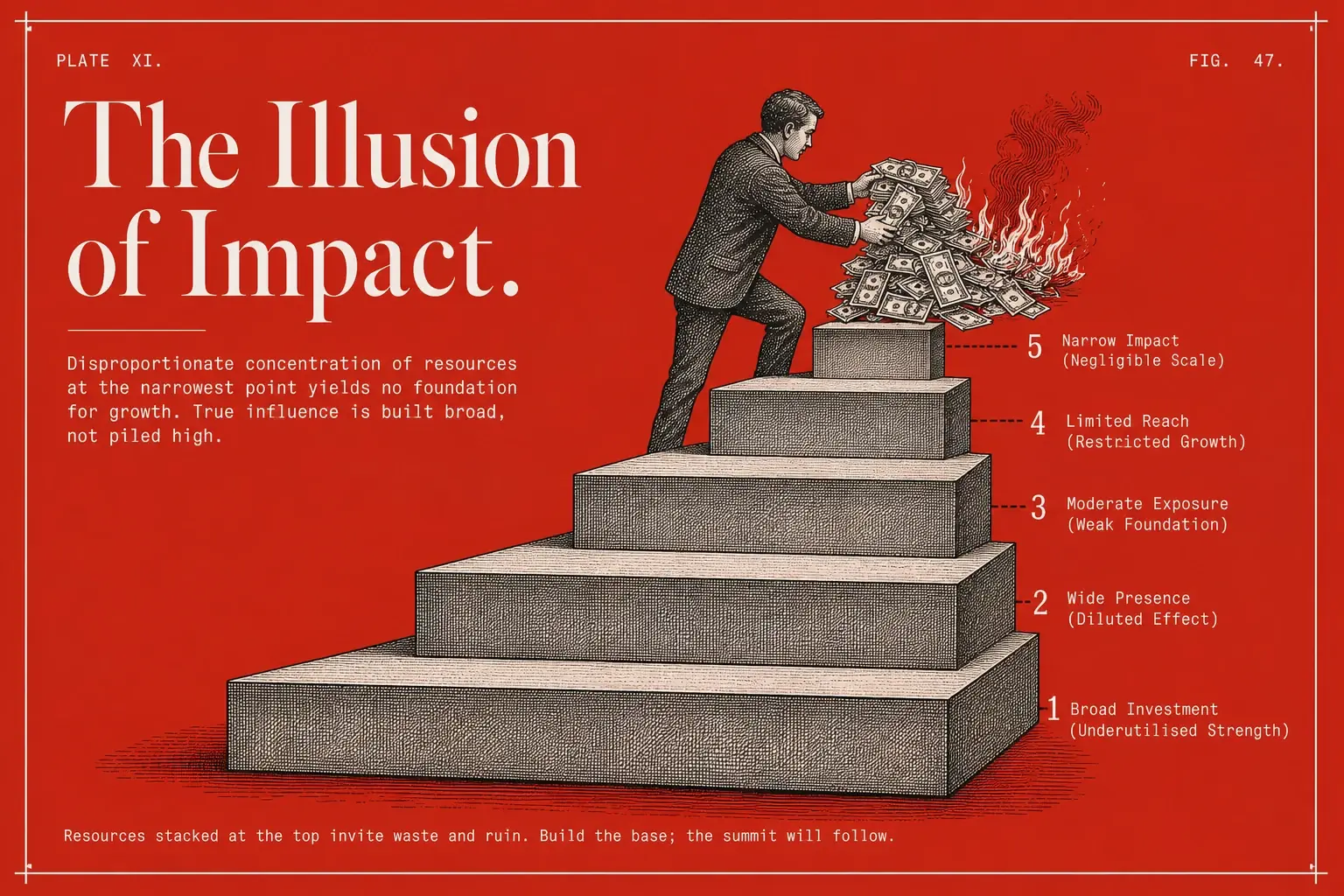
Eugene Schwartz's five stages, written in 1966 and still true because awareness is a property of the market, not the era.24
| Stage | ~% of market | What the creative must do | Example hook | Force it targets |
|---|---|---|---|---|
| Unaware | ~60% | Teach the problem, never mention the product | "Nobody told me the reason I was so tired…" | Push |
| Problem-Aware | ~20% | Validate the pain, name the solution category | "If you've tried every moisturiser and still…" | Push to Pull |
| Solution-Aware | ~10% | Differentiate your mechanism vs the category | "Most X do it this way. Here's why that fails." | Pull |
| Product-Aware | ~7% | Remove objections with proof and demos | "Here's the 2-minute setup, on camera" | Anxiety |
| Most-Aware | ~3% | Lead with the offer and urgency | "48 hours: first month free" | Habit |
Read the distribution and the arbitrage jumps out. Roughly 60% Unaware, 20% Problem, 10% Solution, 7% Product, 3% Most-Aware, yet most budgets crowd into the bottom 10% (Product and Most-Aware) while the top 80% goes unspoken to. That is exactly why customer acquisition cost saturates.25 The stage hooks are not interchangeable:26
- Unaware uses relatable stories and pattern interrupts.
- Problem-Aware uses "if you…" call-outs.
- Solution-Aware uses category comparisons.
- Product-Aware leads with proof.
- Most-Aware leads with the offer.
The failure this prevents is the classic one. Run a product-focused ad with a discount CTA to a broad, cold, mostly Unaware audience and you get clicks and zero conversions, because the message-to-awareness fit is broken.25 Meta's own data confirms ads matched to the right stage convert two to three times better.25 There is a budget heuristic, too: a common split is 20 to 30% on Stages 1 and 2, 20 to 30% on Stage 3, and 40 to 50% on Stages 4 and 5, weighted higher up the funnel for newer brands that need to fill the retargeting pool.25
One trap is baked into the timing. Awareness content needs 90 to 180 days to show measurable impact on pipeline. Cut a top-of-funnel campaign after four weeks because branded search has not moved and you have made a structural error, not a creative one.27
The stages also double as a diversity engine. Five genuinely different awareness scripts keep Meta's Andromeda from treating your ads as one near-identical entity and suppressing them.26
CH.06
Every install is a switch, and every switch is a tug-of-war
The cheapest way to find a hook is Bob Moesta's switch interview. Ask a handful of recent users to walk you backwards through the moment they switched. Every switch is a tug-of-war between four forces, and each force maps to a specific kind of ad, so the interview literally hands you your creative.
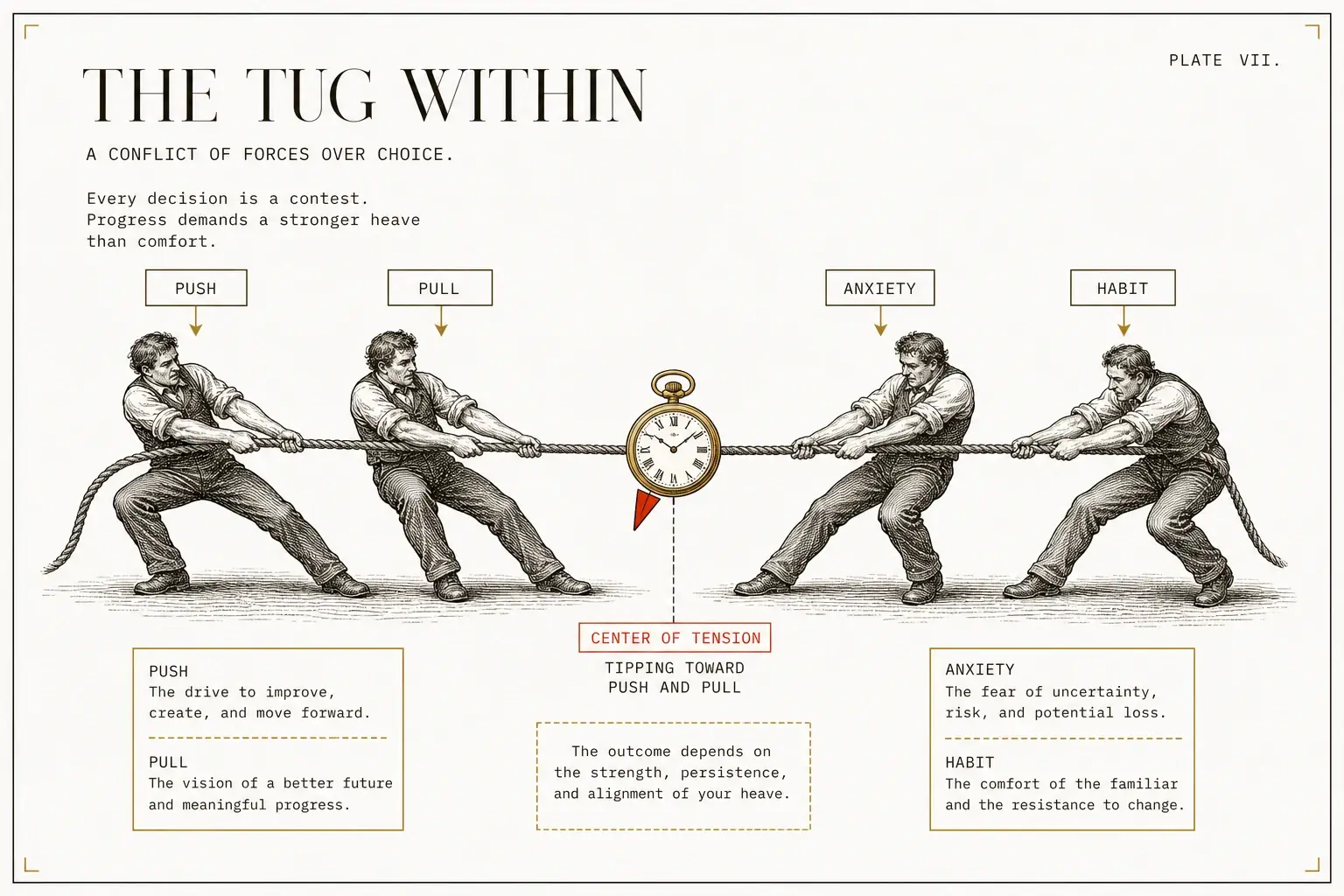
The model: a person switches when Push plus Pull beats Anxiety plus Habit. Push is the frustration with the old way. Pull is the attraction of the new. Anxiety is fear of the new (the learning curve, the buyer's remorse). Habit is the comfort of the current mess.21 Here is the part that makes it operational. Each force is a type of ad.
| Force | What it is | The creative it becomes |
|---|---|---|
| Push | What's driving them crazy now | A problem-aware ad that names the exact frustration |
| Pull | The promise of the new situation | A solution or outcome ad that shows the after-state |
| Anxiety | Fear of switching or failing again | An objection-handling ad: proof, demo, "it's easy," a free trial |
| Habit | Inertia, comfort with the old | A "switch from [spreadsheets / competitor]" comparison |
You do not survey for the forces. You run a short interview about one specific past event, the moment they switched. The protocol reconstructs four moments, walked backwards from the purchase.28
flowchart LR
  A["First Thought"] --> B["Passive Looking"]
  B --> C["Active Looking"]
  C --> D["The Decision"]
The trick to getting real answers is anchoring on the concrete: "What time of day was it? Were you at home or work? Was the TV on? Who were you with?" Specific recent events produce specific answers. Abstract questions produce abstract mush.29 You do not need many. About 10 to 15 conversations in one segment surface the dominant patterns.20
You know a force is real when it repeats. In one famous set, a "dining-room-table anxiety" surfaced in three of four interviews. Once something comes up three times by about the fourth interview, you know there is something there.30 That "first thought" moment, the instant they realized they had to make progress, is usually your best hook.
And once you have named the Anxiety, you can design it away in the creative. One CRM cut switching friction by automating data import and offering a 100-row free test, turning a fear into a reason to try.21 Hannah Parvaz's "seem" was this exact kind of find. Not a feature. The felt motivation under the switch.12
CH.07
Rank your sources by signal per effort, and never trust just one
You do not need every source. You need the high-signal ones and a rule to combine them. App-store reviews, competitor ad libraries, and Reddit give the most insight per hour. The rule that turns raw pain into a confident bet is triangulation: a pain point earns budget only when it shows up in two or more independent sources.
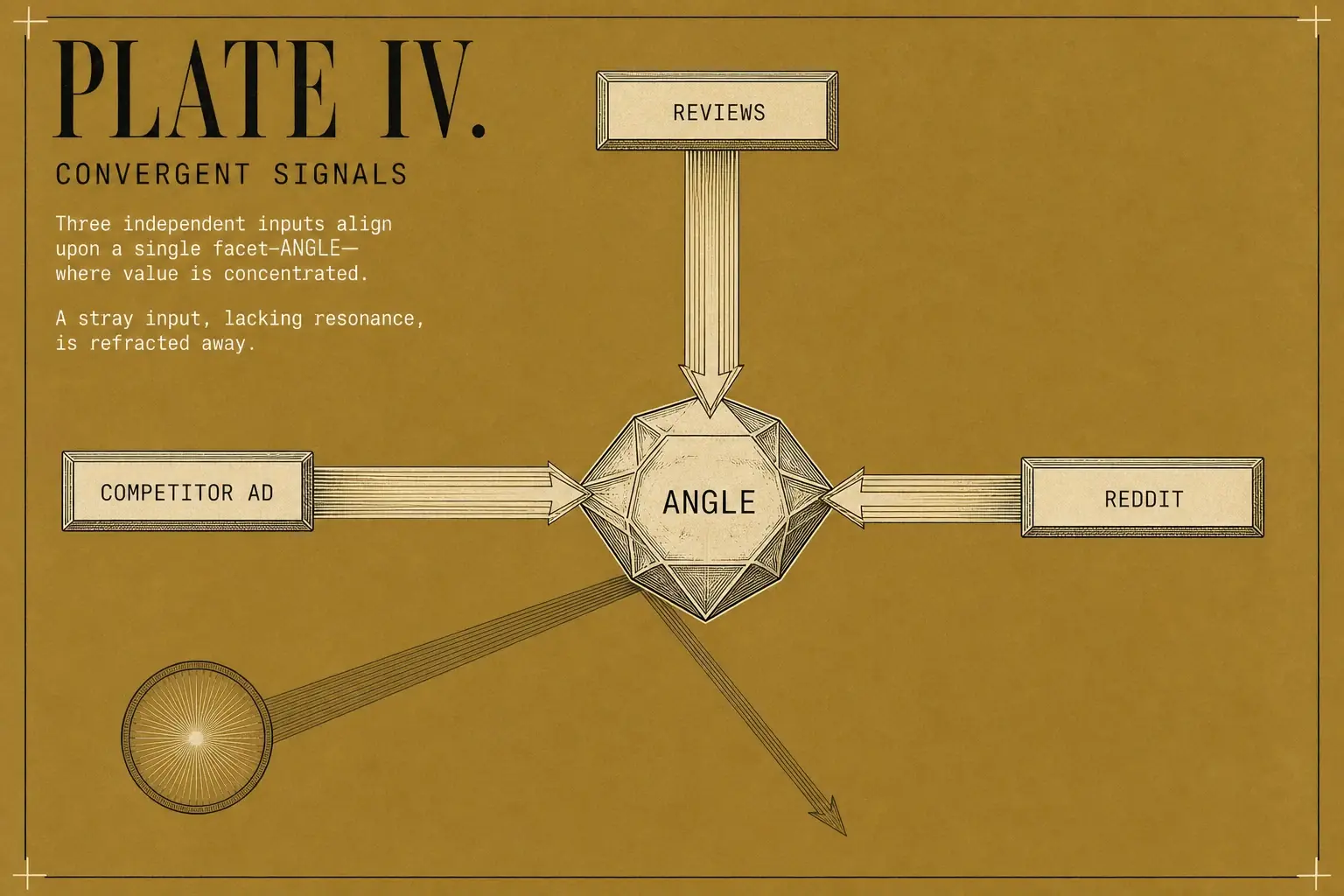
Here is the map. Signal is how much real insight it carries. Effort is how hard it is to get.
| Source | Signal | Effort | Best for | Main failure mode |
|---|---|---|---|---|
| App-store reviews (yours plus competitors') | High | Low | Exact language, filter 2 to 3 stars for unmet needs | Summarizing instead of copying verbatim |
| Competitor ad libraries (Meta, TikTok) | High | Low | Proven angles (long-running means working) | Copying execution, not the angle |
| Reddit / forums / Discord | High | Medium | Raw switch stories, shame-layer words | Mistaking the loudest voice for the pattern |
| Search / keyword intent | High | Medium | The exact demand language people type | Reading intent off the keyword, not the results page |
| Support tickets / chat logs | High | Medium | Specific friction at the moment it happens | Skewed toward problems only |
| User interviews / win-loss | Highest | High | The "why" and the trigger (JTBD gold) | Slow, small samples |
| Surveys | Medium | Medium | Quantifying how widespread a pain is | Weak for discovery, leading questions |
| Social comments | Medium | Low | Reactions to existing creative | Noisy without tight queries |
The combining rule is the whole game. A pain that appears in reviews AND in a long-running competitor ad AND in a Reddit thread is a validated angle. Bet on it. A pain that appears in a single loud review is a hypothesis at best. Triangulating across qualitative feedback, support tickets, and behavioral data cuts prioritization errors by 58% versus single-source decisions.31 And the reason you cannot just read your own app's reviews and stop: as Jellyfish's Juliana Jackson points out, only about 5% of the customer's path happens inside the app. The other 95% happens across the open web, in exactly these sources.31 The next three chapters are the techniques for the top three.
CH.08
Mine reviews like a copywriter, not a summarizer
App-store reviews are the highest-signal, lowest-effort source, but only if you copy the words verbatim instead of summarizing them. Filter for the lukewarm reviews, tag every complaint by pain type, score by frequency and intensity, and cross-check sentiment against the star rating so an AI does not mislabel sarcasm as praise.
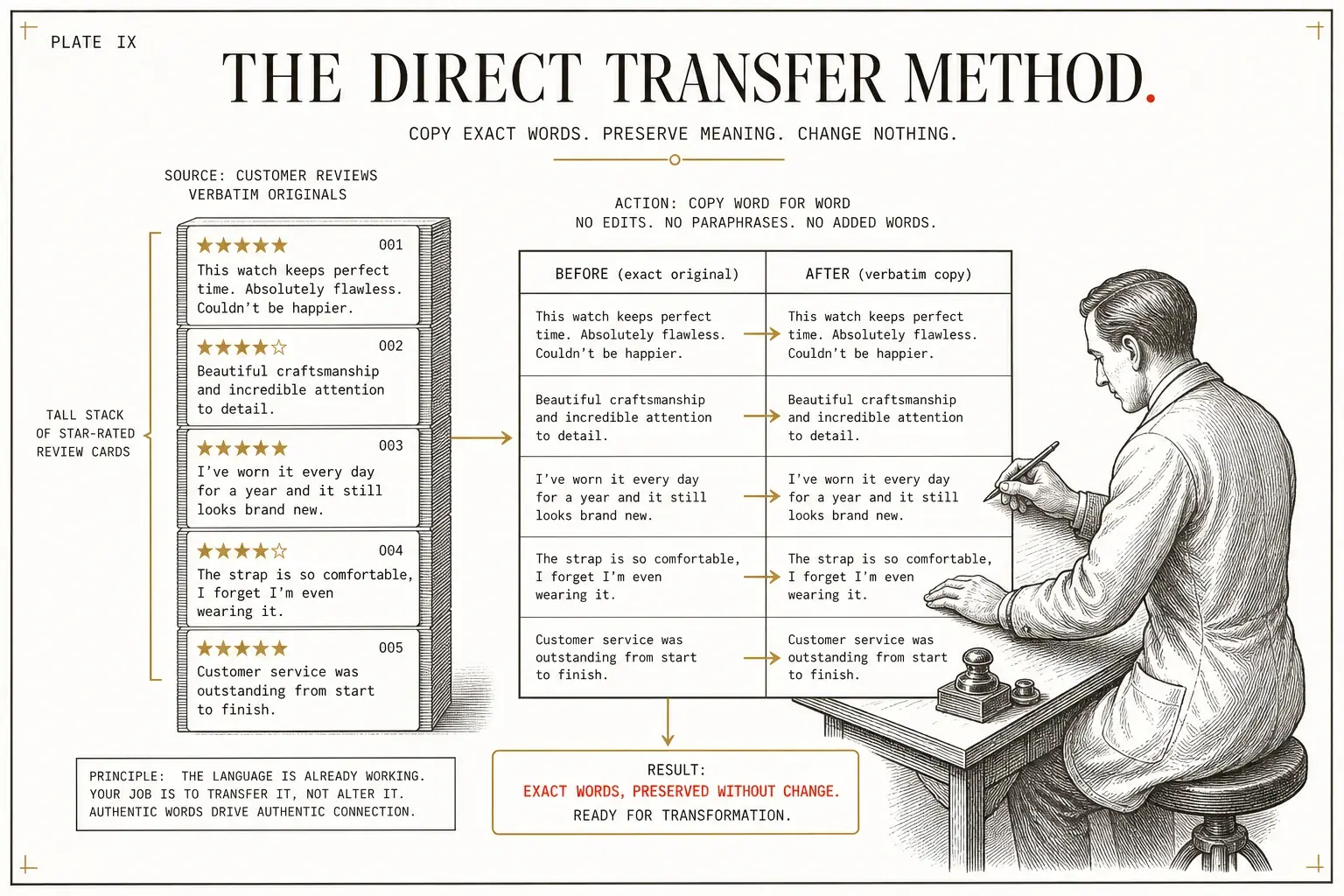
The procedure, start to finish, no code required.
Pull 200 to 500 reviews, yours plus three to five competitors. Export them from the store, or use a review tool (the stack chapter covers those).
Filter to 2 and 3 stars. Not 1-star (emotional outbursts), not 5-star (rarely exposes a gap). The 2-to-3-star reviews are nuanced and name the specific, fixable problem.32
Extract verbatim. Copy the exact words into a before-state / after-state table. The moment you paraphrase "I was tired of explaining to my CFO why our numbers never matched the CRM" into "customers value accuracy," you have thrown away the headline.33
Tag every line by pain type. Six buckets do it.
- Outcome pain, not getting the result
- Process pain, hard to use, confusing
- Time pain, too slow, too much work
- Money pain, too expensive, low ROI
- Trust pain, support, reliability, security, honesty
- Social or identity pain, looking bad, anxiety, status34
Score and rank by frequency times intensity times purchase-impact, and require at least three supporting quotes per theme.34
Cross-check sentiment against the star rating. A 1-star review your AI tagged "positive" is almost always sarcasm.35
One operational shortcut some teams borrow from the open-source "app-store-review-arbitrage" skill: complaint_weight = (4 minus rating) times recency_factor, where recency_factor is 1.0 for reviews 90 days old or newer, 0.7 for 91 to 365 days, and 0.4 for older. Themes with fewer than three reviews get discarded as noise, and cluster names must use the exact verb and noun from the reviews ("Crashes when exporting to PDF," not "Stability issues").36
Two cautions keep you honest.
- Ratings lie about the average. Star ratings follow a J-shaped curve, because mostly the delighted and the furious bother to rate. In a study where everyone was forced to write a review, ratings came out roughly normal, about 3% top and 7% lowest.37 So mine reviews for language, not for "how good is the app."
- Know when to systematize. Juliana Jackson's threshold is more than 5,000 total reviews and more than 100 new reviews a month before you build a standing process. Below that, manual reading is fine.31 At scale, a tool like AppFollow's Semantic Analysis groups reviews by topic across 20-plus languages and 30 tags and weeds out spam, and you can point it at competitor reviews for first-hand insight into their users' pain.38
There is an honest emotional reason this work gets skipped. As one practitioner confessed, "I love manually combing through reviews… but it becomes very exhausting and time-consuming after a few hundred reviews."31 That exhaustion is exactly where AI earns its place, to read the volume, and exactly where it must not be trusted, on the quotes. We draw that line sharply in a moment.
CH.09
A competitor's longest-running ad is free, pre-validated research
The single best signal in a competitor's ad library is time. Advertisers pause losers within a week or two, so any ad running for 30 days or more is almost certainly profitable. That makes it a validated angle you can study for free. The discipline is to extract the underlying angle, not copy the execution.
The Meta Ad Library and TikTok Creative Center are public and free. The Ad Library shows how many versions of an ad are running and how long each has run. The catch: for non-political ads, Meta does not show competitors' actual spend or ROAS, so you infer from what you can see and validate in your own account.39 Longevity is the proxy. Ads running 30-plus days are primary research targets. Ads paused within 7 to 14 days are noise.39
The repeatable teardown, six phases.
- Build a simple observation ledger, eight fields per ad: Competitor, Date logged, Date started, Ad format, Hook type, Primary offer, Visual treatment, Strategic intent.39
- Extract. Search by advertiser name (not keyword), sort by date started (oldest first), filter by format, look for clusters of variants.
- Categorize by strategic intent, four buckets: Awareness, Consideration, Conversion, Retention/Reactivation. The mix shows where a competitor is strong and where there is white space.
- Decode the hook and messaging structure (what stops the scroll, what promise follows).
- Track visual and format trends over time (video length, treatment).
- Translate the findings into your own briefs. Pull the angle, then build your own execution.39
This is not a fringe tactic. The IAB's 2025 report found 74% of advertisers now use ad-library data as a primary input to creative planning, and teams who do it systematically, a weekly extraction against consistent fields, report 2.3x higher creative testing velocity than those who check reactively.39 In the EU there is an even richer surface. The Digital Services Act forces large platforms to run public ad repositories with the creative, advertiser identity, payer, run dates, and total reach broken down per member state, kept for a year after the last impression.40
One timing trick turns competitor data into a clock. A sudden drop in a competitor's app rating is a timestamped signal that a specific pain is currently acute, prime timing to launch ads naming that exact pain while their users go looking for an alternative.41
The reason to systematize is the alternative every operator recognizes: "endless tab-hopping… saving screenshots to random folders that are never used again, leading to creative decisions based on vibes rather than data."39
CH.10
Reddit, the search bar, and the support inbox hold the words a survey never gets
Three free sources hold the unfiltered words people will not put in a survey. Reddit (raw struggle language and switch stories), the search bar (the exact phrases people type when they are ready to act), and your support inbox (specific friction at the moment it happens). Each has one technique and one failure mode.
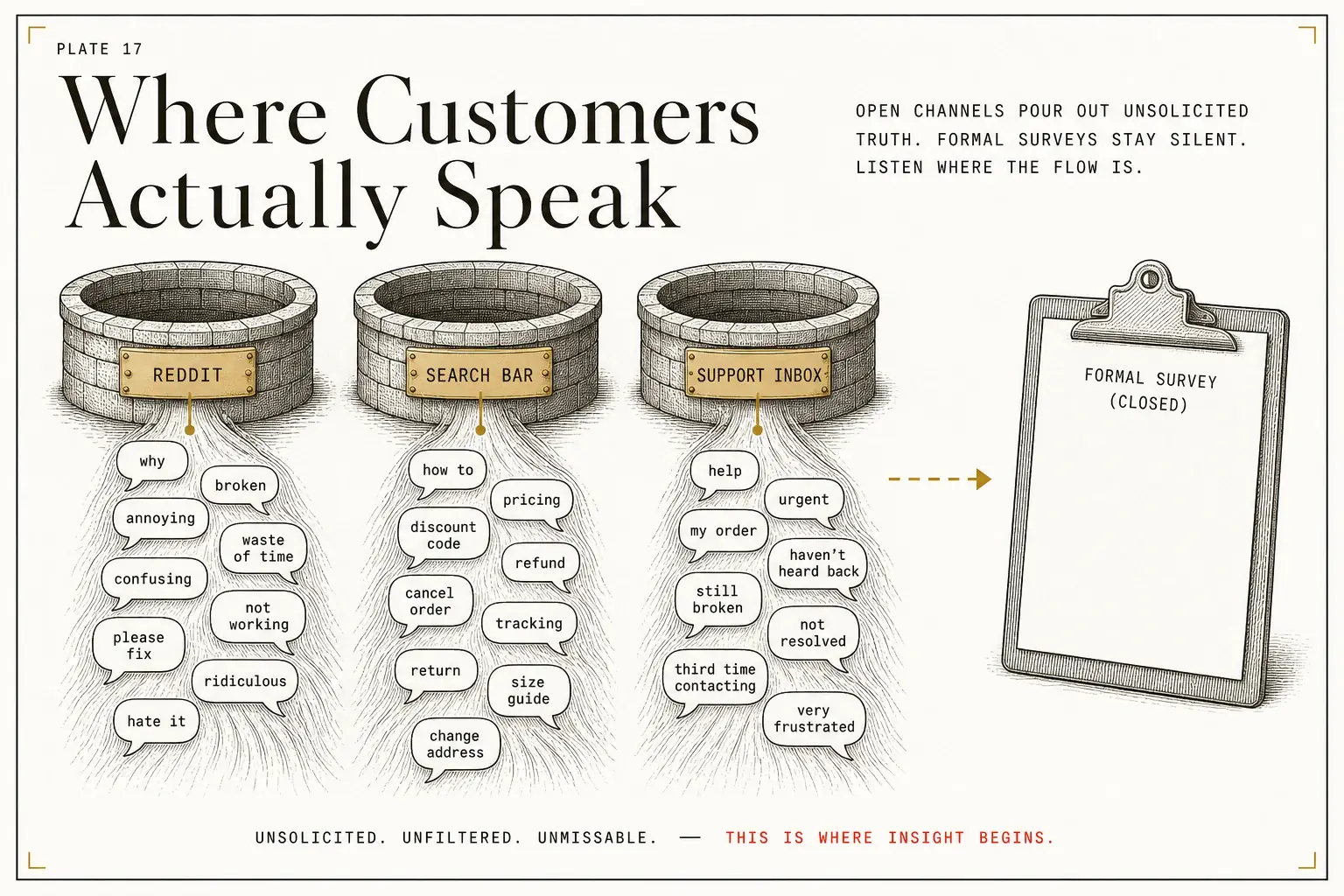
Reddit and forums turn a vague persona into a real human
Instead of "an angler," a few threads give you "Jake, 35, Minnesota, fishes year-round from a kayak, struggles with winter gear, freezing fingers, broken fishing lines." The method: search niche communities (r/productivity, r/SkincareAddiction), look for repeated questions and high-engagement comments, and note the exact language, "I'm overwhelmed by endless to-do lists."42
"An angler" becomes "Jake, 35, Minnesota, fishes year-round from a kayak, struggles with winter gear." The detail is the difference between a guess and a person.42
Reddit users also tend to be high-value. In Adjust's data, users acquired from Reddit showed 22% higher Day-30 retention, 136% higher Day-1 spend, and 200% higher LTV in the first 30 days versus other social platforms.43 The failure mode: a quiet channel does not mean people are happy, and high volume is not a crisis. Treat an issue as real only when it repeats across multiple places and survives past one update, not when a single thread gets loud.44
The search bar reveals intent a survey cannot
The same keyword can hide different jobs, so read the search results page, not just the keyword. For the questions people ask before they ever open an app, a tool like AlsoAsked surfaces them, and AppTweak flagged a major Apple search-algorithm shift in mid-2025 that pushed results toward more search-intent diversity.45 The failure mode: chasing exact-match keywords instead of grouping by the underlying need (learn, compare, buy, fix).
The support inbox is the most specific source you own
It is friction captured at the exact moment it happens. The move: mine 30 reviews and 10 support tickets and you typically pull three problem phrases (your hooks), three hesitations (your objection-handling), and three specific results (your proof).46 Categorize tickets, find patterns by frequency and trend, root-cause with the "5 Whys."47 For games especially, support tickets are the most accurate signal of all. Unlike reviews (a lagging indicator) or surveys (survivor bias), tickets come from the full population of affected players at the moment of friction.48 The failure mode: it skews toward problems, so pair it with the positive-language sources.
A warning for the junior who manages someone else's account. A "channel of truth" is a trap. Different channels tell different stories. Discord is emotional and chaotic, Reddit is slower and considered, support is specific. The mistake is reacting to the loudest one rather than the theme that repeats across all of them.44
CH.11
AI multiplies your reading, then lies to your face about quotes and numbers
AI is a real multiplier on the boring, high-volume steps. Clustering hundreds of reviews, tagging sentiment, transcribing interviews, drafting thirty hook variants. It is also a confident liar about anything that has to be true. It fabricates verbatim quotes, invents statistics, and misreads sarcasm. The rule that keeps you safe: AI may cluster and draft, but it may never be the source of a quote or a number.
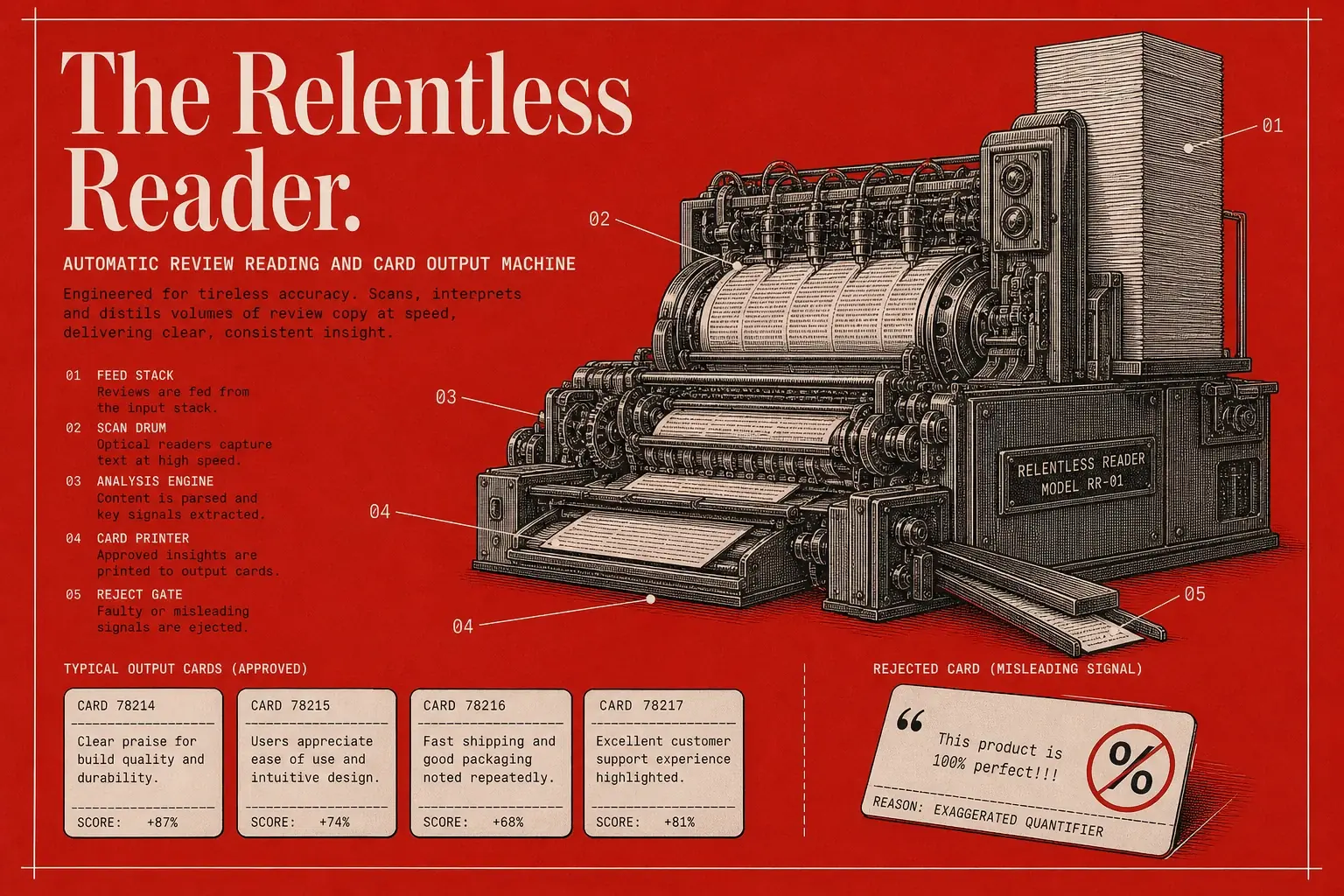
Here is the honest split, task by task.
| AI genuinely accelerates this | AI fabricates, never trust it here |
|---|---|
| Clustering 500 reviews into themes | Producing a verbatim quote (it paraphrases, then presents it as exact) |
| Tagging sentiment at volume | Any statistic ("47% of users said…" is invented) |
| Transcribing and translating interviews | Sarcasm, irony, mixed sentiment |
| Drafting 30 hook variants for you to pick | Predicting how a real person will behave |
| Reformatting findings into a framework | Being the final judge of what is true |
The danger is not obvious gibberish. It is research that looks rigorous and is not.
As one qualitative researcher put it, you ask the model for the audience's main pain points, it returns a confident, structured list, and "no interviews were conducted. No transcripts were analyzed. It reads like research. It is extrapolation."49
The fix is a question you must be able to answer for any AI-surfaced insight: how many people said this, in what context, in what words? If a quote appears, check the wording, the attribution, and the context against the source, because AI routinely paraphrases while presenting text as a quote, slightly modifies wording, combines statements, or misattributes.49 A senior practitioner's habit: always make the AI show you the exact verbatims under each theme, both to verify and to keep building your own intuition.50
This has a body count.
- Air Canada's chatbot invented a bereavement-refund policy for a grieving customer, who relied on it, and a tribunal forced the airline to honor the policy it never had.51
- Apple Intelligence stamped a fabricated summary on a real BBC headline, so readers believed the false version came from the BBC.52
- Across the industry, AI hallucinations were estimated at $67.4 billion in losses in 2024, with even leading models hallucinating somewhere between 15% and 27% of the time depending on the task.53
- Synthetic respondents, AI standing in for survey takers, show only about 60% consistency across question formats, and research fraud already costs more than $350 million a year.54
So use AI where it is strong, to read more than you ever could and to draft more options than you would bother to. Then put your own eyes on every quote and every number. That one discipline separates a research system from "I asked ChatGPT and it sounded smart." It is the same discipline that keeps an automated content pipeline from lying by staying silent: the machine is trusted to do volume, never to certify that what it produced is true.
CH.12
Use synthetic personas to screen ideas, never to validate them
Synthetic personas, AI characters that simulate your customer so you can "interview" them, are real and useful for one thing: cheaply screening out obviously bad ideas before you spend. They are not trustworthy for validating a real-world bet. Use them to kill losers. Use real humans and a paid test to confirm winners.
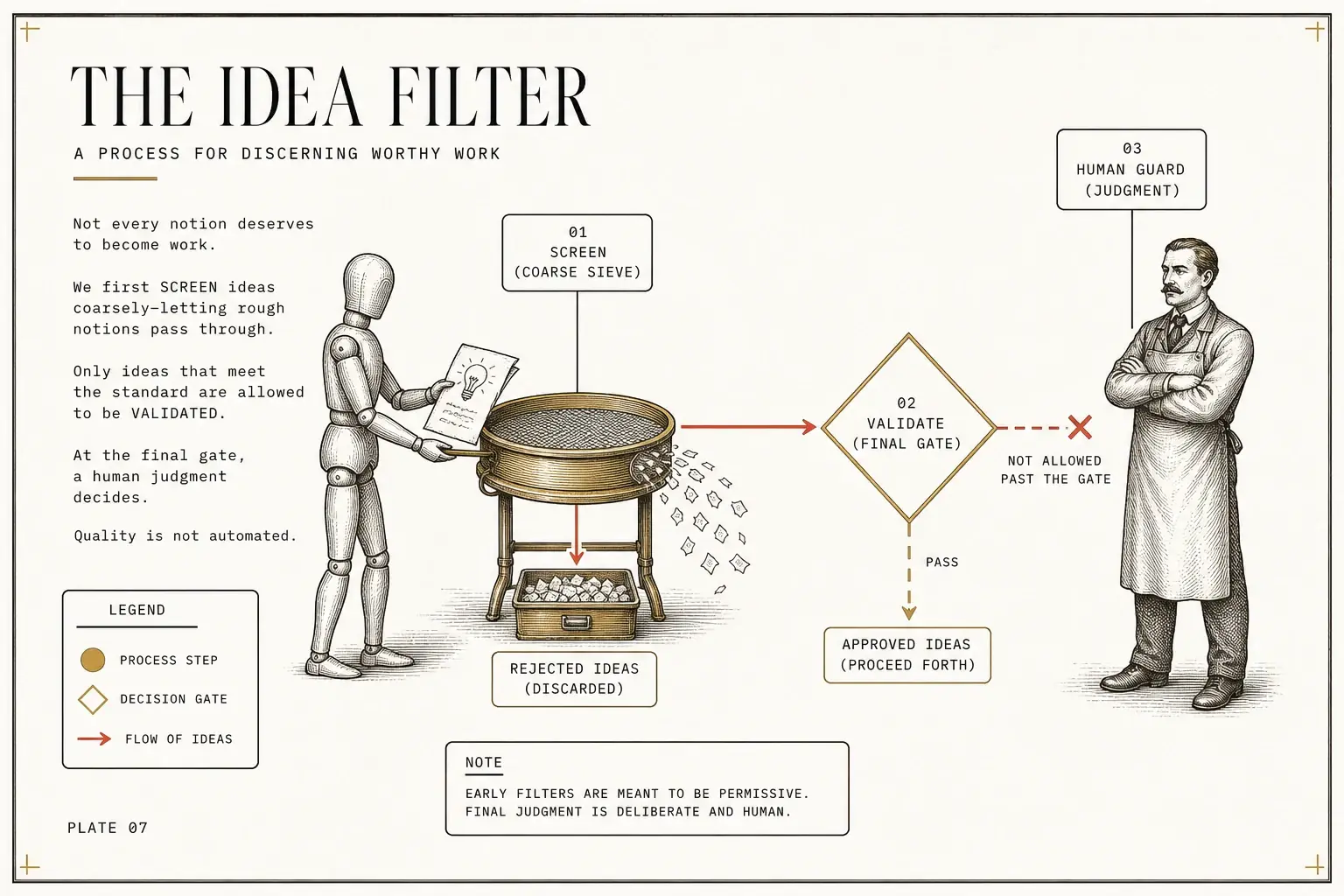
They earn their keep in low-risk, exploratory screening. Pre-testing a questionnaire. Narrowing a field of angles. Sanity-checking a message before you commit budget. Grounding matters enormously here. A persona built on real survey data, like GWI's, built on more than 2 million annual interviews across 50-plus markets, is far more credible than a generic LLM you simply tell to "act like my customer."55 PyMC Labs' rigorous method (translating free text into rating distributions) reached about 90% test-retest reliability and over 85% distributional similarity against 57 real consumer surveys covering 9,300 people.56 Calibrated panels reach 85 to 95% agreement with real panels, versus roughly 55% for a generic LLM prompt.57
| Use synthetic personas FOR (screen) | NEVER use them FOR (validate) |
|---|---|
| Killing obviously weak angles before spend | Confirming a winner you will bet real budget on |
| Pre-testing a survey or a message | A rebrand or any high-stakes decision |
| Exploring segments you cannot reach fast | Treating their output as customer truth |
| Low-risk ad-copy screening | Medium or high-risk calls (those need real humans) |
The reasons for the hard line are specific. A generic "act as my 42-year-old working mom" returns a validating reply that sounds reasonable. It is the AI mirroring your own pitch back to you, a confident hallucination, not real friction.58 Digital twins go uncanny. Asked "do you drink alcohol in the morning?", one said yes and volunteered it was for weddings and work events, the inhumanly thorough answer a real person would not give.59
A 2026 Google DeepMind paper put it plainly: synthetic audiences model how people get talked about online, not people themselves, and their output collapses around stereotypes for niche audiences.60
The cost of forgetting this is real. A DTC brand that built an AI-persona rebrand saw revenue drop 34%, because the personas were averages representing no actual human. Old-school qualitative work revealed what customers actually valued: the 15 minutes of peace the product gave them.61
Treat every vendor's reliability claim as marketing, not proof. Evidenza claims synthetic customers within 95% of human survey results.62 Independent skeptics, citing weak individual-level correlation (around r=0.20) and under-dispersion, argue for excluding synthetic data from serious decisions.63 The standards bodies converge on "augment, do not replace." So: synthetic to screen, real to validate, and the paid test is the only judge that spends real money.
CH.13
Buy the stack to your spend, not the hype
You can run a credible research operation for under about $110 a month in tools, and a strong mid-market one for under about $800. Match the stack to your spend tier, map each tool to a step, and ignore the enterprise suites. At this level the bottleneck is your query and your synthesis, not the platform.
First, the stack mapped to the workflow, by spend tier. All prices as of early-to-mid 2026, and the sales-gated ones are estimates, flagged.
| Workflow step | Scrappy (under $20K/mo) | Mid-market ($20K to $500K/mo) |
|---|---|---|
| Review / VoC synthesis | ChatGPT, Claude, or Gemini (about $20/mo) | plus Atria's Review Mining (bundled) |
| Social listening | Free Reddit search plus Google Alerts or Mention | Brand24 (about $149 to 199/mo) |
| Surveys / interviews | Typeform with AI (about $25/mo) | Strella ($150/mo) or Sprig (about $175/mo) |
| Synthesis / repository | Google Docs plus the LLM | Dovetail (about $15/editor) or Marvin (about $19/user) |
| Ad / angle research | Foreplay ($49/mo annual) | Foreplay plus Atria ($129/mo) or Motion (about $250/mo) |
For the ad-intelligence tools specifically, the ones that show you competitor ads, the honest verdict matters because they look similar and are not.
| Tool | Price (as of) | What it is | Best at | Weak at | Pick it when |
|---|---|---|---|---|---|
| Foreplay | $49/mo annual ($59 monthly). Analytics (Lens) only from the Workflow tier ($149/$175), as of Feb 2026 | Swipe file, ad discovery, competitor tracking, AI brief builder | Collecting and organizing competitor ads, turning a saved ad into a brief fast | No Google or YouTube ad coverage, no creative generation, tells you what is running, not what to fix | You are scrappy and need research plus briefs. Start here |
| Atria | Core about $129/mo | Ad library, analytics, AI ideation, review mining in one | Most features per dollar, mining reviews into briefs | Steep learning curve (assumes you know the metrics), its AI "Clone Ad" distorts products, no video generation | You are mid-market and want one all-in-one tool |
| Motion | About $250/mo up to $50K spend (one source cites a $99 Starter, the figures disagree) | Creative analytics and visual reporting across platforms | Stakeholder-ready reports, finding which hook or format wins in your own account | No ad library, no generation, no review mining, backward-looking, needs about 10 to 15 live creatives to have signal | Your reporting (not your research) is the bottleneck |
A few honest calls. Foreplay is the proven first buy for the research step. Atria is the best mid-market all-in-one if you already read ROAS and hook rate fluently, but its AI generation is the hyped part. Reviewers found the Clone Ad tool "significantly altered the look of my products."64 Motion is excellent reporting and a poor research tool. It measures what you made, it does not tell you what to make.
Social listening
On listening, Brand24 (25M-plus sources including Reddit and forums) is the value pick. Skip the enterprise suites (Brandwatch, Sprinklr, Meltwater at $800 to $10,000-plus a month) at this tier, and remember that 39% of companies now spend over $100,000 a year on listening "while still struggling to get reliable insights out of it."65 The tool is rarely the bottleneck.
Interviews and the tool graveyard
For interviews, Strella runs AI-moderated interviews at $150/mo for 16 completes ($400 for 40), with access to a large global panel and 46-plus languages. It compresses a three-week interview process into days.66 Typeform with AI follow-ups (about $25/mo) is the cheapest entry. The trap all of this solves is the one every operator names: the AI-tool graveyard, where you spend more time switching between five tabs (Claude for strategy, ChatGPT for copy, a spy tool for ads) than actually shipping, re-explaining the audience to each tool in turn.65 Buy fewer tools, map each to a step, keep the human in the verification seat.
CH.14
Three prompts you can paste in today
You do not need code to run an AI research pipeline. You need three good prompts. The first turns hundreds of reviews into a ranked pain-point list. The second turns pain points into angles per awareness stage. The third stress-tests an angle. Each one carries a guardrail that stops the AI from fabricating.
Paste your raw reviews, pains, or angle where the brackets say, in ChatGPT, Claude, or Gemini. For long review dumps, pick a model with a large context window (Claude and Gemini handle several thousand reviews in one go).
Prompt 1, 500 reviews to a ranked pain-point list.
"You are a voice-of-customer analyst. Below are [N] app reviews. Do NOT invent or paraphrase quotes, use only exact text present in the input. (1) Cluster the reviews into themes. (2) For each theme give a label, a frequency count, a severity rating 1 to 5, and 2 to 3 verbatim quotes copied exactly. (3) Tag each theme as Push, Pull, Anxiety, or Habit. (4) Rank themes by frequency times severity. (5) Flag any theme with fewer than 3 supporting quotes as low-confidence. [paste reviews]"
The guardrail: the "do not invent quotes" line plus the under-3-quotes flag are what stop the model from confidently writing "40% of users said…" out of thin air.
Prompt 2, pain points to angles per awareness stage.
"Using ONLY the pain points below, generate ad angles for each of Schwartz's five awareness stages (Unaware, Problem-Aware, Solution-Aware, Product-Aware, Most-Aware). For each angle give the stage, the core promise, a 3-second video hook (12 words max), and which Force of Progress it targets (Push, Pull, Anxiety, or Habit). Do not invent product features not present in the input. [paste pain points plus product facts]"
The guardrail: "no invented features" plus the 12-word hook keep the output shippable and honest.
Prompt 3, stress-test an angle against a skeptic.
"Act as a skeptical [segment] who recently tried and abandoned a competitor. Here is my ad angle: [angle]. (1) React in the first person. (2) List your top 3 objections or anxieties. (3) Rate believability 1 to 10 and say why. (4) Say what would make you stop scrolling. Treat this as a hypothesis to test with real users, not as evidence. [paste]"
The guardrail: the final line, "a hypothesis, not evidence," keeps you from doing the one thing the last chapter forbade, treating a synthetic persona as validation.
One finishing pass on anything the AI writes. It still leaks clichés. AI-drafted copy reliably reaches for "maximize," "amplify," "unmatched," "best in class." Edit those back into your audience's actual language before they go near an ad.36
CH.15
Run the light loop in two days, the heavy loop in two weeks
The system is one loop run at two intensities. The lightweight version takes a day or two and costs almost nothing in tools. The thorough version takes one to three weeks and adds listening, search intent, and real interviews. Both end the same way: a brief that feeds a paid test, whose results feed the next round.
flowchart LR
  R["Research (extract pain)"] --> T["Triangulate (2-plus sources)"]
  T --> M["Match to awareness stage"]
  M --> B["Angle bank plus briefs"]
  B --> P["Paid test (hook matrix)"]
  P --> R
Before either version, run the gate. Confirm acquisition is actually your bottleneck (use AARRR), not activation or retention. Then pick your intensity.
| Step | Lightweight (1 to 2 days) | Thorough (1 to 3 weeks) | Output artifact |
|---|---|---|---|
| Inputs | Your app plus 3 to 5 competitors, Meta plus TikTok ad libraries | plus a 1 to 2 week listening window | scope |
| Pull pain | Export 200 to 500 reviews, filter 2 to 3 stars | plus Brand24 listening, plus a search-intent map (AlsoAsked) | review corpus plus VoC report |
| Cluster | Prompt 1 (verify every quote) | plus 8 to 10 switch interviews (Strella or live) | ranked pain matrix plus switch synthesis |
| Find proven angles | Foreplay teardown of 30-plus-day ads | plus synthesize everything in Dovetail or Marvin | angle teardown board |
| Triangulate | Pain in reviews AND a long-running ad | Pain in 2-plus independent sources | validated-angle bank |
| Generate | Prompt 2 to an awareness-by-angle matrix | plus optional synthetic pre-screen (kill losers) | creative matrix |
| Brief | 5 to 10 concepts on the top 3 angles | 15 to 25 across the full matrix | concept briefs to paid test |
This mirrors the proven shape of a fast voice-of-customer program. User Intuition's VoC-to-Campaign framework compresses the research-question-to-brief cycle to under two weeks, versus the 8 to 12 weeks of traditional qualitative agencies, by running interviews, coding the language into a "language map," and translating it straight into headlines and briefs.33 Every step has a clear input, method, AI tool, and artifact, and each artifact is something you can hand to the next person. The loop closes when the paid test returns. Winning angles go into the bank. Losers get re-examined. The next round starts from a stronger candidate set. After four to six cycles, you are no longer guessing. You are drawing from compounding intelligence.
CH.16
Hook rate tells you in a day, the angle is confirmed downstream
You can read whether an angle resonates within 24 hours from one metric, the hook rate. You can only confirm it converts by following it downstream to revenue and retention. Read the funnel in order, use a simple grid to know what to fix, and never let a clickbait metric fool you into killing a quiet winner.
Three diagnostic metrics, defined.
- Hook rate is 3-second video views divided by impressions. It answers: does the opening stop the scroll? It tells you in a day whether the angle has potential, long before cost stabilizes.
- Hold rate is ThruPlays (sustained views) divided by impressions or 3-second views. It answers: does the body deliver on the hook?
- IPM is installs per thousand impressions, the install-side metric that survives best on iOS, because it sits inside the ad network's own attribution and reports in real time.6
Benchmarks are orientation, not targets. Your own account's median is the real benchmark.
| Metric | Meta | TikTok | What it tells you |
|---|---|---|---|
| Hook rate (3s) | ~25 to 35% | ~30 to 45% (40%-plus is elite) | Does the angle stop the scroll? (read in 24h) |
| Hold rate | ~35 to 50% | ~40 to 55% | Does the body pay off the hook? |
| Downstream | CTR, CVR, CPI, ROAS, D7 retention | same | Did it drive quality installs? |
Then read the funnel in order: hook rate, hold rate, then CTR (click-through rate), CVR, CPI, ROAS, retention. For subscription apps especially, the metric that actually matters is trial-to-paid conversion (median 34.8%, upper quartile 51.5%), not install volume. A creative that drives cheap installs at poor trial conversion is not a winner no matter how high its click rate.6 Use this grid to know what to fix.
| Low hold rate | High hold rate | |
|---|---|---|
| Low hook rate | Concept fails, test a new angle | (rare) |
| High hook rate | Strong open, weak body, fix the body | Scale candidate. If CPA is still bad, fix the landing page or offer, not the creative |
The way you fool yourself here is by trusting the wrong number. CTR influences only about 4% of ROI on SKAN, so optimizing on clicks gets you clickbait that does not install.6 Creative quality drives 50 to 70% of the variance in CPI, and the top 10% of creatives generate 80%-plus of installs, so one great angle outweighs a hundred tweaks.10 Do not change the hook, the visual, and the CTA all at once, or you get noise instead of a signal. The cost of getting this wrong is visceral. One team described a creative whose fatigue score looked fine while the real problem was a 6-second page load, chasing the wrong metric while the actual issue hid in plain sight.6
CH.17
Design the test so the algorithm can actually read the angle
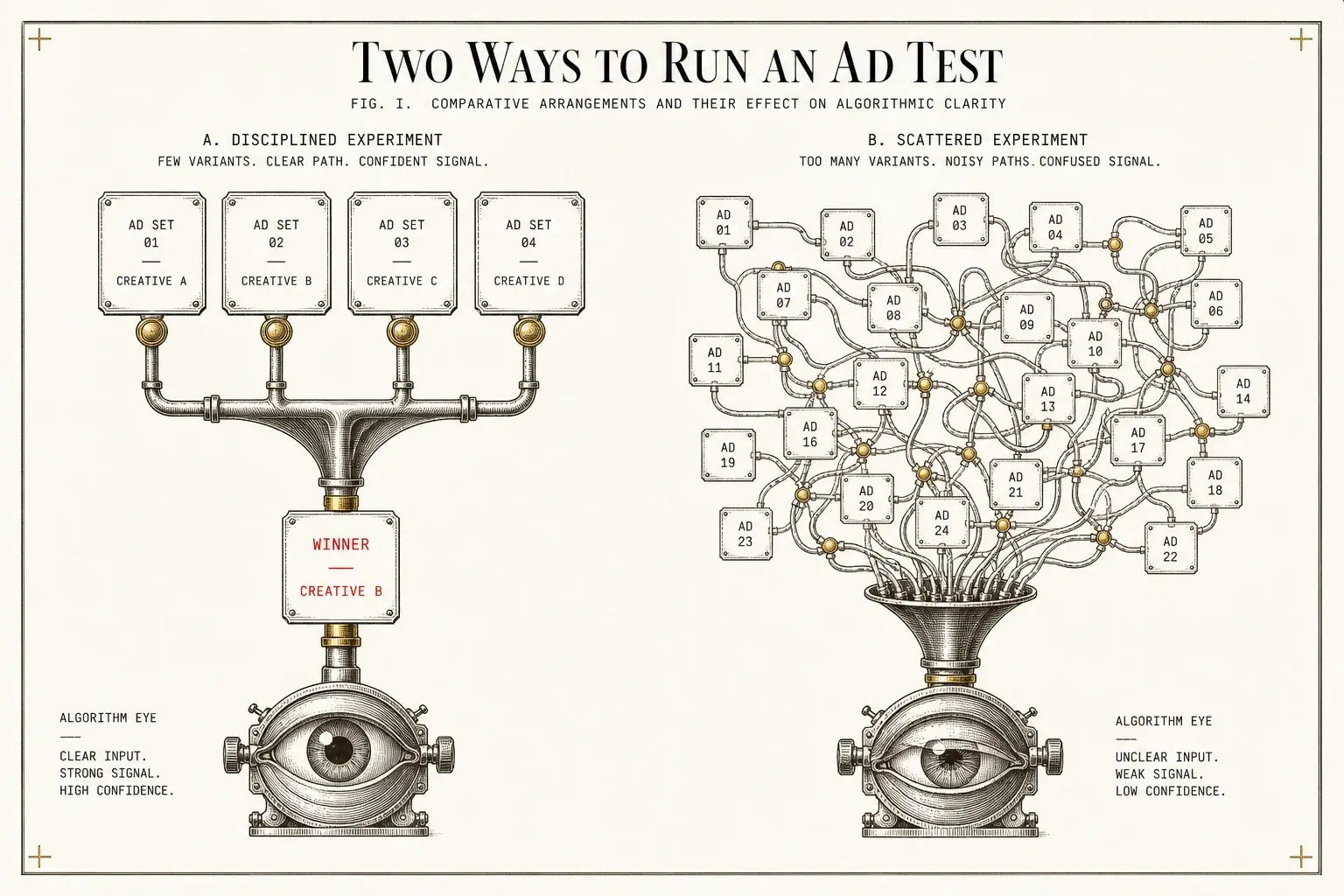
A test only teaches you something if you isolate the variable and give the algorithm enough time and data to learn. That means forcing equal spend across your angles, turning off the platform's auto-remixing, consolidating instead of fragmenting, and the rule that saves your best creative: never kill on day 3.
The rules, in order of how often a junior breaks them.
- Use ABO, not CBO, for the test. ABO (Ad Set Budget Optimization) lets you set an equal budget per angle, so each one gets a fair read. CBO (Campaign Budget Optimization) concentrates spend on early winners and starves the rest before they are tested. Save CBO for scaling a proven winner.67
- Turn Advantage+ Creative OFF during testing. It silently remixes your headlines and re-crops your images, which destroys variable isolation. You would credit a "winning ad" to the wrong element.67
- Consolidate, do not fragment. The strong shape is one campaign per objective, one ad set with 10 to 50 diverse creatives, broad targeting, and a weekly feed of new concepts. Fragmented structures starve the algorithm of the data density it needs.9
- Change one variable at a time. A hook matrix (say 5 hooks by 2 angles) isolates exactly what moved.
- Give it about 50 conversion events. Meta's delivery system needs roughly 50 optimization events per ad set within a 7-day window to exit the "learning phase," the noisy period right after launch. Editing before that resets the clock.67
- Kill on hook rate fast, but not on cost early. Pause a creative whose hook rate is below about 25% after 24 to 48 hours and 1,000 impressions (below 30% after 1,500 on iOS). Do not kill on day-1-to-3 cost. That is noise.67
The day-3 kill is the trap that throws away your best creative. Andromeda's learning needs 5 to 7 days to stabilize, and on iOS the signal arrives in waves. SKAN's first postback covers days 0 to 2, the third covers days 8 to 35. A creative with a weak first postback but a strong third postback (good late-stage value) is the highest-value win you can find. Kill it on day 3 and you lose your LTV creative entirely.67
Two more guardrails. Cap parallel concepts at 3 to 5 per round on iOS, or you fragment installs into coarse buckets SKAN cannot read.67 And do not build more than about 5 audience segments in the first two weeks. A segment getting fewer than 50 conversions a week cannot be reliably optimized.27
When the test returns, feed the winning angle into the bank and re-examine the losers. Was it the angle, or the execution? The discipline here is genuinely hard, because the kill decision feels different at different budgets. One team could not pull the trigger on a failed shoot worth $20,000, while another shrugged off killing a $300 concept board. The difference was not data literacy. It was the invoice. Pre-written kill thresholds are what let a team name the kill without naming the person.68
CH.18
The fastest ways to fool yourself, and the lines you cannot cross
Two kinds of mistake will sink this system. The biases that make bad research look good, and the legal lines that make smart research illegal. Triangulate and verify to beat the first. Prefer official tools and respect consent to stay clear of the second.
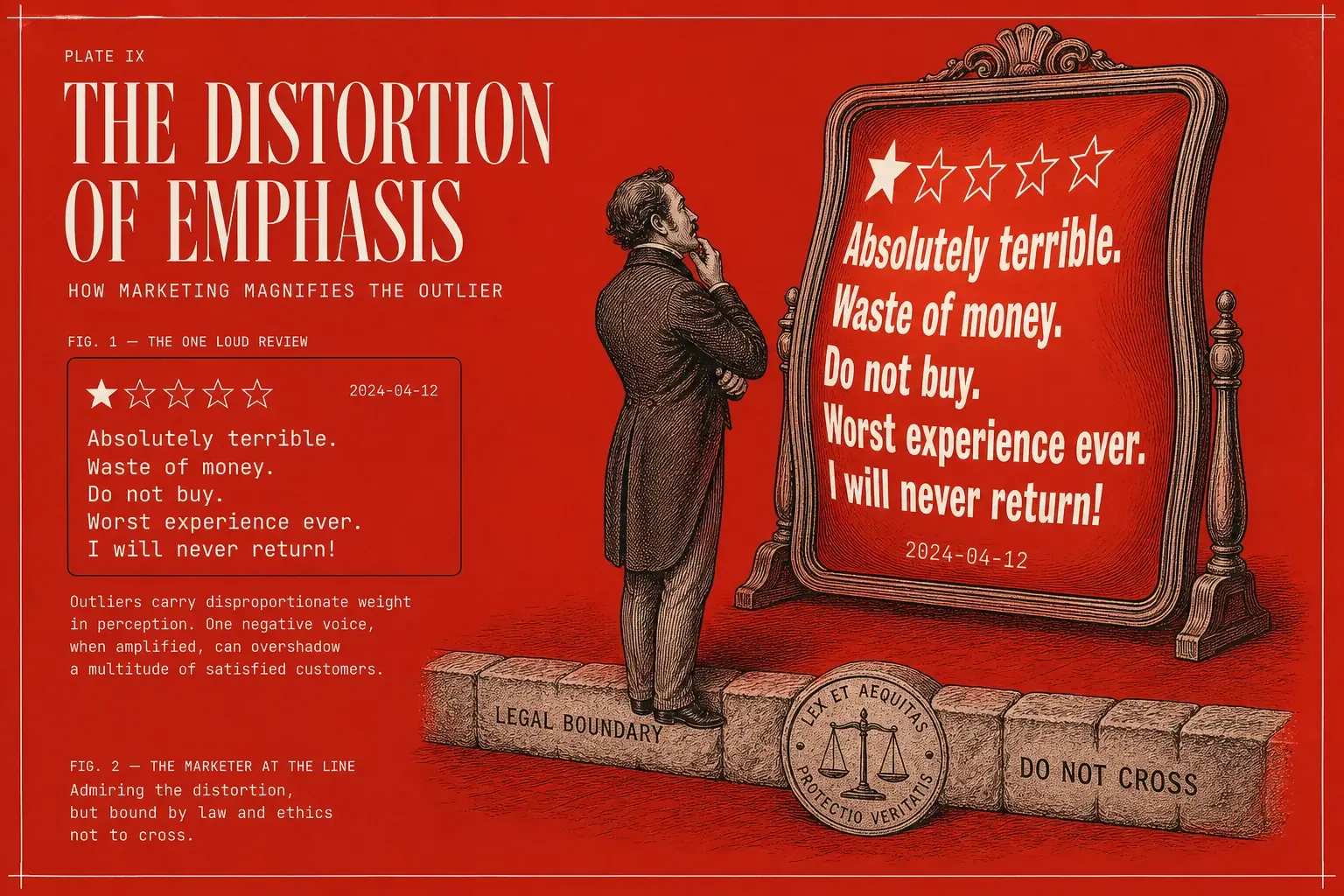
The research biases that quietly corrupt your angle bank, and the guardrail for each.
| The trap | What goes wrong | The guardrail |
|---|---|---|
| Confirmation bias | You mine for quotes that fit the angle you already chose | Decide the angle after the data, not before |
| Survivorship bias | Reviews over-represent the delighted and the furious (the J-curve) | Mine reviews for language, not for "how good." Triangulate |
| Vocal-minority bias | The loudest Reddit thread is not the pattern | Require repetition across 2-plus independent sources |
| AI fabrication | Invented quotes and statistics that "sound right" | Verify every quote and number against the source |
| Analysis paralysis | Waiting for perfect data | 20 to 30 data points across sources is enough to act |
The compliance lines you genuinely cannot cross. This is a practitioner summary, not legal advice, and worth a counsel check for EU data.
| Line | The rule | What to do instead |
|---|---|---|
| Scraping ad libraries | A 2024 US ruling (Meta v. Bright Data) found logged-out scraping of public data does not violate Meta's terms. Scraping while logged in likely does | Prefer official APIs and vendor tools (Foreplay, Atria), they shift the burden |
| "Public means free to use" | False under GDPR. There is no general exception for publicly available data, and you need a lawful basis (the Clearview AI cases settled this) | Do not store personal identifiers from scraped reviews, analyze in aggregate |
| Bypassing logins | Never bypass authentication (criminal under the CFAA and equivalents) | Respect robots.txt, use what is openly accessible |
| Platform ad policy | Mined health or finance pain can become a prohibited "personal attributes" claim on Meta ("Struggling with debt?") | Review every angle against ad policy before testing |
| AI data-handling | Do not paste first-party user PII into consumer LLM tiers, and check whether the vendor trains on your inputs | Use enterprise or zero-retention tiers for sensitive voice-of-customer data |
One more honesty note on the methods themselves. When researchers tried to reproduce popular opinion-mining techniques, the accuracy did not hold up. They performed worse than the original papers claimed.37 So treat any accuracy percentage you cannot audit (including a vendor's) as a claim, not a fact. Triangulation and verification are cheap insurance against an expensive, confident wrong answer.
CH.19
The angle bank is what turns a lucky win into a system
The difference between a one-off win and a repeatable system is memory. A validated-angle bank, every winning angle tagged with the pain that birthed it, the awareness stage it served, and the result it produced, is the asset that compounds. Without it, your team rediscovers the same patterns every quarter, and your best insight walks out the door when someone changes jobs.
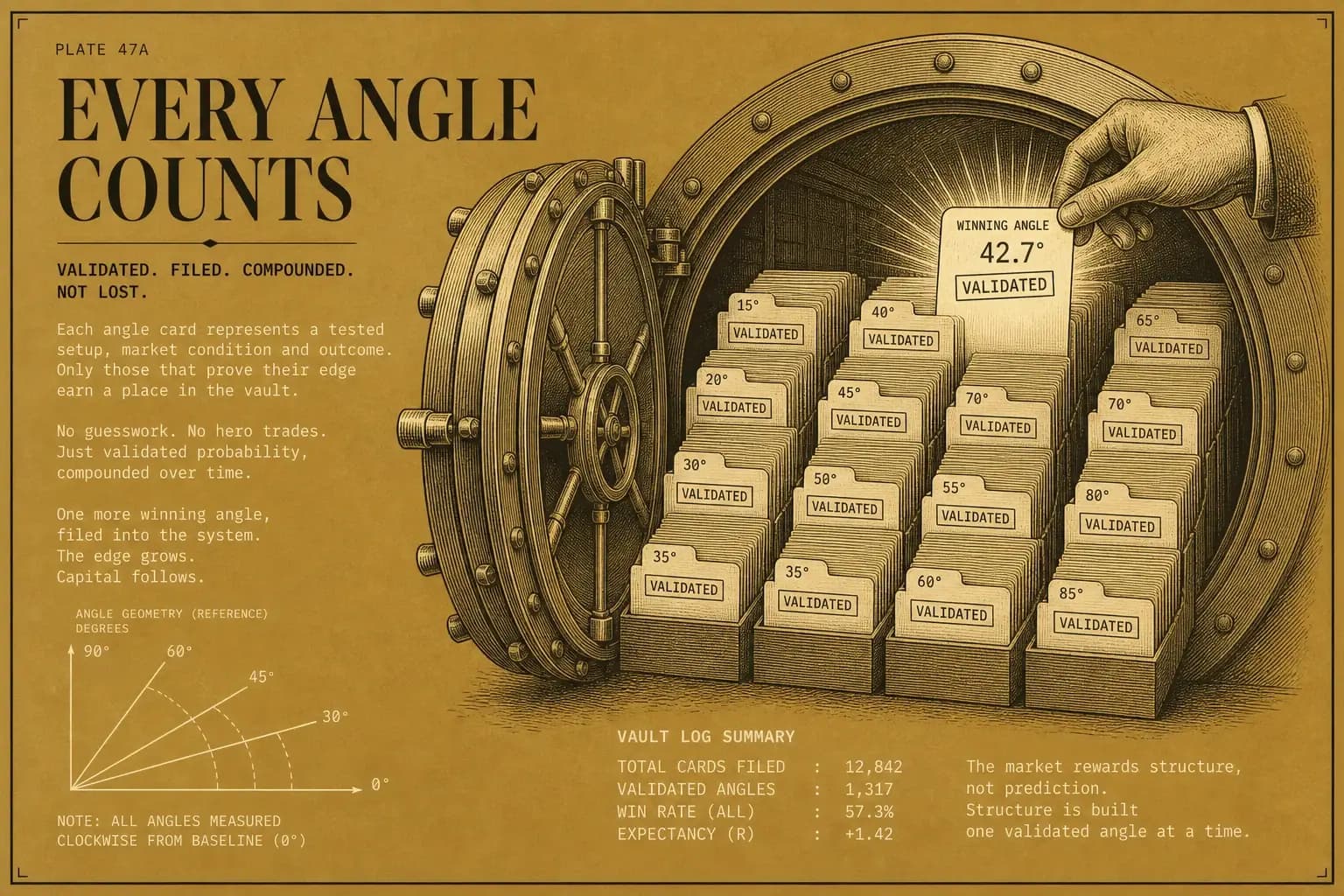
The cost of not having one is concrete. In one large brand portfolio, a manager pivoted an audience mid-campaign and drove sales up 58% year over year, a top-five outcome in the brand's history. Six months later that manager rotated out, the next campaign started from a clean planning sheet, and a year after that a new team facing the identical setup made a different call. The 58% pattern was completely forgotten.69 Millions of decisions get logged across an org. Almost none transfer.
Before, a sprint:
- Angles live in someone's head and a Slack thread
- A win gets celebrated, then its specifics evaporate
- Next quarter starts from "what should we test?"
- The swipe file is a graveyard nobody opens
After, a system:
- Every angle tagged: source pain, awareness stage, hook, result
- Winners surface in 60 seconds when you write the next brief
- Next quarter starts from "here is what's proven, here is the next bet"
- The bank is the asset, and it gets richer every cycle
Keep it alive on a simple cadence so it does not rot.
- Monthly, pull your top 10 performers and re-tag them.
- Quarterly, run a decay check and archive any entry older than six months that is scoring at the bottom.
- Annually, rebuild the baseline from 30 to 50 current category leaders.39
Skip this and you become the documented failure mode of every team that treats research as a project with an end date. They rediscover the same patterns every quarter, and the swipe file becomes a graveyard.36 Build it and you have what Hannah Parvaz built one interview at a time. Not a clever guess. A compounding library of the words your customers actually use.12
That is the whole shift. You started by guessing angles, fragmenting audiences, and arguing about button colors. You end with a loop that mines real pain, hands the algorithm what it rewards, and remembers what worked. So the next ad is not a bet. It is a withdrawal.
The 3 skills behind this note
- Sign in to open
Audit competitors
Audit the FAILURES and SUCCESSES of competitors in our field (AI content publishing + automation) into rank...
- Sign in to open
Write the X posts
Writes ONE source (a research run, the canonical article, or a raw file) into an X/Twitter-native SHORT-FOR...
- Sign in to open
Write the LinkedIn post
Turns ONE source (a research run, the canonical article, or raw notes) into a native LinkedIn package
KEEP GOING
Take this with you.
Sources · 70
Sources
-
CreaScale, The PDA Framework Explained. An A/B test of six AI ad generators on a live Shopify store found image quality barely correlated with CTR, and angle psychology drove the entire result. ↩ ↩2
-
ATT opt-in figures disagree by methodology. 35% of prompted users per Adjust's Tiahn Wetzler (2025-07-15), versus a 13.85% global "yes" rate for immediate-prompt apps per Singular and Purchasely (via the operator research brief). Background: Adjust, What is App Tracking Transparency and RocketShip HQ, How ATT changed mobile advertising. ↩
-
vmobify, Mobile App Creative Strategy 2026. Meta research: creatives drive about 56% of incremental app installs, more than targeting and bidding combined. ↩ ↩2 ↩3
-
audiencelab, Creative Testing at Scale. Nielsen and Google converge on creative being about 56% of performance variance, with a 3.2x spread between best and worst creative at equal budget. ↩
-
Segwise, Creative Research Pre-Brief Playbook. AppsFlyer's 2025 Creative Report (1.1M video ads, 1,300 apps): the top 2% of creatives capture 53% of gaming and 43% of non-gaming spend. ↩
-
Airbridge, How to Test App Ad Creatives Without Burning Budget. About 50% scroll past by the 3-second mark. CTR is about 4% of ROI on SKAN. IPM survives best on iOS. Subscription trial-to-paid median 34.8%, upper quartile 51.5%. The 6-second page-load fatigue example. Contextual-paywall alignment. ↩ ↩2 ↩3 ↩4 ↩5 ↩6
-
Jetfuel Agency, Meta's 2026 Algorithm Update, What Andromeda Changed. Broad targeting with differentiated creative outperforms 1% lookalikes. Advertiser audiences are suggestions, not gates. Creative quality is about 56% of campaign performance. ↩
-
RocketShip HQ, Creative Testing vs Audience Testing. Creative testing is the highest-impact activity, and audience testing is secondary because Advantage+ handles targeting. ↩
-
Christopher Marrano (LinkedIn). Consolidating 8 campaigns to 2 dropped CPMs 20% and CPAs 35% within days. The 1-campaign, 1-ad-set, 10-to-50-creatives formula. Fragmented structures starve the algorithm. ↩ ↩2 ↩3
-
Layer.ai, UA Creative Testing. Creative quality accounts for 50 to 70% of CPI variance. The top 10% of creatives generate 80%-plus of installs. Creative resets auction dynamics. ↩ ↩2
-
Pinnora.ai (Medium), How to Automate High-Level Creative Testing Roadmaps. Angles carry about 70 to 80% of performance variation on Meta. An angle is the emotional belief shift. ↩ ↩2
-
RocketShip HQ, Golden Nuggets, Mobile Ad Hooks from Customer Reviews. Hannah Parvaz at Curio scheduled 1:1 interviews, listened for the repeating word ("seem"), and followed it to the motivation. The best hooks are discovered, not invented. ↩ ↩2 ↩3
-
Fill the Funnel, Steal Your Audience's Exact Words With AI Prompts. "You write about 'optimizing workflow efficiency.' Your reader is sitting there thinking, 'I am completely drowning, and nothing ever gets done.'" ↩
-
AI Prompt Hackers, 8 AI Prompts to Uncover Hidden Customer Pain Points. Shame-based complaints are where the best converting copy lives. The said-versus-meant and before-state-excavation prompts. ↩
-
Sprites.ai, Turn Twitter Complaints into Ad Copy. SURI trained a custom GPT on more than 15,000 Trustpilot reviews to extract "love" phrases and pain points ("gunk," "batteries"), fueling three-second hook variations and 5,000-plus unit sales in week one. ↩
-
Koro, AI Success Metrics. Koro's AI scanned reviews for Urban Threads, found "deep pockets" was a hidden selling point, auto-generated static ads, replaced a $5,000-a-month agency, and lifted Ad Relevance Score from Average to Above Average. ↩
-
Abancommercials, How to Use Customer Feedback to Improve Your Ads. The feedback-to-creative taxonomy (pain to hook, outcome to benefit, objection to copy, language to headline). Pattern identification requires 10-plus customers. The meal-prep use-case example. ↩ ↩2
-
BrandGene, Customer Reviews to Ad Creatives. Repeated benefit to main angle, specific phrase to headline, use case to scene, emotional payoff to CTA mood. ↩
-
Emilis Karvelis (LinkedIn). One product (creatine gummies) sold to gym-goers, busy moms, students, office workers, travellers, and seniors. Opening new audiences for one product is the biggest lever. ↩
-
Koji, Jobs-to-Be-Done Interview Guide 2026. People "hire" products to make progress. Ten to fifteen switch interviews within a segment reveal the dominant patterns. ↩ ↩2 ↩3
-
Brian Rhea, Customer Acquisition and Retention with Forces of Progress. Push plus Pull must outweigh Anxiety plus Habit. The CRM 100-row free-test example. Moesta's "you would never see a 20-year-old driving a BMW" critique of demographics. ↩ ↩2 ↩3
-
Yu-kai Chou, Jobs-to-be-Done: Christensen's Milkshake Framework. Do not conflate the three JTBD schools (Christensen narrative, Ulwick quantitative ODI, Moesta demand-side). JTBD's reliance on retrospective verbal reports is a limitation. ↩
-
Frameworklist, Jobs-to-be-Done Framework Explained. Christensen's McDonald's milkshake study (about 40% bought before 8am by commuters). The B2B "Excel plus an internal champion" and consumer-app "feel productive while procrastinating" reframes. ↩
-
Motion, The 5 Customer Awareness Stages in DTC Advertising. Eugene Schwartz's Unaware, Problem, Solution, Product, Most-Aware. The leaky-funnel failure of over-investing bottom-funnel. ↩
-
Hawky.ai, 5 Customer Awareness Stages. Market distribution about 60% Unaware, 20% Problem, 10% Solution, 7% Product, 3% Most-Aware. Product ads to cold Unaware audiences produce clicks but no conversions. The 20-to-30, 20-to-30, 40-to-50 budget split. ↩ ↩2 ↩3 ↩4
-
Spark UGC, The 5 Stages of Awareness Applied to UGC Ads. Stage-specific hooks ("Nobody told me…", "If you've tried every…"). Five awareness scripts prevent Andromeda's over-60%-similarity suppression. ↩ ↩2
-
Playablemaker, Awareness Stage Advertising for Mobile Gaming in 2026. Awareness content needs 90 to 180 days to show impact. Avoid more than five audience segments in the first two weeks. A segment with fewer than 50 conversions a week cannot be reliably optimized. ↩ ↩2
-
Qualz.ai, Jobs-to-Be-Done Interviews. The Switch protocol reconstructs four moments: First Thought, Passive Looking, Active Looking, The Decision. ↩
-
Frameworklist, Jobs-to-be-Done Framework Explained and Product Talk, Automating Customer Interviews at Zonar. Walk the timeline backwards and anchor on specific recent events ("What time of day? Was the TV on? Who were you with?") to trigger authentic recall. ↩
-
Jobs-to-be-Done Radio, Unpacking the Progress-Making Forces Diagram. The "dining-room-table anxiety" surfaced in 3 of 4 interviews. Once something comes up three times by the fourth interview, "you know there's something there." ↩
-
RevenueCat, Review Mining for Subscription Apps. Juliana Jackson: only about 5% of the customer's path is in-app. Systematize at more than 5,000 reviews and more than 100 a month. The "old-school thief… exhausting after a few hundred reviews" confession. Enrich first-party data with qualitative and search-intent (the triangulation principle). ↩ ↩2 ↩3 ↩4
-
Kodekam, Find Market Gaps Using Competitor Reviews. Focus on detailed 2-, 3-, and 4-star reviews (not 1-star outbursts or 5-star fluff). Tag by underlying job or gap. ↩
-
User Intuition, Voice of Customer Programs for Marketing Teams. The unit of useful VoC is a phrase, not a theme. The VoC-to-Campaign framework compresses research-question-to-brief to under two weeks versus the 8 to 12 of traditional agencies. ↩ ↩2
-
Appaca, Review Miner, Pain Points. The six pain types (Outcome, Process, Time, Money, Trust, Social or identity), ranked by frequency, intensity, and purchase-impact, with verbatim quotes. ↩ ↩2
-
Appbot, How to Analyze App Store Reviews. Cross-reference AI sentiment with the star rating to catch sarcasm (a 1-star "positive" is almost always sarcastic). Claimed about 93% accuracy trained on app-store language. ↩
-
Varnan-Tech, app-store-review-arbitrage SKILL. complaint_weight equals (4 minus rating) times recency_factor (1.0 for 90 days or newer, 0.7 for 91 to 365, 0.4 for older). Cluster names use the exact verb and noun. Themes with fewer than 3 reviews are discarded. The banned-cliché list. ↩ ↩2 ↩3
-
Datashake, App Store Review Data API Access in 2026. Star ratings follow a J-shaped distribution (forced reviews come out about normal, 3% top and 7% lowest). Popular opinion-mining techniques failed to reproduce. ↩ ↩2
-
AppFollow, How to Conduct Market Research. Semantic Analysis groups reviews by topic across 20-plus languages and 30 tags, weeds out spam, and works on competitor reviews. ↩
-
AdLibrary, The Competitor Ad Analysis Manual. Ad longevity (30-plus days) as the profitability proxy. The 6-phase teardown and 8-field ledger. IAB 2025: 74% of advertisers use ad-library data as primary input, and systematic teams report 2.3x testing velocity. The winning-elements database maintenance cadence (monthly re-tag, quarterly decay-check, annual rebuild). ↩ ↩2 ↩3 ↩4 ↩5 ↩6 ↩7
-
AdLibrary, EU DSA Ad Repositories for Developers. DSA-mandated public ad repositories carry creative, advertiser identity, payer, run dates, and per-member-state reach, kept one year after the last impression. ↩
-
AppDrift, Competitor Analysis. A sudden drop in a competitor's rating is a timestamped signal that a specific pain is currently acute, prime timing to launch ads naming that pain. ↩
-
Anushree Sharma (LinkedIn), The Reddit Method. Turning "an angler" into "Jake, 35, Minnesota, kayak, freezing fingers." Search niche subs, watch high-engagement comments, note exact language. ↩ ↩2
-
Reddit for Business, How Reddit Drives Higher LTV for Mobile Gaming. Adjust data: Reddit-acquired users show 22% higher D30 retention, 136% higher D1 spend, and 200% higher LTV in the first 30 days versus other social platforms. ↩
-
Mobidictum, Monitoring Community Conversation, Where Are Players?. Different channels tell different stories. Treat an issue as real only when it repeats across channels and persists. Do not react to the loudest platform. ↩ ↩2
-
AppTweak, How to Choose the Right AI Tool for ASO. Read the search results page for intent, not the keyword. AppTweak flagged a mid-2025 Apple search-algorithm shift toward more search-intent diversity. ↩
-
John Parvu, Your Best Ad Copy Is in Your Support Inbox. Mining 30 reviews and 10 support tickets yields 3 problem phrases (hooks), 3 hesitations (objection-handling), and 3 specific results (proof). ↩
-
Pelin.ai, Turning Support Tickets into Product Insights. Categorize tickets, find patterns by frequency and trend, root-cause with the 5 Whys, prioritize by frequency plus severity plus trend. ↩
-
Helpshift, Player Sentiment Analysis. Support tickets are the most accurate signal (the full affected population at the moment of friction), versus lagging reviews and survivor-biased surveys. ↩
-
Usercall, How to Avoid Fake AI Qualitative Research. "It reads like research. It is extrapolation." Verify wording, attribution, and context for every AI-surfaced quote, because models paraphrase, modify, combine, and misattribute. ↩ ↩2
-
Sachin Rekhi, AI-Powered Customer Discovery. Always ask the AI to show the exact verbatims under each theme, to verify and to keep building your own intuition. ↩
-
svetkis, triage-and-voice (GitHub). Air Canada's chatbot hallucinated a bereavement-refund policy for a grieving customer, and a tribunal forced the airline to honor the policy it never had. ↩
-
Eshu Marneedi. Apple Intelligence stamped a fabricated summary on a real BBC headline, making readers believe the false summary came from the BBC. ↩
-
Mint.ai, When AI Gets It Wrong. AI hallucinations caused an estimated $67.4 billion in losses in 2024. Leading models hallucinate 15 to 27% of the time depending on task complexity. ↩
-
Monigle, AI in Market Research. Synthetic respondents show only about 60% consistency across question formats, and research fraud costs $350 million-plus annually. AI is good at theme analysis with verification but fails as unvalidated synthetic primary data. ↩
-
GWI, Synthetic Personas: The Complete Guide. Survey-grounded personas (built on GWI's 2 million-plus annual surveys across 50-plus markets) are far more credible than generic-LLM role-play. The four-approach hierarchy. ↩
-
PyMC Labs, Synthetic Consumers: A Practical Guide. The Semantic Similarity Rating method reached about 90% test-retest reliability and over 85% distributional similarity across 57 real surveys (9,300 participants). ↩
-
neuroflash, Benchmarking Synthetic Audience Accuracy. Calibrated AI panels reach 85 to 95% parity with real panels versus about 55% for generic LLM prompts (vendor-adjacent, read as marketing). ↩
-
LBB Online, Why 'Just Ask AI' Isn't a Research Strategy. A generic "act as a 42-year-old working mom" returns a validating "confident hallucination" that mirrors your own pitch back, not real friction. ↩
-
Digiday, WTF are synthetic audiences?. A digital twin asked about morning drinking answered yes and volunteered "for weddings or work events," the inhumanly thorough tell. Best used as a first step to weed out ideas, then test with humans. ↩
-
Advertising Week, Synthetic Audiences Don't Model People. A 2026 Google DeepMind paper: synthetic audiences model how people get talked about online, not people themselves, and collapse around stereotypes for niche audiences. ↩
-
Sagum, The Dangerous Truth About AI Market Research. A DTC brand's AI-generated-persona rebrand saw revenue drop 34%, because personas were averages of no real human. Old-school qualitative work revealed the real value (15 minutes of peace). ↩
-
CMSWire, Is Persona Research Ready for an AI-Powered Overhaul?. Evidenza claims synthetic customers within 95% of human Global Brand Survey results (a vendor claim). ↩
-
Replism, The State of Synthetic Audiences 2026. Skeptics cite weak individual-level correlation (about r=0.20) and under-dispersion ("funhouse mirror"). Standards bodies converge on "augment, do not replace." ↩
-
Hackceleration, Atria Review 2026 and Listicler, Atria vs Foreplay. Atria Core about $129 a month with Review Mining. Documented Clone-Ad quality issues ("significantly altered the look of my products") and a steep learning curve. ↩
-
Nextiva, Best Social Media Listening Tools and YouScan, How to Choose the Right Social Listening Tool. Brand24 (about $149 to 199 entry, 25M-plus sources including Reddit and forums) as the value pick. 39% of companies spend $100,000-plus a year on listening and still struggle to get insight. Avoid enterprise suites at this tier. ↩ ↩2
-
Strella, an AI-moderated interview platform. Pricing $150 a month (16 completes) and $400 a month (40), access to a large global panel via a User Interviews partnership, 46-plus languages. Compresses a roughly three-week interview process into days. Figures per the operator research brief (Bessemer Venture Partners coverage of Strella). ↩
-
Segwise, How to Test Creatives in the iOS Era and Chatterbuzz Media, Ad Creative Testing. Use ABO to force equal spend for isolation (CBO scales winners). Turn Advantage+ Creative OFF during testing. About 50 events to exit the learning phase. Kill on hook rate (under 25%, or under 30% on iOS) but not on day-1-to-3 cost. SKAN postback windows (0 to 2, 3 to 7, 8 to 35 days) mean a weak postback-1, strong postback-3 creative is a high-value win to keep. Cap parallel concepts at 3 to 5 on iOS. ↩ ↩2 ↩3 ↩4 ↩5 ↩6
-
LSA Global, Project Postmortem Facilitation and Apex Brands, How to Test Creative Concepts Before Launch. The kill decision feels different at a $20,000 shoot than a $300 board. Pre-written, agreed thresholds let a team name the kill without naming the person. ↩
-
A.Team, The $75M Playbook Hiding in 1.5 Years of Campaign Data. A manager's mid-campaign pivot drove 58% year-over-year growth (a top-five outcome). Six months later the manager rotated out, the next campaign started from a clean sheet, and the pattern was forgotten. ↩
Loading the discussion…
Sign in to join the discussion. It's free.