X / Twitter growth — 2026-06-30PUBLIC
How X/Twitter growth actually works in 2026: pass the AI's value prediction, then out-system everyone
X reach in 2026 is decided before anyone sees your post, by an AI value prediction. I mined 23,000 automation posts to find the levers that actually move reach, why follower count is the wrong scoreboard, and how to separate reach from revenue.
≈ 45 min read
An operator does everything the growth courses still preach:
- Three posts before noon.
- A hundred "great insight" replies dropped under big accounts.
- The feed refreshed like a slot machine.
Then he posts the thing he actually built, a real launch, a real announcement, and it reaches three people. Not three thousand. Three. His own followers never see it, because he burned the day's reach on "GM" replies and the machine quietly filed his best work in the void. One account I pulled put crypto Twitter's version of this in three blunt words: "dying from suicide." Now look at the account out-reaching him.
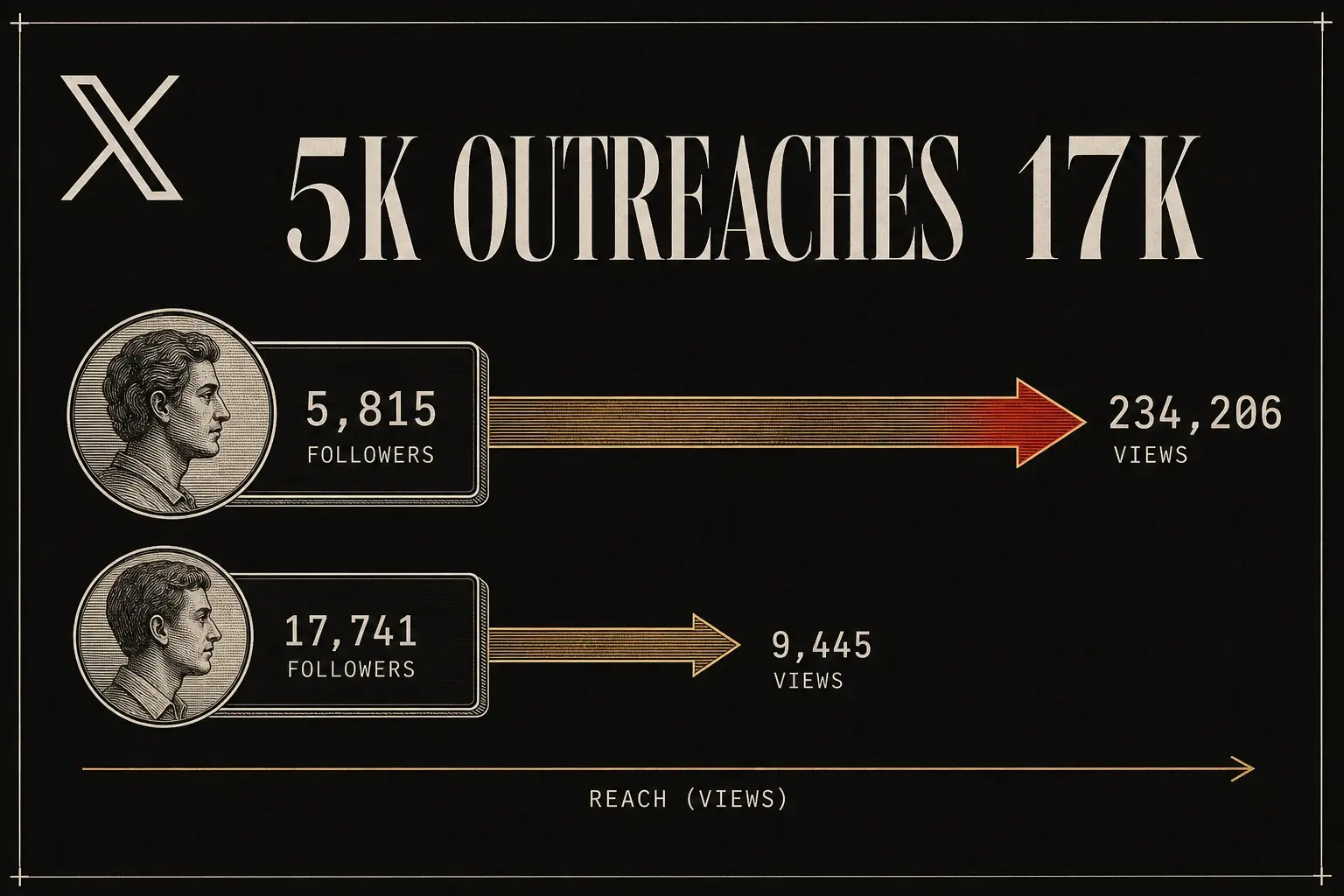
| Account | Followers | Median views |
|---|---|---|
| Account A | 5,815 | 234,206 |
| Account B | 17,741 | 9,445 |
Real accounts from my corpus, names withheld here since they're a data point in a comparison, not a credit. The full breakdown with sources lives on pravda.systems.
Account A's median is more than 40x its follower count. Account B, with three times that audience, gets a twenty-fifth of the reach. The gap isn't talent and it isn't luck. One account treats posting as a system the machine rewards. The other broadcasts and hopes. Here's the shift almost everyone missed, the one that quietly retired the old playbook:
X stopped counting reactions after the fact and started predicting them before anyone sees your post.
An AI ranking layer reads the words of every post and scores its predicted value to one specific reader, then decides how far to push it. None of the old tricks survive a model that judges substance instead of tallying signals:
- Engagement pods
- "like this if you agree"
- mass-follow waves
- copy-paste threads
So I did the obvious thing: I mined a corpus of 23,234 posts from 7,526 accounts in AI-automation X to find out what actually correlates with reach. This note is that system, in order:
- Pass the AI's prediction in the first window.
- Stack the measured mechanical levers.
- Separate reach from revenue with a layered offer.
- Trust the data over your follower count, because follower count is the wrong scoreboard, and I have the numbers to prove it.
CH.01
What did the X algorithm actually become?
The shift from heuristics to AI ranking is structural. The model now reads the text of every post and estimates its value, relevance, and originality for a specific reader, instead of counting reactions after the fact. The old algorithm was rule-based: fixed if-then boosts fired when a post crossed an engagement threshold, so "like this if you agree" was a real tactic because the system literally counted the likes. That lever is gone overnight, which is exactly why begging for engagement stopped working.
flowchart TD
    Y["Your post"] --> S["One attention slot in one reader's feed"]
    O["Every other author"] --> S
    S --> K["Ranker keeps the reader, not the creator"]
The frame most people miss: the ranker is reader-centric, not creator-centric. It is not hunting for viewers for your content. It is hunting for the best content for its viewers, they generate the ad revenue, they are the ones it has to keep.
You aren't fighting the algorithm. You're competing against every other author for one attention slot in one person's feed.
Internalize that and every later decision simplifies. You stop asking "how do I get reach?" and start asking "why would this exact reader give this their next thirty seconds?" A second change reinforces it: the feed is matched to interests, not only to accounts followed, so a post with a tight, consistent topic signal can surface in front of strangers in a dedicated interest cluster. Niche focus now beats broad appeal because a sharp signal is something the machine can route.
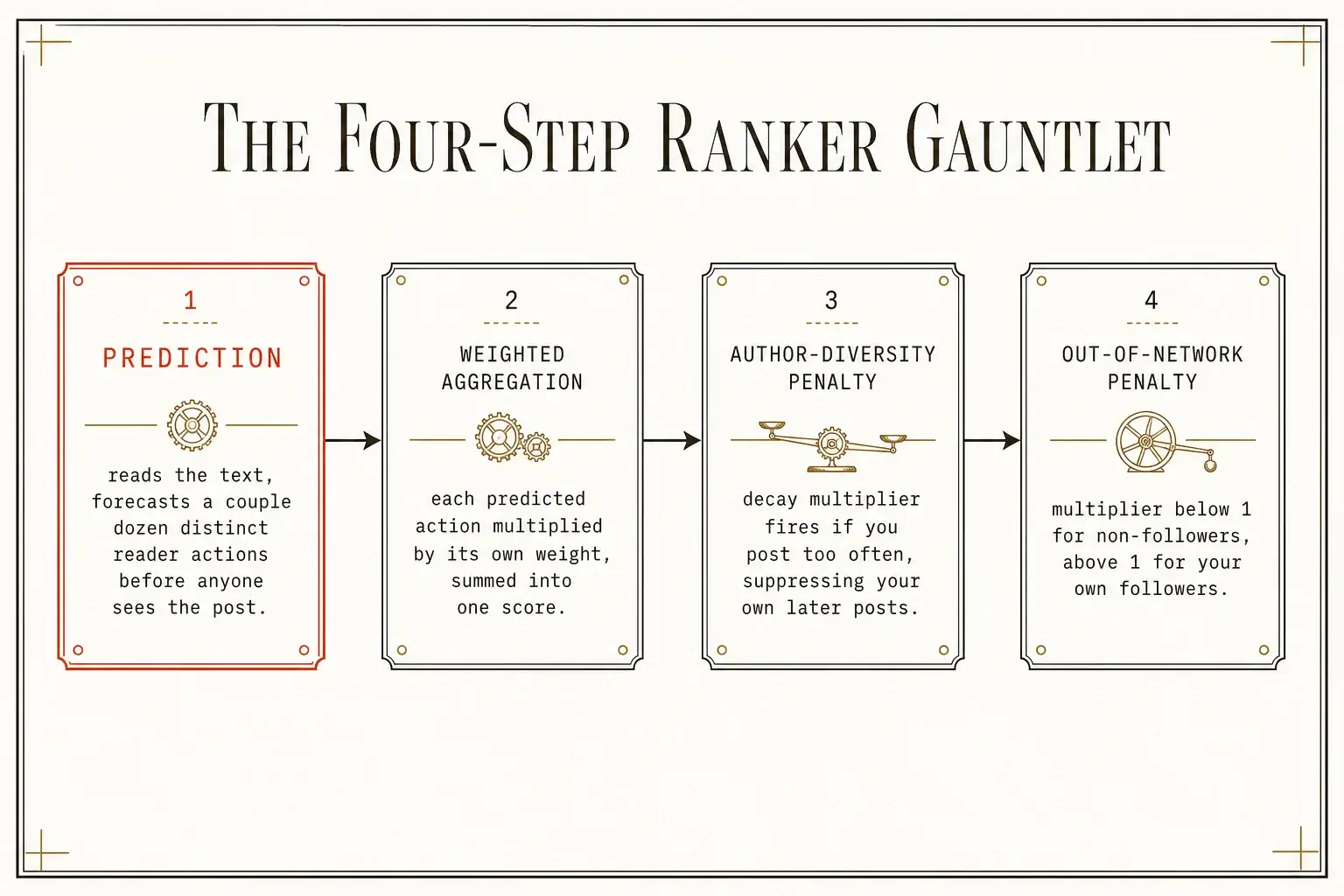
When you hit publish, your post runs a four-step gauntlet:
- Prediction. The ranker predicts the probability of a couple dozen distinct reader actions, repost, reply, quote, bookmark, follow, profile click, DM share, dwell, and more, reading your post against your own history and current trends. It forecasts behavior, it does not tally it. (The exact action count and list come from reported breakdowns of X's ranking code, not my measurement.)
- Weighted aggregation. Each predicted action is multiplied by its own weight and summed into one score. Not every action counts the same.
- Author-diversity penalty. A decay multiplier hits you if you've posted too often, suppressing your own later posts so one author can't flood a feed. Your own volume works against you.
- Out-of-network penalty. Posts shown to non-followers carry a multiplier below one, posts to your own followers carry a multiplier above one. Strangers are expensive, which is why every real follower is a permanent advantage.
Not every predicted action is worth the same, and the reported relative weights are lopsided enough to change how you write. Treat these magnitudes as reported from breakdowns of X's ranking code, not as my measurement:
| Predicted action | Reported weight vs a like | What it signals |
|---|---|---|
| Reply / conversation | 13.5–150× a like (some breakdowns 27–75×) | real engagement, the author replying back is the single strongest move |
| Repost / quote | ~20× a like | worth spreading, or worth arguing with |
| Follow | very high | the purest expertise signal |
| Bookmark | ~10–12× a like | reference-worthy, "I'll come back to this" |
| Dwell time | ~a bookmark, a 2-minute read earns a real bonus | you stopped the scroll and stayed |
| Profile click | more than a like | deeper intent, they want to know who you are |
| Like | 1× (baseline) | the weakest active signal there is |
| The killers | negative | "not interested," mutes, blocks, reports, they devalue a post over time |
The field's phrase for chasing outrage and earning those killers: "shooting out your own kneecaps." One honest footnote on the machinery, the public write-ups can't even agree on the out-of-network ranker's name (Fenix in one, Phoenix in another), treat it as one system paired with the in-network delivery path. And the feed is personalized against you: the system pulls a reader's recent engagement history, then scores your post against their interaction circles, Primary (frequent interaction, ~50x boost), Secondary (~20x), Interest-grab (~10x). Those circle figures and the history window are reported reverse-engineering, not my measurement. The practical reading never changes: write something the model predicts a specific reader will repost, follow you for, or DM to one friend, without burning your own diversity budget.
CH.02
I pulled 23,000 posts. Here's the floor you're fighting.
The median AI-automation post on X earns 37 views. On the honest denominator (6,489 posts, with the top-selected winners excluded to kill survivorship bias), only 12.31% cross 1,000 views, 2.62% cross 10,000, 0.52% cross 100,000, and 0.03% cross a million. Half of everything in this niche dies with fewer views than a small group chat has members.
That 37 is the floor every "lift" below is measured against. The distribution is savagely top-heavy:
| Views percentile | Value |
|---|---|
| p10 | 4 |
| p25 | 10 |
| p50 (median) | 37 |
| p75 | 202 |
| p90 | 1,435 |
| p95 | 4,568 |
| p99 | 36,761 |
A tenth of posts get 4 views or fewer. The gap between p50 (37) and p99 (36,761) is roughly a thousandfold. This is not a niche where small edges compound gently, it's one where a handful of structural choices decide whether you live in the 37-view graveyard or the four-figure tier. One caveat holds over every number here: views on freshly-pulled recent posts undercount because impressions are still accruing. Medians dampen that and the lifts are ratios so the undercount partly cancels, but read absolute view counts as a dated snapshot, not a ceiling.
CH.03
Which levers move reach, and which quietly tax it?
Five levers carry almost all the measurable lift, and the two tactics growth-hungry accounts pour the most effort into are the two that actively suppress reach. These are my own measured medians on the Latest denominator, exact, not rounded:
| Feature | ON n | ON median | OFF n | OFF median | Lift |
|---|---|---|---|---|---|
| Blue / verified | 4,107 | 70 | 2,382 | 17 | 4.12x |
| Has video | 455 | 117 | 6,034 | 34 | 3.44x |
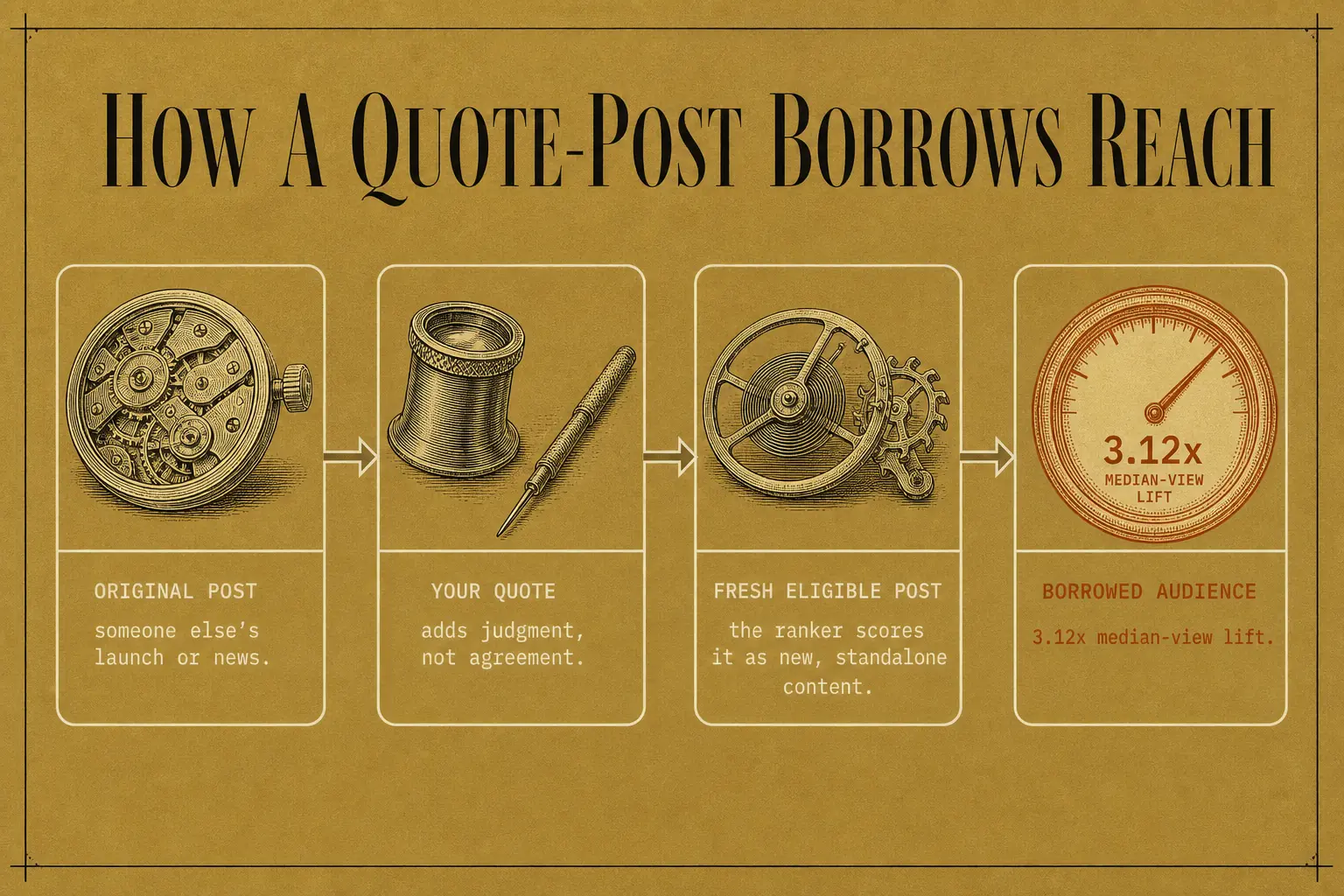
| Is quote | 606 | 106 | 5,883 | 34 | 3.12x |
| Long text (280+) | 2,837 | 71 | 3,652 | 23 | 3.09x |
| Short text (<100) | 753 | 40 | 5,736 | 37 | 1.08x |
| Has link | 2,639 | 37 | 3,850 | 37 | 1.0x |
| Has hashtags | 1,372 | 21 | 5,117 | 46 | 0.46x |
| Is reply | 2,174 | 22 | 4,315 | 53 | 0.42x |
One mechanism explains all eight rows: the ranker rewards native, dwell-generating content and penalizes low-effort distribution hacks.
- Video holds visual attention without leaving the platform.
- Long text forces a scroll-stop and delivers payload, the winners aren't essays, they're dense lists, internal-email pastes, or high-stakes hooks where the length is the value.
- Quotes let you publish a standalone, eligible post while inheriting context.
- Blue sits on top of everything.
Links deserve a verdict, because two camps are loudly wrong about them. The "links kill your reach" camp and the "always drive traffic off-platform" camp both assume links do something. My data says they don't: 37 median with a link, 37 without, a flat 1.0x. The demotion people blame on links is really the demotion on what usually accompanies a link: a thin "check this out 👉" post with no native payload. Put the value in the post, then add the link.
The two formats that feel like work are the two that get taxed
Two different things wear the word "reply."
- A reply someone leaves on your post is one of the strongest signals the ranker has (the reported 13.5–150x of a like, above).
- But a reply you post as your own content is the worst-performing format I measured, 0.42x the reach of an original, because replies are architecturally buried in sub-threads and they spend the same author-diversity budget your real posts need.
Hashtags are nearly as bad at 0.46x. My working hypothesis is that the ranker routes by inferred topic now, so a tag adds nothing retrievable and reads like a 2014 move. My corpus proves the penalty, not the cause, but the penalty is real either way. The account-level data confirms it from the other side: across my winner and loser quartiles, losers reply about five times as much and hashtag about four times as much (the exact percentages are in the winners-vs-losers table below).
The save is the exception
One quiet corollary of the bookmark weight (~10–12x a like): the winners openly engineer the save. The fresh pull is full of "Save this :)" stamped on dense guides, and it is not the empty engagement-beg the new ranker punishes, it is honest signposting on content that is genuinely save-worthy, so the high-weight bookmark actually fires. Asking for a save on a thin post does nothing. Asking for it on a real reference earns the strongest passive signal there is.
CH.04
Why does a 5,000-follower account out-reach a 50,000 one?
Reach on X is a function of algorithmic amplification, not follower count, and follower-normalized reach collapses as accounts scale. Nano accounts squeeze 0.2093 views per follower. By the macro tier that craters to 0.0016, a 130-fold efficiency drop. The machine doesn't reward the size of your audience. It rewards how much of it actually watches.
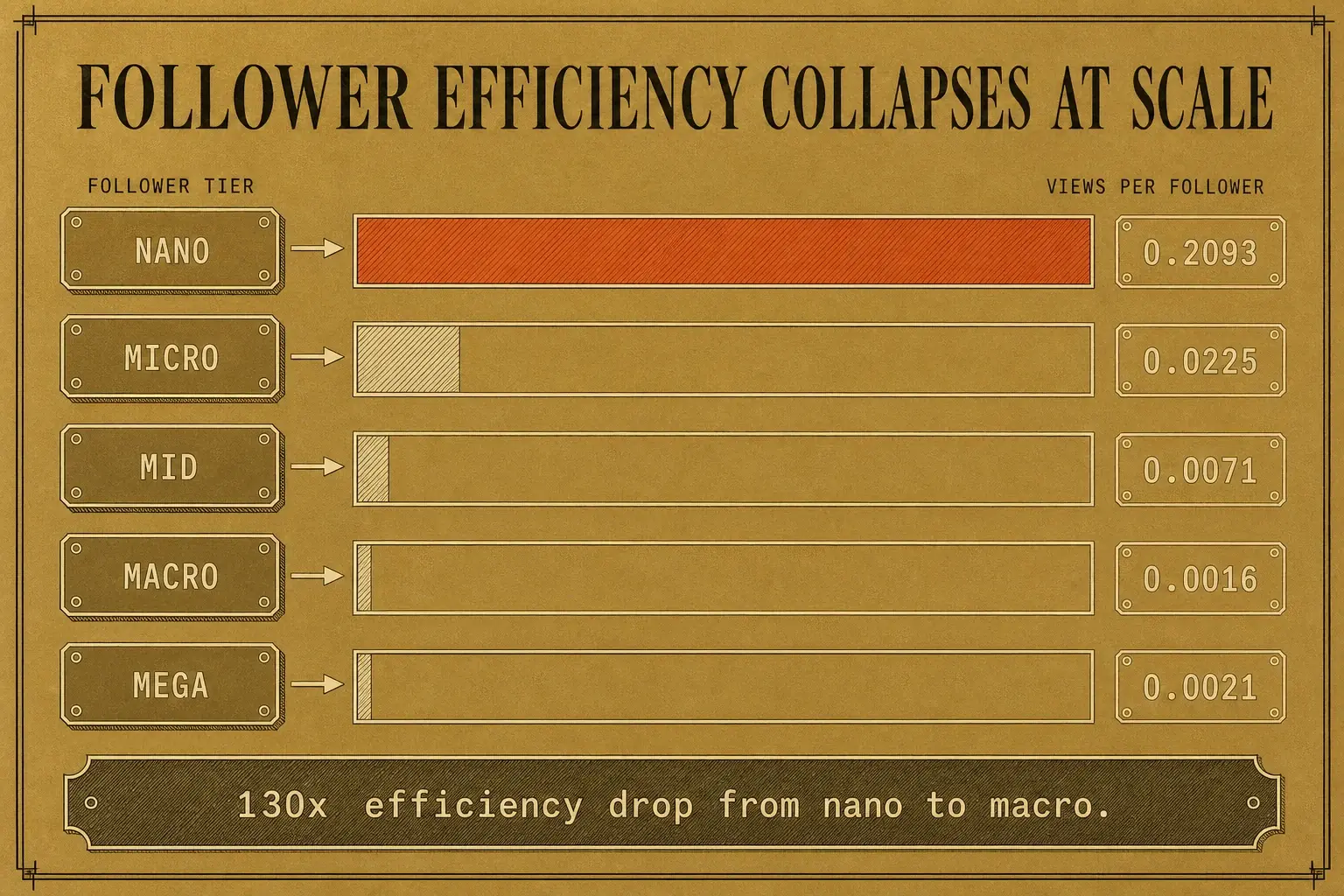
| Tier | Posts | Median views | Eng rate | Views/follower |
|---|---|---|---|---|
| nano | 3,228 | 20 | 0.0095 | 0.2093 |
| micro | 1,954 | 61 | 0.0223 | 0.0225 |
| mid | 994 | 171 | 0.0151 | 0.0071 |
| macro | 301 | 295 | 0.0107 | 0.0016 |
| mega | 12 | 5,925 | 0.0093 | 0.0021 |
Absolute median views rise with followers (20 → 295 from nano to macro), but the return on each follower falls off a cliff, which makes early attention disproportionately efficient and a bought audience disproportionately worthless. (The mega tier is n=12, treat its numbers as directional.)
One account makes it concrete. @TangriKunal, founder of @farsight_ai, carries 773 followers. His X-native essay "The System of Judgment" pulled past 228,000 views, roughly 295 times his entire audience, with no badge halo and no follower base to lean on. The machine does not check your follower count before it decides. It checks whether the next reader would stay.1
Now the comparison that compresses the whole argument. I ranked 427 accounts by follower-normalized median reach and split off the top and bottom quartiles, 106 each. The winners have a third the followers and win anyway:
| Trait | Winners (top 25%) | Losers (bottom 25%) |
|---|---|---|
| median followers | 5,048 | 15,270 |
| follower-normalized reach | 1.0089 | 0.0117 |
| % Blue | 93.4 | 83.0 |
| median engagement rate | 0.0185 | 0.0153 |
| mean % posts with video | 33.1 | 10.7 |
| mean % replies | 4.4 | 23.7 |
| mean % with link | 38.1 | 44.2 |
| mean % with hashtag | 4.5 | 18.1 |
| median text length | 298 | 215 |
| % money signal (proxy) | 27.4 | 8.5 |
The reach row is an ~86-fold gap on the exact metric that controls for audience size. Underneath it, every behaviour points the same way. The mechanism is a single posture: broadcast beats conversation, and authority is built through abstention.
Losers act like members of the audience, they spend their budget replying up at bigger accounts and spraying hashtags, hoping to siphon traffic the architecture never sends them. In the agentic-engineering cut, the loser pattern is almost a caricature: replying to @narendramodi, debating pension economics, offering "depression tips." Winners post monologues instead, a launch as a statement, a model release as an event, a running demo clip as the proof a description can't give.2 Even @elonmusk's throwaway "Put 'Never Went to Therapy' on my gravestone" works as pure unreplyable broadcast.
The losers, with three times the followers, built an audience that doesn't watch. The winners built a smaller one that does.
And the shape replicates in every sub-niche I measured, but two "winner traits" actually flip:
| Trait | Global (W / L) | Agentic engineering (W / L) | AI content & media (W / L) |
|---|---|---|---|
| follower-normalized reach | 1.0089 / 0.0117 | 1.2839 / 0.0121 | 1.2227 / 0.0357 |
| % video | 33.1 / 10.7 | 37.7 / 10.3 | 34.1 / 7.4 |
| % replies | 4.4 / 23.7 | 4.5 / 22.8 | 0.5 / 13.9 |
| % hashtags | 4.5 / 18.1 | 4.9 / 16.6 | 0.3 / 18.3 |
| median text length | 298 / 215 | 304 / 231 | 565 / 142 |
| % Blue | 93.4 / 83.0 | 96.3 / 81.5 | 85.7 / 92.9 |
| % money signal | 27.4 / 8.5 | 25.9 / 1.9 | 21.4 / 28.6 |
Agentic-engineering winners out-reach their losers 106-fold per follower, content-and-media winners by 34-fold, where the behavioural extremes go almost comic (winners post 28× fewer replies and write four times longer). The format levers, video, length, original-over-reply, are universal. The status-and-commerce signals are not. Follower count is the wrong scoreboard. The behaviour is the moat.
CH.05
What does Blue actually buy you?
Verification changes how the ranker weights your content, not just whether you wear a badge, it's worth 4.12x on median views in my data, but it's an amplifier on signal, not a substitute for it. It gets you into the feed, surviving the opening window still depends on format and velocity. The pattern is consistent: unverified accounts hit invisible impression ceilings where velocity-worthy posts flatline, while verified accounts posting equivalent content keep distributing.
The nuance keeps it honest. Blue shows up in the vast majority of my winners, but in most losers too (the exact split is in the table above). Necessary, plainly not sufficient. And it's segment-dependent:
- in agentic engineering, 96.3% of winners carry Blue (it's minimum viable legitimacy, unverified voices are presumed non-practitioners),
- but in AI content and media, fewer winners are Blue than losers (85.7% vs 92.9%), because there the work speaks in the video and losers over-buy the badge as a substitute for craft.
Two reach claims float around for Blue, and they measure different things:
| Figure | Source | What it covers |
|---|---|---|
| 4.12x median-view lift | my niche corpus | what verification does to a typical post in this niche, the one I trust |
| roughly 10x median reach (Premium) | broad third-party analyses, reported | platform-wide, not my measurement |
| around 15x (Premium+) | broad third-party analyses, reported | one figure: over 1,550 impressions per post versus under 100 for non-subscribers |
I trust my measured 4.12x for "what verification does to a typical post in this niche", treat the 10x/15x as reported. Either way, for a small unverified account the subscription is the highest-impact single investment, and not for the badge, its real job is reply infrastructure. The paid tier floats your comments toward the top of the threads where buyers are asking for help. At the growth stage that's the price of entry, not a vanity purchase. The arithmetic is rare: if Premium costs less than one billable hour a month and multiplies the reach of your buyer-intent replies, a single extra client a year covers years of subscription.
CH.06
How do quote-posts pull 3x?
A quote-post is the most underused 3x lever on the platform: your commentary enters the stream as a fresh, algorithm-eligible post with its own metrics while borrowing the social proof of whatever you quote. The ranker treats it as original. The reader experiences a conversation, which lifts dwell and reply propensity. The amateur quotes to agree or drop an emoji. The professional quotes to reframe, disagree with a premise, extend an argument, translate it for a new audience.
The cleanest example is a giant account adding the one judgment a launch lacked. @karpathy (3,008,751 followers) on a model release:
This is a super exciting release... the benchmarks are great and it's SOTA on everything by a margin but I'll add that qualitatively also, this is a major-version-bump-deserving step change forward
That pulled 2,687,548 views, 25,276 likes. He didn't break the news, he added the one judgment the announcement lacked, and that judgment is what traveled.
The format is an engine in its own right, and not only for giants. A 7,521-follower account runs the same quote scaffold on repeat, dropping a different attributed line each time, and one such post hit 860,737 views.3 Run systematically, it scales into a whole feed: a hard attributed quote up top, a number that stops the scroll, a "watch this, then read the guide below" bridge underneath. One of them carried a Spotify architect's "20-30% to 80%" loops stat to 450,100 views.4 The quote is the hook, the borrowed authority of the quoted figure is the distribution.
CH.07
Why do replies sit at 0.42x, and when do they still work?
That 0.42x reply penalty is an average hiding a bimodal distribution, which is the whole reason replies are still worth posting at all. A reply's reach is its multiplier times the parent's audience, not yours. Early on a fast-moving viral post it can out-reach your own original, late on a dead thread it reaches no one.
My corpus has a clean natural experiment. @Apostolakis_Geo, a 15-year-old with 153 followers, ran a deliberate challenge, "I will do 100 replies a day for 1 week to see if I get any results", and reported back:
DAY 1 UPDATE: Did 112 replies yesterday. Gained 18 new followers. Reply guy, is it that simple?
That update post drew 189 views, 4 likes. Eighteen followers from 112 replies is a brutal conversion on high-effort work, and it's exactly why volume-replying doesn't scale. The accounts that win with replies invert the strategy. Four rules:
- Reply where the denominator is large. 0.42x of a 50-view post is twenty impressions, 0.42x of a slice of a 500,000-view post is still thousands. Reply on posts going viral now, or on accounts well above your size. Never on dead threads.
- Reply early. The ranker surfaces early replies. The 200th reply on a viral post is invisible regardless of quality.
- Reply with standalone value. A reply that reads as a complete thought, screenshotted alone, can pull past 300 saves on a viral parent it never wrote.5 "Great thread!" gets buried.
- Use replies as a networking tool, not a broadcast tool. The ROI isn't impressions on the reply, it's the follow-back, the relationship, the quote-post that emerges later.
flowchart TD
    P["A post to reply to"] --> Q1{"Large or viral audience?"}
    Q1 -->|no| Skip["Skip: a dead thread reaches no one"]
    Q1 -->|yes| Q2{"Early on the thread?"}
    Q2 -->|no| Skip2["Skip: the 200th reply is invisible"]
    Q2 -->|yes| Q3{"Standalone value?"}
    Q3 -->|no| Skip3["Buried: 'Great thread!'"]
    Q3 -->|yes| Win["Reply: networking, follow-back, later quote-post"]
Replies are a precision instrument and a relationship channel, never a volume play. They also turn into a lead engine when you reply under the right stranger's problem, but that's a search-and-targeting discipline, covered below.
CH.08
Which content formats win, and which strangle a post?
A great hook in the wrong vessel still dies, format carries roughly as much lift as hook quality. Right now there's one standout arbitrage window: long-form articles are getting active priority while the platform pushes its everything-app direction. The reported evidence:
In one operator's analysis, five of the eleven best-performing posts out of 500 were articles, with a single article cited at 162 million views.
Creator-reported, so take the magnitude as marketing and the pattern as real, and take the honest caveat seriously: long-form boosts have faded before and threads have returned. Use the window, don't build your identity on a format the platform can re-weight.
You don't have to take the 162M on faith, because the window is visible in my fresh pull on real accounts. One 773-follower account turned a single essay into 228K views.6 Several others in the same week did the same with deep technical pieces, loops walkthroughs and build guides clearing six figures of views and racking up bookmark saves in the hundreds and thousands.7 Read those save counts: the high-weight bookmark is precisely the signal that keeps a long-form piece distributing. (These are platform-displayed counts at capture, still accruing, so treat them as directional, not final.)
| Format | Verdict | Why |
|---|---|---|
| Long-form article | highest out-of-network ceiling right now (the arbitrage) | premium, subheadings, visuals, split into "growth" (broad) and "authority" (teach a skill) |
| Single tweet (claim + proof) | highest ratio | claim is the hook, mechanism is the proof, complete in four sentences8 |
| Native video (verbal hook in 2s) | highest ceiling, highest variance | bimodal: massive or near-zero, auto-plays muted, so the visual must work on mute |
| System-thread (each tweet a step) | overperforms | each tweet a step you can't skip9 |
| List-thread ("100 tools") | underperforms (~1x) | the first tweet gives everything away10 |
| Quote-post | near-free multiplier | a second vessel for the same hook, never your only format |
| Artifact post (image + one takeaway) | high (visuals boosted) | a system diagram, an n8n graph, a before/after metric, cheapest authority a technical founder can build |
| Reply-as-post | volume, not reach | see 0.42x, above |
| Hashtags | suppresses | dead weight even on big accounts11 |
@100F_exe diagnosed the video failure mode in one line:
"The video doesn't die in the middle. It dies in the first line."
Winners open with the hook spoken aloud in the first two seconds, and prefix posts with "VIDEO" as both a reader and an algorithm signal.12 Threads split into two species and only one earns its effort, the system-thread (each step depends on the last) beats the list-thread (skimmable, forgettable), winning threads compress to three-to-five tweets with the CTA last, and the first tweet must stand alone, because most readers see only one. One penalty worth flagging: reuse trending video from another platform and you must download, edit, caption, and genuinely alter it before re-uploading, or duplicate-content suppression triggers.
The deepest pattern, and the easiest to invert:
Format complexity should inversely track mechanism complexity.
Complex systems need simple presentation, simple tools need rich context. A four-line "loops" quote-post can describe a system that would take pages to document, and the compression is exactly why it travels.13 A one-line trick, conversely, needs a thread or a long-form to explain why something that small matters. Match the vessel to the inverse of the mechanism, and the hook gets room to work.
CH.09
Which hook actually stops the scroll?
The feed rewards two things above content quality: a gap the reader can't leave unresolved, and a status or guilt they can't ignore. Every post that travels does at least one. Tool lists and feature roundups do neither, they're junk food, saved not shared. A genuinely clever multi-agent workflow sat at 84 views in my corpus, a lazy "50 AI tools" list beside it cleared a million. The insight was never the problem. Six archetypes recur in the winners, each a different machine for opening a gap the brain refuses to close:
| Hook | The gap it opens |
|---|---|
| Arbitrage | numerical, old cost against new result |
| Paradigm Shift | status, you're on the wrong side of history |
| Identity Displacement | possibility, this person shouldn't exist |
| Opportunity Cost | guilt, your low-value default vs this |
| Skill-Stack | dependency, step one sets up step two |
| Conceded-Claim | argument, pre-empts its own rebuttal |
The Arbitrage Hook is the highest-lift opener, when the spread is real and checkable. @0xKnzo (297 followers, 4,938 median) runs it on repeat:
"JAPANESE DEV REPLACED $249/DAY IN AWS BILLS WITH 4 MAC MINIS STACKED ON A WOODEN DESK. He paid $2,400 once. Electricity costs $12 a month."
The all-caps signals the number is the point, the figures are never rounded, because "$249/day" reads real and "$250/day" reads invented. But the spread lands differently on two readers: the aspirational beginner reads it as a door opening, the skeptic reads it as ragebait. The deciding variable is whether the claim is checkable. The versions that satisfy both spell out every step, and the fresh pull is full of the same engine: a $4-a-month JARVIS against Tony Stark's billions, a $100 model-training run against the $43,000 it cost in 2019.14 Both anchors real, both checkable, which is what separates an arbitrage that converts the skeptic from one that only baits the beginner.
Each of the other five archetypes opens a different gap:
- The Paradigm Shift declares the reader's current workflow obsolete in sentence one, @0xCodez: "Since Opus 4.5, i uninstalled my IDE... 100% my code is written by Claude."15
- The Identity Displacement describes a person who shouldn't exist (@100F_exe's AI character that earned a brand deal), the specific physical detail, "a tiny mole above her lip", is load-bearing, signalling a real system over a vague claim.
- The Opportunity Cost converts the guilt of passive scrolling into action, the Netflix-versus-this-course format that pins a single high-value asset against the reader's default dopamine drip.16
- The Skill-Stack hands a sequence, not a list, so step one implies step two.17
- And the Conceded-Claim is the one that looks like it should cost reach, @Prathkum (448,904 followers, 671,597 median): "Hot take: Building software was not the best use case for Fable 5... Fable 5 was in a different price tier (~2x)." A naked hot take invites a pile-on, one that names its own counter-evidence leaves the reader nothing to argue with, only something to forward.
(That "readers pass along what they can defend" reasoning is a hypothesis my corpus is consistent with, not a measured effect, hold it loosely.)
CH.10
How do you reverse-engineer winners instead of guessing?
This is the single most copy-pasteable play in the system: stop creating from a blank page, extract what already won in your niche, and re-voice it through your own expertise. Five moves.
- Find the proven winners. Open a niche leader's profile, go to advanced search, and run the
min_faves:operator at a high threshold, sorted by latest to surface recent winners.min_faves:5000is a sane starting input for a sizable account, drop tomin_faves:1000for smaller accounts, raise tomin_faves:10000for very large ones. This filters out everything that didn't work. - Extract the structure with an AI assistant. Paste 5–10 of those high-performing URLs into Claude and ask for the skeleton, hook type, information architecture, body rhythm, closing mechanic, as reusable templates, not paraphrases. The distinction is load-bearing: copying a post triggers the repetition detection the ranker is built to catch, extracting the skeleton and building fresh does not. The exact prompt: "Analyze these posts and turn them into actionable templates and frameworks that I can reverse-engineer for my own niche." The claim is this moves you 50–70% of the way to finished content.
- Inject your audience and offer. Hand the model your specifics: "My offer is to help [specific audience] achieve [specific outcome]. Use this offer to write new hooks following the structural patterns you just identified."
- Layer in your own IP, the non-negotiable final 30%: your beliefs, your stories. It's what makes the post convert, and it's what keeps you off the platform's undisclosed-AI-content enforcement list. The AI gets you most of the way, your voice is the part that has to be yours.
- Match the proven content mix. One reverse-engineered account ran roughly 35% long-form articles / 40% threads / 25% short-form. As you grow, transition toward one high-quality post per day with consistent visual and structural branding.
flowchart LR
    A["Find proven winners (min_faves, sort by latest)"] --> B["Extract the skeleton with AI (templates, not paraphrase)"]
    B --> C["Inject your audience and offer"]
    C --> D["Layer in your own IP (the final 30%)"]
    D --> E["Match the proven content mix"]
The fresh pull shows the method at industrial scale, and where it breaks. A single 26-minute Boris Cherny interview about agentic loops spawned a whole genre inside one week, dozens of accounts re-voicing one source.18 The ones that extracted the structure and layered a real take traveled. The ones that bolted a fabricated origin story onto it traveled too, then got dunked in their own replies. The honest accounting on the original claim: the headline result behind this method (a modeled account reportedly hitting tens of millions of impressions and five figures inside 60 days) is single-source and self-reported. Copy the method, discount the totals.
CH.11
Which posture wins, and why "build in public" is a trap?
The archetype you adopt is itself a lever, and despite the romance around it, narrating your build in public, the running progress diary, is the weakest posture in my data. Agencies and tool-promoters lead on follower-normalized reach, educators follow, builders who mostly narrate their path trail badly, and that posture attracts other builders, not buyers. The one exception lives in the themes table below: a single system reveal post still reaches. The losing posture is the day-by-day build-log narration, not the occasional reveal. Selling the shovels, or showing the finished mine, beats journaling the dig.
| Archetype | n | median followers | median fnorm reach | % money signal |
|---|---|---|---|---|
| agency | 10 | 12,932 | 0.2141 | 40.0% |
| tool-promoter | 117 | 3,849 | 0.1692 | 23.9% |
| educator | 58 | 15,693 | 0.1635 | 27.6% |
| builder | 29 | 2,572 | 0.1092 | 6.9% |
| other | 213 | 6,461 | 0.0878 | 18.3% |
The builder is the cautionary tale: lowest reach (0.1092) and by far the weakest money proxy (6.9%) on the smallest median audience. Tool-promoters make up 37 of my 106 winner accounts versus 21 of the 106 losers, the accounts solving an acute, monetizable problem and saying so beat the ones narrating their path. (Mind the samples: agency n=10 is small and directional, the tool-promoter row, n=117, is the most reliable positive signal here, conveniently also the most replicable posture for a working builder.)
The winning move doesn't even need a big audience. @trybagel has 65 followers and a 106-view median (follower-normalized reach north of 1.0, squarely winner territory) running it cleanly, name a specific competitor, draw the line, position in the gap:
"We kept hearing 'why can't we just use Claude for this?'... Claude writes a great summary. Your product team still ships the wrong thing." @trybagel
The same posture works at size and as a value-first argument that closes on the sale instead of opening with it.19 Contrast all of them with a builder account from my corpus (21,873 followers, name withheld since it's a cautionary contrast, not a credit): strong individual posts, but the feed is weekly build-logs and event recaps, narration of construction, no named offer.
That's the catch with build-in-public stated plainly: it attracts other builders, not buyers. Perfect if you monetize via courses, templates, or consulting, useless if you sell done-for-you services. Accounts that pair build-in-public with a high-ticket-service CTA consistently underperform.
CH.12
Which themes carry reach, and which carry revenue?
Six themes generate real engagement, and they split by job, some carry reach, some carry revenue, and almost none do both in one post. The highest-reaching format and the highest-converting format are never the same one. Know which job a theme does before you pick it.
| Theme | Job it does |
|---|---|
| "I automated X" result screenshot | highest-converting, not highest-reaching |
| System reveal (the one-off "here's the whole thing I built", not a daily build-log) | highest-reaching |
| Contrarian take | reach from both camps |
| Step-by-step tutorial | the workhorse, high save, low build |
| Tool launch / demo | works only when the output is visually undeniable |
| Results screenshot + story | most-faked, credible ones show the cost |
Four of those themes deserve a closer read:
- The "I automated X" screenshot converts because it shows result first, method second, friction third, so the reader self-selects into the offer. @eng_khairallah1's "47 clients a month. $400 each. $18,800/month. $480 in API costs" is believable precisely because it includes the cost, and its credibility detail, "Set triggers to only wake the human operator if a deal breaks >$3,000 or the reply rate drops below 12%", is the "I still have a life" signal that separates real automation from grindset fantasy.20 The credibility lives in the operational specifics, not in the headline dollar figure, which on its own would read invented.
- The tutorial is the workhorse: it doesn't go viral but it compounds, and it has an extremely high save-rate and an extremely low build-rate, which makes it excellent for audience growth and poor for direct conversion.21
- The contrarian take is the most dangerous because it's the easiest to fake, the test is whether the claim survives contact with technical reality. "Loops over prompts" survives because independent builders demonstrate the same structure (state on disk, a separate checker agent grading output, exit conditions set before the loop).22 "AI will replace all developers" doesn't survive, the evidence is full of human judgment as the bottleneck.
- The results-story is the most-faked theme on X, the credible ones include the cost, not just the revenue: "$18,800/month, $480 in API costs" reads true because the margin is realistic, while "$147,009 in 60 days" from one viral video is weaker because it omits production cost and the failure rate of every other video, and one account's "these teenagers are making $27,454/month" (name withheld, this is the not-credible example) draws a wall of "source?" replies.23 The proxy nature of these numbers is visible right there in the comments.
CH.13
How do you frame an offer without killing your reach?
The algorithm doesn't penalize a link on a post that stands on its own (chapter 3 measured that). What it buries is a post that reads as a pure ad, all pitch, explicit pricing, a naked CTA with no native value. Winners solve it with a three-layer architecture that keeps the reach post valuable and moves the selling into a bridge, and the accounts that tank are the ones that collapse all three into one promo post.
| Layer | What it is | The discipline |
|---|---|---|
| Reach post | the theme itself, the result story, the reveal, the contrarian take | no pitch, no pricing, no offer, it exists only to generate impressions (a bare link won't cost reach per the data, but the selling still belongs downstream, not here) |
| Bridge asset | the lead magnet, delivered by DM | must be genuinely valuable, not a teaser, a 2-page PDF breaks trust, a real template compounds it |
| The offer | the actual service or product | lives behind the bridge, never appears in the original post |
The bridge mechanic is explicit in @Prathkum's format, and it's the one place the 0.42x reply penalty works for you, because the reply is a funnel action, not content competing for reach:
ChatGPT is outstanding... To get it, • Like • Reply "👋" • Follow me (so that I can DM)
That post pulled 1,609,527 views, 12,903 likes, 5,708 replies, almost all the "👋" it asked for.24 The detail most accounts skip: put a qualifying question inside the bridge step, the auto-DM asks "what do you sell?" or "what's the one task eating your week?" before it hands over the asset, which filters tire-kickers and seeds the audit conversation, plus an anti-spam guard that dedupes by user ID and skips non-followers so you don't burn the DM allowance. That qualifying question is where a list-grab quietly becomes a lead.
flowchart LR
    C["Comment keyword ('free')"] --> W["Webhook keyword trigger (Make or n8n)"]
    W --> G{"Follower and not a duplicate?"}
    G -->|no| Stop["Skip: protect the DM allowance"]
    G -->|yes| Q["Auto-DM asks: what do you sell?"]
    Q --> A["Hand over the asset, seed the audit"]
The monetization pattern across every account with a revenue signal is the same move: sell the outcome, not the tool.
- Target a boring industry you understand and sell the weekend automation as a $400/month outcome.25
- Price the outcome rather than the hours, with a low-risk AI audit as the entry point that naturally surfaces the upsell.26
- The retainer is the real product: a one-time setup fee covers the build, a monthly retainer covers the relationship (one operator's split: "$5k one-time setup and a $2k monthly retainer").27
The mechanics of actually running and pricing those audits are an agency's own subject, not this note's. What ties it back to everything here is the warning from @mardehaym: an agency selling "AI automation" with no scaffolding gets squeezed as model access democratizes, "Doubling your model spend when scaffolding is zero still gives you zero." The moat is the system around the model, not access to it, which is the whole reason reach and revenue are separate problems.
CH.14
How do you find buyers in the act of asking for help?
Stop broadcasting and start searching. X's advanced search surfaces people literally typing "need an n8n consultant" right now, you reply with a real diagnostic, let your profile do the selling, and move to DMs only when invited. This is the entire lead engine, and it runs on a handful of operators plus discipline: "exact phrase" matches intent language, OR widens a tool cluster, -job -hiring strips recruiters, lang:en keeps it readable, -is:retweet ignores reposts, min_faves:3 keeps only posts with traction, and filter:replies finds the questions buried under bigger accounts, often the most targeted of all.
A starter set you can paste straight into X search (switch to "Latest"):
# Direct consultant / implementation requests
"need an n8n consultant" OR "n8n expert" lang:en -job -hiring -is:retweet
("automation expert" OR "automation engineer") ("need" OR "looking for") -job -hiring lang:en -is:retweet

# AI / agent infrastructure pain
("multi-agent" OR "agents") ("infra" OR "orchestration") ("help" OR "stuck") lang:en -job -hiring -is:retweet
("LLM" OR "GPT" OR "Claude") ("stuck" OR "can't scale") ("agents" OR "automations") lang:en -is:retweet

# Tool-specific pain
("n8n" OR "make.com" OR "Zapier") ("broken" OR "keeps failing" OR "brittle") lang:en -job -hiring -is:retweet

# Founder time-sink complaints
("spending" OR "wasting") "hours" ("manual" OR "copy pasting") lang:en -is:retweet
("founder" OR "indie hacker") ("need to automate" OR "automation help") lang:en -is:retweet
Append min_faves:3 to any line to filter for posts that already have a little traction.
The funnel runs daily and short: pull 3–10 high-intent posts a day (more than that and quality drops), qualify fast (is the author plausibly a buyer, is the problem in your lane), write a high-signal reply that mirrors the problem in one line and offers a concrete diagnostic with actual node names, closing with a soft step ("DM me your stack and I'll outline what this could look like"), let the profile sell, and DM only when invited. Automate the finding, never the answering. Reading and searching on a schedule is within the rules, auto-replying or auto-DMing on keyword matches is explicitly banned and a fast route to suspension. The tool reads and ranks. You write every reply, every DM, every post, by hand, in your own voice.
flowchart LR
    S["Advanced search: intent phrases plus operators"] --> P["Pull 3-10 high-intent posts a day"]
    P --> Q["Qualify: plausible buyer, in your lane?"]
    Q --> R["Manual high-signal reply (real diagnostic)"]
    R --> Pr["Let the profile sell"]
    Pr --> D["DM only when invited"]
CH.15
How should your profile sell while you sleep?
Every reply you write sends a stream of strangers to your profile, so it has to work like a one-screen landing page, a visitor decides in about three seconds. Four elements do the work:
- Name plus a short descriptor ("Danylo Pravda ⚙️ AI automation engineer", trust beats cleverness).
- A bio aimed at the buyer with one real proof point and the outcome you help people reach: "I build AI + n8n automations for solo founders. Kill manual ops, ship agents."
- A banner with a minimal system diagram, not a stock photo.
- A pinned post treated as a mini landing page, who you help, two or three bullets of proof, one clear next step ("DM 'automation' if you want help mapping this"), not a viral tweet you got lucky with.
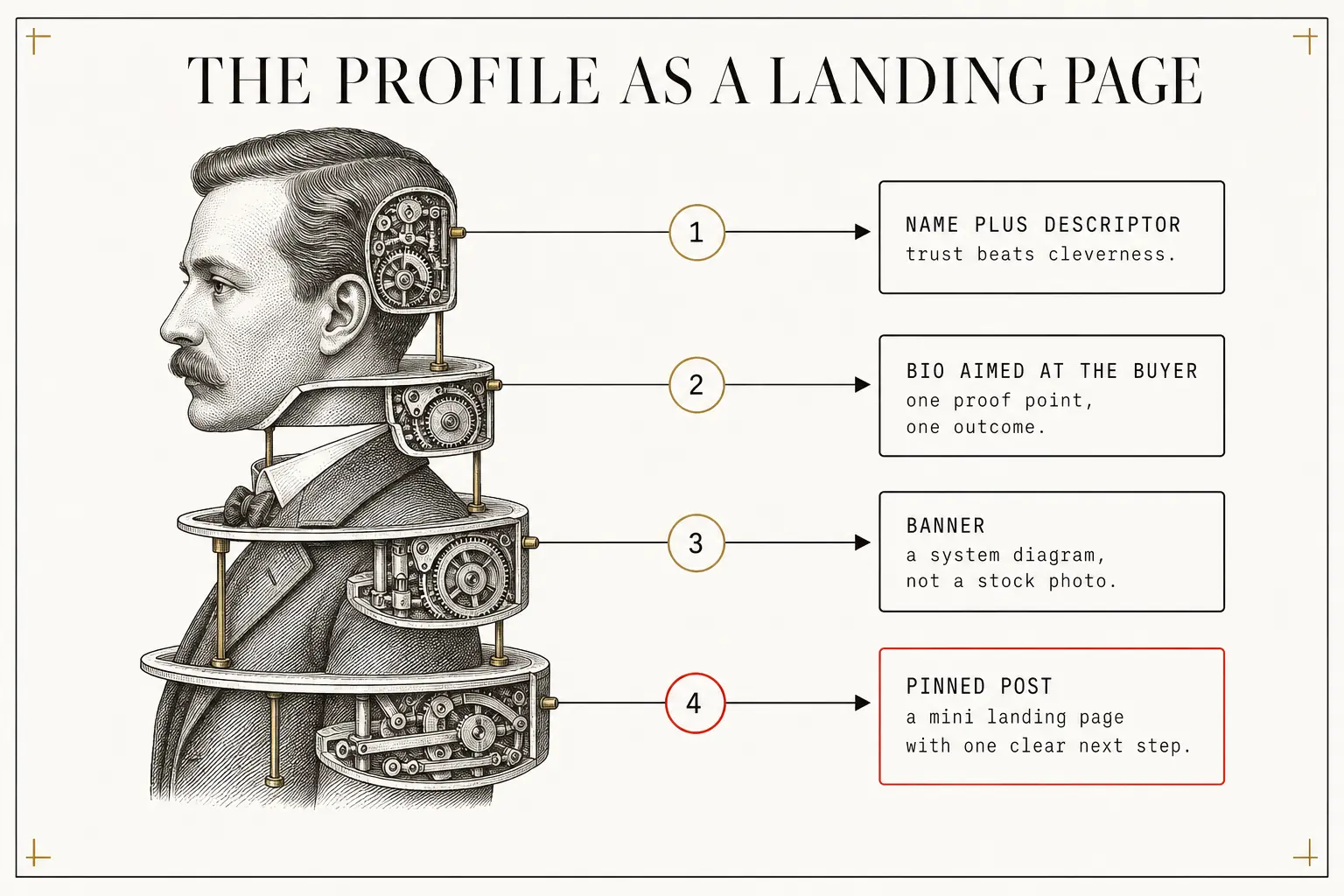
Diagnose it with your profile-efficiency ratio (followers ÷ profile visits). Most profiles convert around 5%, optimization pushes toward 20%, below 5% means the headline is failing the three-second test, not that your content lacks reach. The profile is also exactly why most of your posts don't need a body link at all, your link surface lives here.
CH.16
How often should you post, and when?
The "post 8–10 times a day" playbook is dead. Your first post of the day reaches furthest, and each one after it reaches sharply less. The exact curve is creator-reported, but the shape is consistent:
| Post of the day | Reach vs your first |
|---|---|
| 1st | roughly 100% |
| 2nd | around 70% |
| 3rd | around 50% |
| 10th | 10–20% |
Space posts at least four to six hours apart and treat each one as expensive. Lifespan compounds it, and these figures are creator-reported too:
- posts older than seven days are reportedly filtered out of the feed entirely,
- peak engagement lands in the first 30 minutes to 2 hours,
- and reach drops about 90% after the first 24 hours.
There is no evergreen reach on X. Every post lives or dies inside its first day, so don't post and walk away, post when you can sit with it and reply to the first comments while the thread is young.
For a solo founder, 3–5 posts a week is the sweet spot, not the brand-style five a day. The algorithm wants a few strong objects it can rank and a steady history, not a firehose of filler that decays your account quality. Timing controls the ratio of early engagements to impressions, not an absolute clock, and my corpus shows only a weak day-of-week signal, with one big confound to flag (below): mid-week medians look highest and the weekend looks quiet.
| Weekday (UTC) | n posts | median views |
|---|---|---|
| Monday | 3,160 | 15 |
| Tuesday | 267 | 233 |
| Wednesday | 289 | 237 |
| Thursday | 395 | 102 |
| Friday | 553 | 112 |
| Saturday | 574 | 90 |
| Sunday | 1,251 | 42 |
Read that Monday row with suspicion. Monday is nearly half my entire sample at a rock-bottom median, which is the exact shape of the accrual artifact from the scoring chapter: the pull caught a wave of same-day Monday posts before their impressions had accrued, not proof that Monday "dilutes." The honest read is narrow. The mid-week medians rest on only a few hundred posts each (n≈270–290), so treat day-of-week as a weak tiebreaker, not a strategy: if you have one post that matters this week, ship it Tuesday or Wednesday and don't overthink the rest. And reframe one piece of folk wisdom, "many touchpoints before someone acts" does not mean many posts a day (the frequency penalty buries you). It means many quality impressions across formats: a post here, a reply there, an article, a video. Frequency of impression matters. Frequency of publication must stay disciplined.
CH.17
How do you turn a long note into native X reach?
Repackage, don't paste. The reader should get complete value without leaving X, and the link to the full version lives in your first reply, not the body. Copy-pasting an article is the most common mistake, desktop paragraphs, no subheadings, a body link, a dead post. The recipe instead: extract one thesis, five to seven key insights, and one concrete example, then build a single long-form post in order:
- a 1–3 line hook,
- one short paragraph on who it's for,
- the insights as a numbered list (each with a real number),
- a mini case snapshot,
- a 3–5 bullet checklist,
- and a close that states one belief and asks a real question.
flowchart LR
    A["Long note"] --> B["Repackage: 1 thesis, 5-7 insights, 1 example"]
    B --> C["One complete long-form post (hook to checklist)"]
    C --> D["Reply to yourself with the link"]
Thread one to three visuals through it, then post and immediately reply to yourself with the link. The main post stays clean and complete (it earns the impressions on its own value), and the reply carries the click-through as a funnel action rather than content competing for reach.
The fresh pull shows the recipe run clean. One essay delivered its entire argument on-platform, complete, no body link, with the pointer to the full version parked in its first reply, and pulled past 228K views with the click in a reply, exactly where the 0.42x reply penalty stops mattering.28 It also travels on one portable line readers can carry back, which is the repackage working because the post is finished, not because it teased.
The proof that complete-on-platform beats teaser-and-link is also in the reported results:
A mid-sized industrial manufacturer posted daily 2,000+ character troubleshooting cases with images, and design managers from previously unreachable companies began DMing, with a steady flow of quote requests attributed to the X content. An education creator who switched from link-only teasers to complete 5,000-character "mini-lectures" with a soft CTA reported a large jump in newsletter registrations. And a B2B brand's case-study thread reportedly drove more retweets and follower growth than single short tweets. (These are reported single-source examples, directional only, not measured in my corpus.)
CH.18
What's the plan from zero, week by week?
From zero you have no audience, so you borrow other people's and convert them. Run this in order, with a verification gate at every step. Budget 5–10 hours of content work a week. A new but consistent account with Premium can reasonably reach 300–1,000 impressions a post and 100–300 followers by week four, plus 5–15 real automation conversations, without Premium, the same effort may stay under ~100 impressions a post.
flowchart LR
    W1["Week 1: foundation and listening"] --> W24["Weeks 2-4: acceleration"]
    W24 --> M23["Months 2-3: monetization prep"]
Week 1, foundation and listening.
| Action | Verify |
|---|---|
| Subscribe to Premium, optimize the profile to pass the three-second test | profile-efficiency ratio trending up |
| Build three Lists (big creators 100K+, same-size peers, cross-niche) + your saved searches / read-only monitor | a working set in each list, searches saved |
| Define your identity claim, not a bio line, build a bridge asset good enough that someone would pay for it | a complete template/course/prompt library exists |
| Post 0–1× a day + 5–10 genuine manual comments a day (half buyer-intent, half mid-tier founders who reply to strangers) | impressions and follows logged daily |
Weeks 2–4, acceleration. Settle into 4–5 posts a week: deploy three reach posts (an "I automated X" result, a build-in-public reveal, a contrarian take), none with links or pricing, all ending in a reply-keyword CTA, watch which theme performs, because the algorithm is telling you which identity claim resonates. Shift toward articles if their reach clearly beats short-form. Build the offer behind the bridge (pick which audit, then build it, the audit is the entry point, the retainer is the product). Activate the contrarian-to-tutorial pipeline: for every contrarian take, follow within ~48 hours with a tutorial that proves it. Turn on mechanic-only automation:
- schedule posts,
- auto-repost a piece once it crosses a like threshold (e.g. 7 or 15 likes) after a delay,
- autoplug a CTA under a high performer,
- auto-DM the bridge to keyword commenters via a tool like HypeFury.
Automate the mechanics. Never automate the voice, the moment the words come from a machine, the ranker reads the synthetic signal and your advantage evaporates.
Months 2–3, monetization prep. The ad-revenue-sharing program reportedly gates eligibility on three things:
- an active Premium subscription,
- at least 500 followers,
- and 5 million organic impressions in the trailing 90 days (~55K a day).
Treat those as platform-stated and verify the current numbers before quoting them. The trailing-impression bar is the real wall, and clearing it is the point of everything above. For a high-value service business, one consult or build generated in 30–90 days is already a strong return, even while the vanity metrics lag.
CH.19
How do you verify it's working before followers move?
Follower count is a lagging indicator. The leading signal is follower-normalized reach, median views ÷ followers, and a tight diagnosis loop tells you which lever to fix. Calibrate it against my own quartiles:
| fnorm (median views ÷ followers) | Where you stand |
|---|---|
| near 0.01x | loser quartile, median views about 1% of follower count |
| around 1.0x | winner quartile, median views roughly matching follower count |
| a few times 1.0x | the very top accounts |
So below ~0.05x your distribution is broken, around 1x you're at the winner median for this field, and a few times that is top-tier. The 773-follower essay from chapter five sits near 295, the kind of number a single article can buy a no-name account.
Measure it weekly, never act on a single week, and give any change three to four weeks (~a dozen posts) before you judge it, because the snapshot noise lives at the single-post level and only washes out across a batch. The rule:
If fnorm climbs toward and past ~1.0 and holds there for three straight weeks you're at winner level for your tier, keep the format mix. If it sits down near ~0.01 you're in loser territory regardless of follower count, change one lever the data says matters (add video, cut replies/hashtags, write longer) and re-measure, one variable at a time.
When something stalls, check the levers in order before blaming the writing:
- replies getting no engagement means they're too generic,
- posts getting no reach means you're either eating the author-diversity penalty or your niche is too broad to match an interest circle,
- profile visits that don't convert mean the headline fails the three-second test.
Then the funnel metrics, all rough guides on proxy data:
| Metric | Healthy | What a miss means |
|---|---|---|
| Reply-to-like ratio | above ~0.2 | content isn't sparking conversation |
| DM conversion (commenters → resource request) | above ~20% | the offer or the friction is off |
| Lead-to-call rate (DMs → discovery call) | ~10–30% for warm leads | the bridge or the framing is off |
| Service-to-product ratio | shifting toward 50%+ product | still 80% services after six months = trading time for money |
Audit by follows, not impressions, impressions measure reach, follows measure resonance, and follows compound. One honest complication: X no longer reliably exposes raw impressions to every account, so when the denominator is hidden, use a proxy from what you have (reply-to-like ratio over time, or likes-per-post normalized by followers). The trend matters more than the absolute number.
CH.20
How do you scale without killing the account?
Once you have a real base of your own followers, the strategy flips from borrowing other audiences to building your own gravity, and three pitfalls quietly kill accounts right at this stage. Drop to one high-quality post a day, rotate a small set of formats, and hold visual and structural consistency so the brand is recognizable at a glance. Instead of one narrow topic, become "the niche": an overarching message carried by four content pillars, three from your genuine expertise, one from your personal story, so the brand can grow without losing the audience.
The pitfalls:
- Niche drift, you can ride a trend, but return to the core immediately or the interest-circle matching destabilizes and reach turns erratic.
- The toxicity trap, the engagement-maximizing incentive pushes inflammatory content and that exposure is sticky, knowing it is a reason to stay on-brand, not chase outrage.
- The selfish-content trap, documenting your own routine (a play-by-play of your day) is selfish content, reframing that same routine to solve a specific reader's problem is selfless content, and the angle is the entire difference between a vlog and a value post.
CH.21
What's hype, and what's worth keeping?
The mechanism is real. The headline totals are not, and telling them apart is the difference between copying a method and believing a billboard. What transfers: the AI-prediction shift and the four-step pipeline, the signal hierarchy (optimize for reposts, quotes, follows, dwell, video, treat likes as noise, avoid the killers), the frequency and lifespan reality, long-form as an honestly-labeled arbitrage window, the min_faves → extract → your-IP → match-the-mix system, the lever stack, and the three-layer offer that separates reach from revenue.
What to discount or ignore:
- All headline reach and income numbers are creator-reported (162M-view articles, six-figure 60-day results). Copy the methods. Don't believe the totals as fact.
- Buying followers (SMM panels at "$1.30 per 100") is vanity fraud, it signals a low-quality audience to the interest-circle system, degrades your real reach, and risks suspension. That it shows up in "how to grow on X" results at all tells you how polluted that corpus is.
- Undisclosed AI content gets accounts penalized or de-verified. Use AI for research, extraction, and formatting, the take and the voice must be human, which is also why the personal-story and specific-mistake formats out-convert everything. They're the part the machine cannot fake.
- The local-vs-cloud war is a topic to post about, not capital to sink. Accounts citing ~$5,280/year saved push local Mac Mini / Ryzen clusters, and others counter that frontier models still win the hardest tasks. On the engineering question each is right within their range. But a large share of the accounts pushing local hardware are, on inspection, selling clusters and parts lists, the "$5,280/year" is a content hook, not a line item on a client's invoice. If you sell services, don't buy the cluster. Provision cloud, let the client's volume decide whether any workload is worth pinning to hardware.
The freshest tell is the manufactured leak
Pull the automation feed today and one packaging dominates the winners: the leaked playbook. The strongest of them opened with "Anthropic's internal loop engineering playbook just got leaked. And it's the most valuable AI guide I've read all year," and it topped 94K views.29 The variants rotate the same costume, a file "a friend on Karpathy's team" supposedly showed the author, a framework someone "just open sourced" that is "f*cking dangerous" to share.30 The hook works because forbidden knowledge opens a gap nobody can leave closed.
But read the replies, because the audience is now reading them too. One commenter under the leak post put the tell plainly:
"Leaked implies someone wasn't supposed to see it. Boris Cherny has been describing this in interviews for weeks... The rules themselves are still gold."31
The pushback piles up underneath every variant, the doc that doesn't exist on a search, the claim that the named engineer doesn't even use the file, the line that "dangerous someone open sourced it is the cadence of every author whose paid version just got commoditized."32
The split is the whole lesson. The mechanism is real: loops, a separate verifier, state on disk, a hard stop condition, even the skeptics concede the rules are gold. The leak is theater, and the theater is increasingly the thing that gets you quote-dunked under your own post. Use the substance, drop the costume. A fabricated origin story is borrowed reach you pay back with your credibility, and on this platform the receipt prints in your replies where every reader can read it.
A note on the numbers themselves, because the honesty of the method is the whole point:
- Money is a proxy throughout, there's no revenue data in my corpus, only follower-normalized reach, monetization signals in bios and posts, and audience size, a 27.4% winner money-signal rate does not mean 27.4% are profitable.
- The big lifts (Blue 4.12x, video 3.44x, long text 3.09x) are correlations, not proven causes, serious accounts may adopt these features because they're already serious.
- Three samples are too thin to lean on and were flagged where they appear (the mega tier n=12, the agency archetype n=10, the mid-week days n≈270–290).
- The fresh per-post numbers above (228K, 94K, 74.4K, 450.1K and the rest) are platform-displayed counts at capture, still accruing, quoted verbatim from the named accounts, not re-measured by me.
- And for confidence: an earlier, smaller pull I ran showed a median around 19 views, Blue roughly 5x, and video roughly 3.8x, different pull, same shape, a brutal base rate with Blue as the largest single multiplier and video close behind. The agreement across two independent pulls is itself a small mark of confidence.
The throughline is the same as the opening. Growing on X in 2026 isn't about out-writing everyone, it's about out-systeming them. Value, now, is whatever the ranker predicts a stranger would bookmark, follow you for, or DM to one specific friend. So build your audience with the extreme version of the content and your business with the durable one, stack the levers the data actually backs, separate the reach post from the revenue, and never automate the voice. The personal, fallible, specific human part is the one thing the machine can't fake, and it's the one part of the system that has to stay yours.
The 4 skills behind this note
- Sign in to open
Mine X/Twitter intel
Gather X (Twitter) intelligence on our topics (AI automation / AI agents / build-in-public / X-growth / mon...
- Sign in to open
Analyze X authors
Analyze the FULL corpus/x set (winners AND losers + stats) to find what differentiates successful X authors...
- Sign in to open
Write the X posts
Writes ONE source (a research run, the canonical article, or a raw file) into an X/Twitter-native SHORT-FOR...
- Sign in to open
Write the LinkedIn post
Turns ONE source (a research run, the canonical article, or raw notes) into a native LinkedIn package
KEEP GOING
Take this with you.
Sources · 33
Sources
-
Even a Claude Code lead at Anthropic, @bcherny, gets reach this way, dropping a flat five-archetype role taxonomy as pure unreplyable statement to 74,400 views, asking for nothing. ↩
-
@AnthropicAI announcing export controls as a statement, @claudeai introducing a model as an event, @bindureddy demoing an "Agent Swarm" on video, because in a field where you can't judge an agent from its description, the running clip is the proof. ↩
-
@0xCodez (7,521 followers) runs the scaffold repeatedly: "Claude Code creator: 'I don't prompt Claude anymore. I write loops, and the loops do the work. My job is to write loops.' in 30 minutes Boris reveals his actual daily Claude Code setup." 860,737 views, 3,984 likes, 472 reposts. ↩
-
@AnatoliKopadze, leading with Spotify chief architect Niklas Gustavsson, "Once we implemented loops in our workflow, our agent success rate went from 20-30% to 80%," tied to a 26-minute Boris Cherny interview and the line that 73% of Spotify's code is now written by AI. 450,100 views. ↩
-
@ProspectingPro: "'My job is to write loops' is true right up until the loop writes code you don't understand against a goal you didn't verify. Then your job is debugging an autonomous system you can't see inside. Fun job. Different job." Past 300 saves riding a viral parent. ↩
-
@TangriKunal, "The System of Judgment," 228K views from a 773-follower account. ↩
-
@mikenevermiss "How to Create Loops with Claude" (126.2K views, 1,600 bookmarks). @Av1dlive nanochat "$100 ChatGPT" build guide (175.8K views). @poteto (Cursor) "Loops You Can Trust" (758 bookmarks). @sairahul1 "Claude Code Hooks: The Most Powerful Feature Nobody Uses" (44.7K views). ↩
-
Account A from the opening comparison, 5,815 followers, 234,206 median (~40x). ↩
-
@Asteri_eth, 1,993 followers, 5,857 median. ↩
-
@AkterBrist39045, 3,629 followers, 3,117 median. ↩
-
@PJaccetturo and @anujcodes_21 prefix posts with "VIDEO" as both a reader and an algorithm signal. ↩
-
@0xCodez's four-line "loops" quote-post is the case in point, a system that would take pages to document compressed into four lines. ↩
-
A JARVIS build guide, @0xChaseTM: "Tony Stark spent billions on JARVIS. You'll spend $4 a month," which @Serantych called "the funniest comparison." And a model-training guide, @Av1dlive: "You don't need billions to train the next ChatGPT, all you need is $100 and Andrej Karpathy's nanochat," anchored to the guide's line about GPT-2-grade for ~$100 against the ~$43,000 it cost in 2019. The checkable arbitrage @adiix_official ran on an AMD post spelled out every step ("Pull Qwen3 235B. Point Claude Code at localhost") and cleared millions. ↩
-
@_avichawla runs the same paradigm-shift opener. ↩
-
Account B's (from the opening comparison) Netflix format, copied widely, e.g. @Tabbu_ai "Instead of wasting another night on Netflix, watch this Claude full course" and @techxsarfraz "INSTEAD OF WATCHING AN HOUR OF NETFLIX TONIGHT." ↩
-
@AnatoliKopadze, @milesdeutscher, @mikenevermiss, @Freyabuilds and many more. ↩
-
At size, @mikefutia (76,182 followers, 48,768 median) names clients, a stated service, and a funnel link, with a top post at 399,611 views naming the exact stack (Nano Banana + Veo 3 + n8n). And the value-first close, @TangriKunal: "We're building this for financial services first... If you want to know what your firm's acceptance rate is, we should talk," at the end of an essay past 228K views. ↩
-
@coreyganim and @eng_khairallah1 run the result-screenshot. The fresh JARVIS result, @0xMorlex: "THIS GUY BUILT A JARVIS THAT HELPS RUN AN $11,500/MONTH BUSINESS: 4 clients. 847 active users. 23 new leads. 4 calls booked. 3.8x return on ad spend, and it reports everything out loud in under 60 seconds," 74.4K views. ↩
-
@0xCodez, @Mnilax, and @_avichawla independently demonstrate the same loop structure. ↩
-
@100F_exe and @shalevhvs run credible cost-included versions. ↩
-
@dashboardlim automates the same loop ("Comment 'free' and I'll DM it to you") via a webhook keyword trigger (Make or n8n) to an auto-DM. ↩
-
@thegreatest_sv: "Pick a boring industry... Use Claude to automate it in a weekend... Sell the outcome for $400/month." ↩
-
@coreyganim's fixed-price audit, @elewachii's hourly to project to retainer escalation. ↩
-
@bonsaixbt: "$5k one-time setup and a $2k monthly retainer." ↩
-
@TangriKunal's "The System of Judgment" parked its link in the first reply ("Full piece on our site here") and travels on one portable line, "the judgment is in the diff," which a commenter quoted back: @Diptish09, "'Interviews lie, edits don't.' That might be the strongest line in the entire piece." ↩
-
@milesdeutscher, 94K views, 812 likes. ↩
-
@Freyabuilds: "Andrej Karpathy joined Anthropic five weeks ago. A friend on his team just showed me the exact Claude.md file he actually uses" (74.4K views, 1,000 bookmarks). @mikenevermiss: "this is f*cking dangerous, someone just open sourced the entire LOOP ENGINEERING framework for free" (74.4K views). ↩
-
@OnlineInference: "the last 'leaked' doc I saw on this had a different image, showing different text, and there's no reference to it when searched by name on Google". @PzSniper: "This is just fake claim and spam," adding Karpathy works on pretraining and doesn't use claude.md files. @limalemonn: "'dangerous someone open sourced it' is the cadence of every author whose paid version just got commoditized. github has had loop frameworks for years." ↩
Loading the discussion…
Sign in to join the discussion. It's free.