Field research — 2026-06-27PUBLIC
The honest guide to AI-automation creators: how to read their claims and their paid communities
A skeptic's field guide to AI-automation creators: how to separate demonstrated results from creator-reported marketing, read the Tier 1/2/3 credibility ladder, decode the free-to-paid funnel and invented scorecards, run a 7-day pressure test, and spot the five ways paid communities quietly fail.
≈ 19 min read
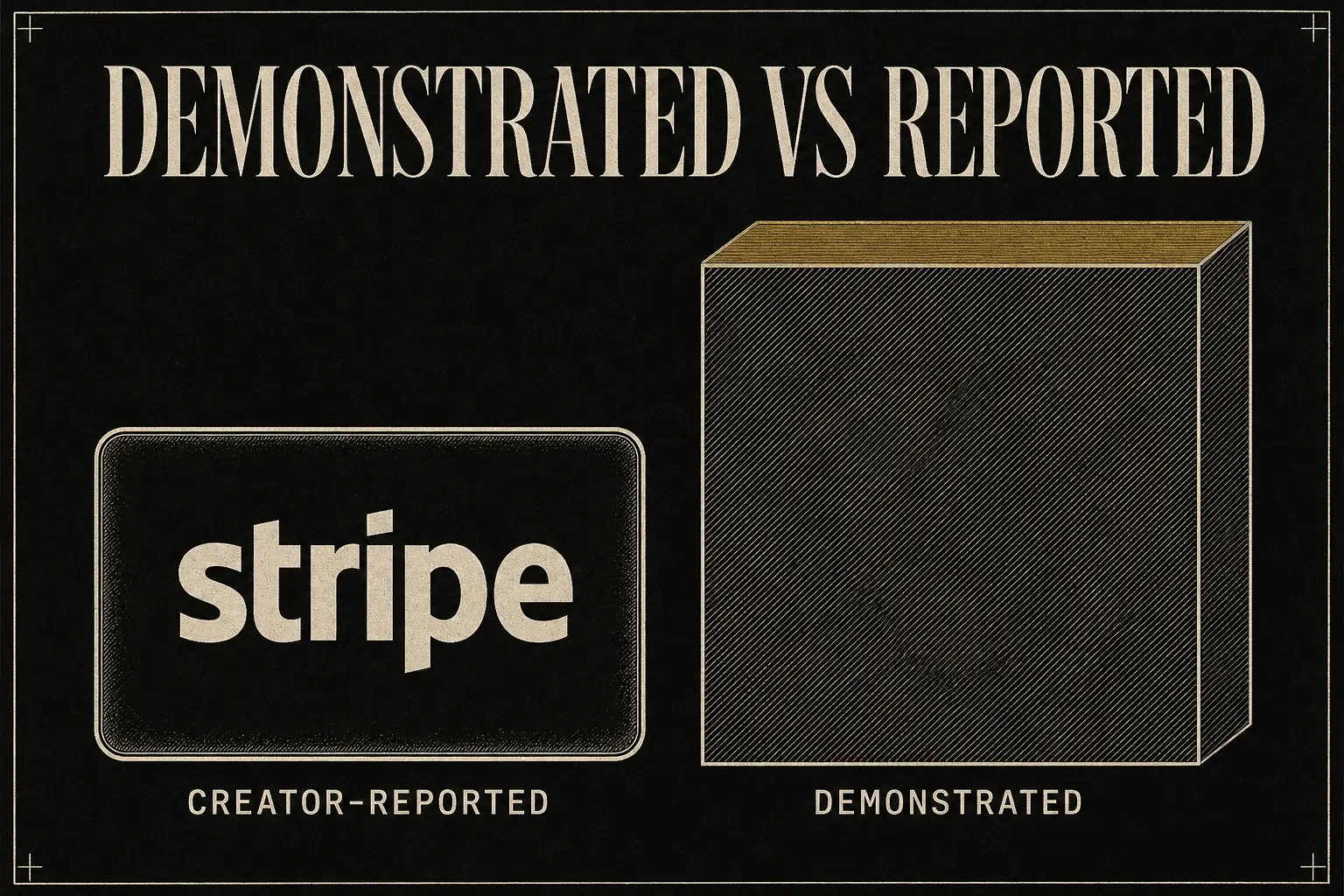
You click the link a 30-second video pushed you toward, and the page loads a wall of value:
- a bonus stack "worth $36,000"
- a Stripe screenshot frozen mid-payout
- a clip promising "£600 a day with AI avatars"
- a sales page advertising "1,000+ done-for-you workflows"
- a banner that says your first dollar arrives in 5–7 days
Your pulse does exactly what the page was built to make it do. The part nobody on that page wants you to sit with:
the question is never whether those numbers exist (they exist in abundance) but whether each one is a demonstrated outcome or a projected possibility engineered to move you through a funnel.
The gap between what gets marketed and what actually compounds into money in your account is where all the revenue, and all the quiet disappointment, lives. This is a field guide to reading that gap, for any AI-automation creator, on any sales page, in any paid room.
flowchart TD
    A["A number on the sales page"] --> B{"Could you verify it yourself?"}
    B -->|"Someone ran it: fixed criteria, observable output"| C["Demonstrated: compounds into money in your account"]
    B -->|"You would just have to trust them"| D["Creator-reported: fuel for the funnel"]
The patterns below are drawn from one of the most polished operators in the market, but none of them are about him. They're about the machine, because every serious creator in this space runs some version of it.
The thesis is blunt. In AI, the only numbers that matter are the ones you can demonstrate, not the ones a creator reports, and the real engine of value is never the tool or the course but the operational stack and the live coaching that force you to ship.
Only a fraction of a good creator's output, maybe a fifth, is genuinely reusable operator IP. The rest is funnel-engineered marketing, interleaved post-by-post with the real thing. Read without a filter and you swallow the marketing whole.
CH.01
What separates a "demonstrated" claim from a "creator-reported" one?
A claim is demonstrated when someone ran the workflow, built the system, or measured the result directly. It is creator-reported when it's asserted as plausible but never witnessed, true for someone, somewhere, presented to you as typical. That single cut is the first thing you make on every figure you read.
A real demonstrated example looks like a head-to-head model test: identical dashboard architectures run through four different AI "brains" for several weeks, each scored on fixed criteria:
- multi-step reasoning
- tool-call reliability
- code quality
- long-context retention
One model reported as holding a 13-step competitor dossier and making dozens of tool calls with only two redundant re-calls, while rivals lost the thread earlier. Whether or not the specific scores are accurate, the shape is demonstrated: same inputs, fixed criteria, observable outputs. That is what a benchmark is.
Now contrast it with "saves 2–4 hours versus hiring a developer" or "£600 a day from avatar content." Plausible. Unaudited. Never witnessed across instances. So when a number appears in this ecosystem, ask one question first: who ran this, and what would I have to do to verify it myself? If the honest answer is "I'd just have to trust them," it's Tier 3, and the ladder below tells you what that means.
CH.02
Which tier does the claim belong to?
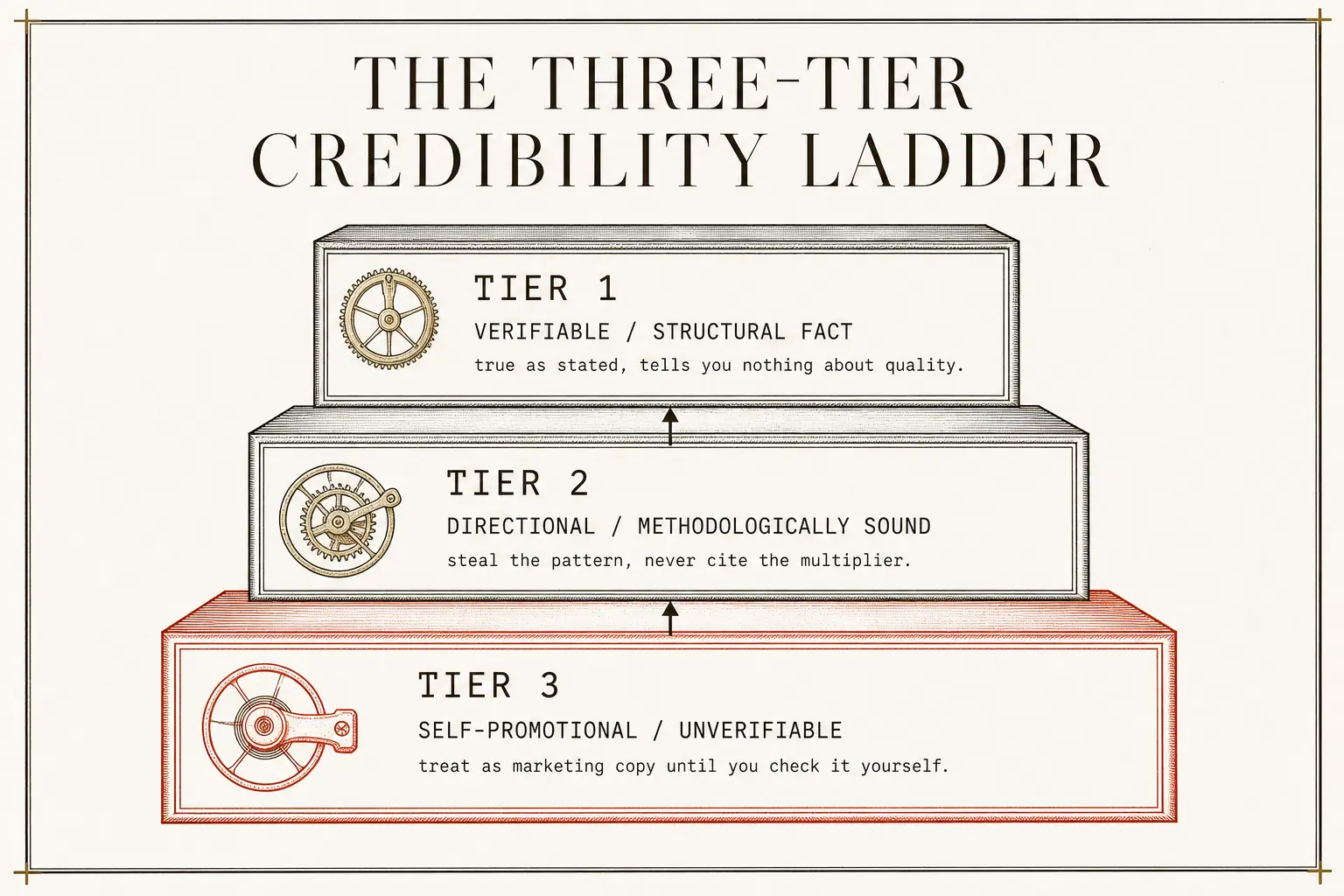
Sort every sentence into one of three tiers before you act on it. The discipline is mechanical, and it's the whole game.
| Tier | What it is | Examples | What to do with it |
|---|---|---|---|
| Tier 1 | Verifiable / structural fact | Listed pricing, tool names that genuinely exist, platform mechanics (a Skool community really does have a classroom, a feed, a calendar), the fact that the paid room costs $59/mo | True as stated, and tells you nothing about quality |
| Tier 2 | Directional / methodologically sound | "Memory turns a tool into an asset," "own the harness, rent the model," "productize the deliverable," "ship-first / 60%-v1 on real input," "Perplexity inherits the Google index," the productized-service pricing ladder | Steal the pattern. Never cite the specific multipliers |
| Tier 3 | Self-promotional / unverifiable | Every revenue, traffic, member-count, and outcome claim. Every invented scoring rubric that ranks the creator's own product #1. Every branded SKU with no public method. Every "free, no API keys" tool claim | Treat as marketing copy until you've checked it yourself |
The trap to avoid: a claim does not graduate from Tier 3 to Tier 1 because it's repeated across fifty posts. Repetition is reach, not evidence.
CH.03
Why do subscriber counts and income screenshots lie?
Because the credibility signals that are easiest to flash are also the easiest to inflate, and the metric that actually matters is the one they hide.
The subscriber illusion
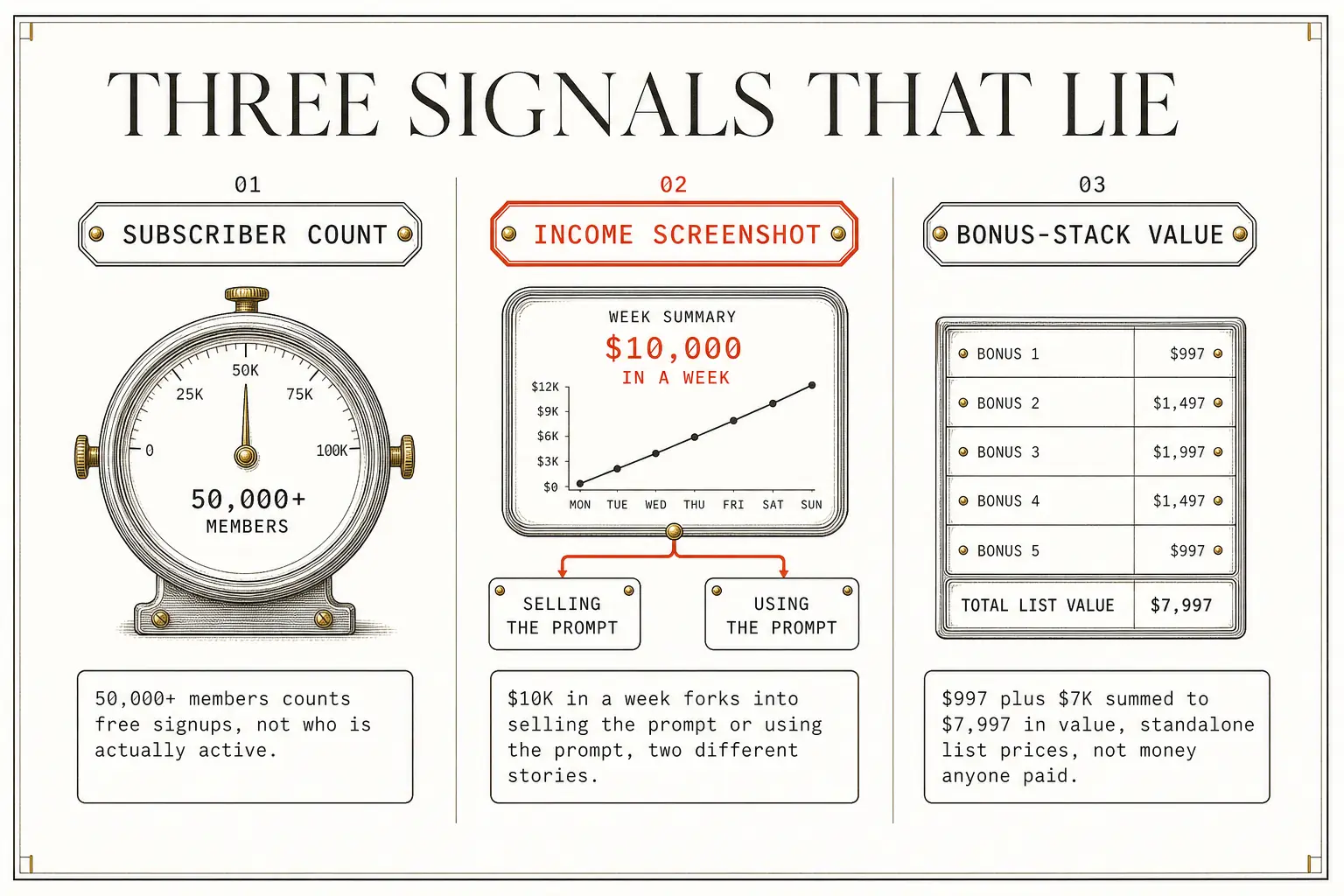
A community claiming "50,000+ members" almost always counts a free Discord or a one-off lifetime purchase. The number that matters isn't lifetime signups, it's active member density. Picture a free room of tens of thousands: the signal-to-noise is dismal, mostly memes, link spam, and 3 a.m. questions from people who will never build anything. A paid, filtered room of a few thousand active operators is a different animal: the worst question in the free room is incoherent. The worst question in the paid room is "how do I price a $5K retainer." Financial skin in the game is what filters the room.
The income screenshot
A Stripe screenshot proves a moment, not a system. "I made $10K in a week with this prompt" forks into two completely different stories. $10K from selling the prompt is a funnel. $10K from using the prompt for client work is a business. Find out which before you copy anything.
The bonus-stack valuation
You'll see "AI Avatar Profit Engine ($997) + Faceless YouTube Playbook ($7K) = $7,997 in value." That's funnel arithmetic, standalone list prices summed, not money anyone paid. The real worth of a bonus is whether it's a deployable asset (a working n8n workflow, a tested sales script, a use-case-tagged prompt library) or a recycled 2023 PDF. Crude tell: three or four generic bonuses means the vault is thin. Twenty-five-plus named, specific kits means the assets are at least meant to be used.
CH.04
Which numbers are real, and which are pure funnel?
Sorted by what survives the filter. Every figure below shows up verbatim as social proof. None is independently audited. Read the table as a taxonomy of claim-types, not a scorecard for one person.
| Claim type | Examples (creator-reported) | Verdict |
|---|---|---|
| Direct operational revenue | "7-figure SEO agency," "team of 50," "$300K/mo AI tech stack" | Stated as current reality. The specificity beats "make six figures," but no external proof |
| Audience counts | YouTube cited as 70,000+ in some posts and 282K+ in others. Free lab 75,200+ (May 2026), 335+ online. Paid room 3,000+ | The 4× YouTube gap is a precision red flag. Cite neither. The rest are recent and specific but self-reported |
| Member outcomes | "£600/day avatar content," "$10K+ from one workflow in 60 days," "£8K/mo / 160× ROI," "20–40 hrs/week saved" | Real people's reported highlights, survivorship-selected (possible, not typical). The failures never post screenshots |
| Traffic / SEO (all the creator's own sites) | 1,134 clicks/day main site, 0→12,700 clicks in 28 days, "19 hours to rank #1" | Their properties, not client results. Even if true, not your outcome |
| Calculated projections | "$59 × 12 = $708/yr, needs $7,080 for 10:1", "50:1 on coaching alone" | Logical constructs, not measurements. Decision frameworks with your hourly rate as the input |
| Stacked-value anchors | "$36K bonus value," "$7K system," "$6,000+ stacked value," "$8,000+/mo giveaways" | Marketing arithmetic. $59/mo may still be a good deal, but never because of these numbers |
| Efficiency multipliers | "185% faster," "80% of revenue with 30 min/week," "90× vs static courses," "92% memory-retrieval accuracy" | Round, convenient, uncited. Tier 3 by default |
A few structural metrics, by contrast, are worth computing yourself, because they turn marketing into arithmetic you control:
- Cost-per-hour-of-live-coaching. A $297/mo room with one 60-minute call a week is about $74/hr of expert access. A $59/mo room with five weekly calls is roughly $3/hr. The absolute price matters far less than the delivered hour, and that ~25× spread tells you more than the sticker price ever will.
- Price-per-update. AI knowledge has a short half-life, so a yearly-refreshed course costs a fortune per still-current fact while a weekly-updated room costs pennies. The full math (and why it's the load-bearing case for the whole subscription model) gets its own chapter below. Use the framework, bin the cherry-picked headline multiplier.
- Time-to-first-dollar. How fast can you open a kit, deploy a workflow, and see real revenue? Free Discords and YouTube comment sections have an effectively infinite time-to-first-dollar, no structured path exists. If a community's average time-to-first-invoice is measured in months, it's structurally weak regardless of vault size.
CH.05
How does a free tier turn into a $59 charge?
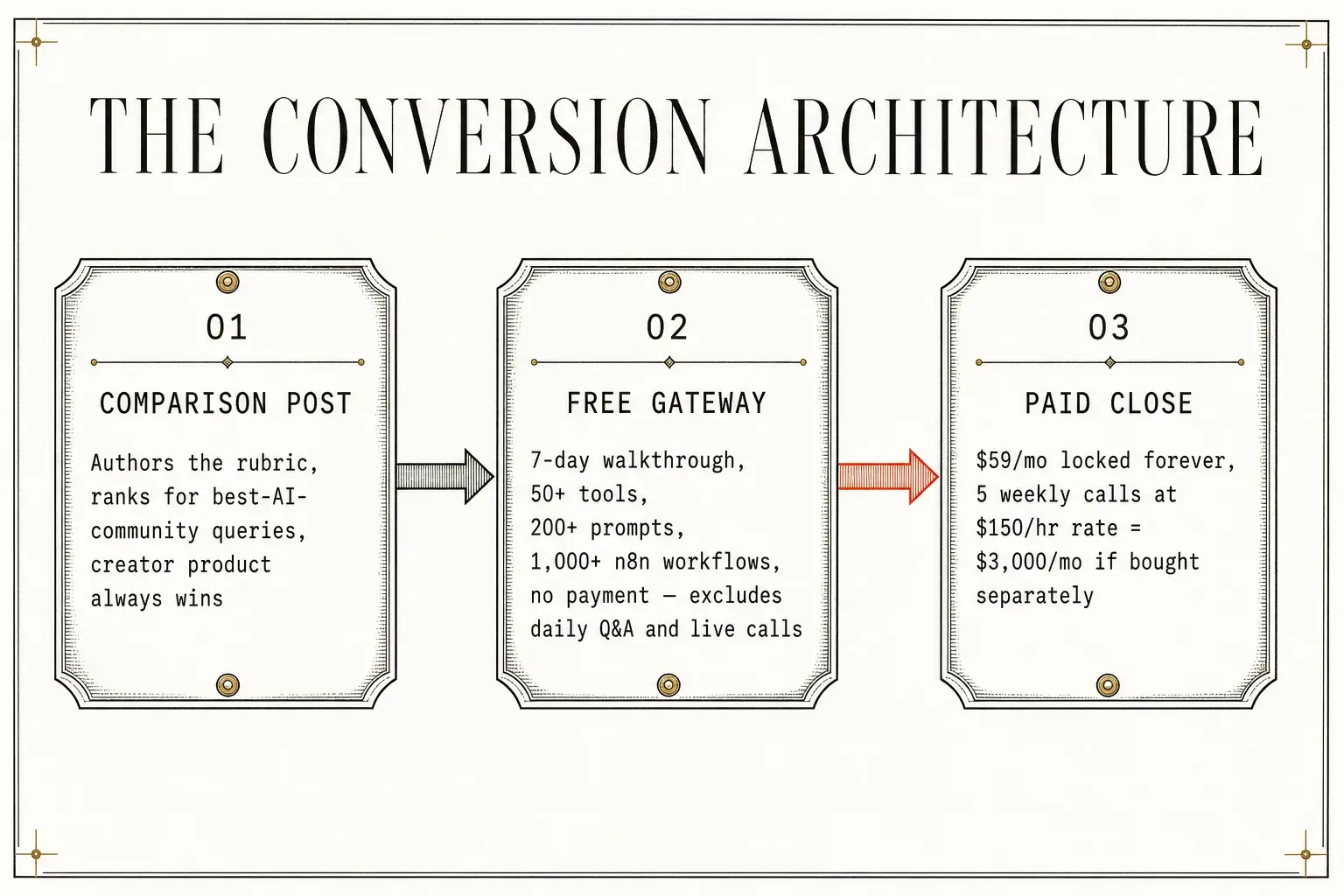
The conversion architecture is the part most worth stealing, and it runs in three moves: a comparison post captures the buyer, a free gateway pre-qualifies them, and a paid tier closes on value math instead of urgency.
Move one: the comparison post earns trust by refusing to look like an ad. Nobody searches for "AI course." They search for the named comparison:
- "best AI community for beginners"
- "best free AI agent builder"
- "OpenClaw vs Agent Zero"
That query is intent at its most expensive, a person mid-decision, comparing two named options, wanting data. So the content is built to be the thing that ranks for it. Titles like "Best AI Community On Skool (4 Finalists Reviewed)" or "Best AI Agent Builders To Make Money (2026)" read as objective reviews. They apply an explicit rubric and score every option. The trick (and it is a trick) is that the creator's own product always wins, because the creator wrote the rubric to describe their own product. They don't deny the comparison. They author it. The neutrality is the product.
Move two: the post funnels you into a free gateway. The free lab gives you the community format with no card and no risk:
- a structured 7-day walkthrough
- 50+ tools
- 200+ categorized prompts
- 1,000+ n8n workflows
- an active daily feed
It is not charity. It's a lead magnet doing two jobs, filtering for the motivated (people who actually finish the walkthrough) and building a permission asset to upsell. And it pointedly excludes daily Q&A, weekly live calls, done-for-you templates, and the "high-revenue tech stack," manufacturing upgrade pressure at the exact moment you hit friction.
"Free isn't replaced by paid. Free is layered with paid." The gap between the tiers is the product.
Move three: the paid tier closes on arithmetic. The entry room is $59/month, "locked forever." The pitch is value-anchoring, not scarcity: five weekly live coaching calls at a $150/hour agency rate would cost roughly $3,000/month bought separately, a claimed 50:1 return on the coaching line alone, before the vault, the kits, or the daily Q&A. (Reported, not audited, but notice the shape of the argument.) It works because you already experienced the format for free before you ever saw a checkout.
The anti-funnel completes it. The same creator loudly warns against the alternatives:
- free Discords ("90% memes, 5% link spam, 5% content")
- YouTube comments ("not a community")
- mid-tier $99–$199/mo rooms ("one call a month, thin vaults")
This positions the $59 room as the rational middle, more structured than free, cheaper than premium, more current than a course. It lands precisely because it contains truth: the free alternatives really are noisy, and the premium ones really are expensive.
CH.06
The invented-rubric tactic: rigging the scorecard
The persuasion move you'll see most often is to invent an evaluation framework, build your own product to pass it, then present the verdict as neutral analysis. Recognize the pattern and the verdicts stop working on you.
What makes it a case study rather than a one-off is the volume. The same operator can mint a half-dozen distinct rubrics to dominate different comparison queries:
| Rubric | What it scores | What it's built to make you conclude |
|---|---|---|
| ROI Ratio Test | Annual cost ÷ expected revenue lift | Below 1:5 = avoid. 1:10+ = worth it, and the $59 tier "obviously" clears it |
| Five-Factor Velocity Framework | DFY templates, coaching cadence, peer density, stack focus, accountability | Speed-to-revenue is the metric, and only this stack has all five |
| Operator-First Scorecard | Deployment speed, vault depth, coaching access, operator density, price-to-value | "Operators" need exactly what this room ships (scores itself 48/50) |
| Six-Criterion Checklist | Platform, price, live calls, coach access, bonus stack, guarantee | Discord and static courses fail on contact |
| Seven Founder Filters | Operator at the top, live not pre-recorded, DFY assets, right scale, direct access, fair price, guarantee | "A real founder" looks suspiciously like the author |
| Stack-Depth Framework | Image/video/voice/avatar/text-gen + vault depth, scored 1–5 (out of 30) | Breadth of the asset library = the win condition |
| Value-Per-Dollar Framework | Founder access, coaching, vault density, member quality, risk reversal, per dollar | Per-unit reframing makes $59 look trivial |
The reusable move underneath all of them is the per-unit reframe (the $3-vs-$74 cost-per-coaching-hour trick from the numbers chapter above). Invent the game, set the rules, win on your home field. The rubric does the selling so the sales page never has to. And it pre-empts competition by construction: define "serious AI community" as one with daily founder presence, five weekly calls, and a 30-day ROI guarantee, and the rubric auto-disqualifies:
- Discord servers (no structure)
- static courses (no live support)
- high-ticket masterminds (poor price-to-value for the non-scaled)
One post explicitly conjures the mid-tier graveyard (the $99–$199 rooms named earlier) where no priced competitor can stand.
Here's the honest split: the rubric method is genuinely powerful and fully transferable. The verdicts are not. They're reverse-engineered conclusions wearing the costume of analysis. The clean version uses real criteria and genuine differentiation. The rigged version uses real criteria and a stacked deck. Learn to spot it when it's aimed at you. Use it ethically only when the criteria actually matter.
CH.07
What's the real moat: content or coaching cadence?
The moat in AI communities is not content. It's coaching velocity, how many times this month you can get unstuck in real time. This is the one place where the marketing and the truth happen to agree.
LLMs commoditize content instantly. A course recorded in January is stale by March. What no vault of recorded material can capture is the value of a live call on Wednesday where someone debugs your broken agent on Thursday. So the real differentiator is the live cadence itself:
| The differentiator | The weak version |
|---|---|
| "5 weekly live calls" | "1 call a month" |
| "daily Q&A with custom video tutorials" | a forum that scrolls into the void |
Most paid rooms trip here: the founder runs hard for the first 30 days, then fades to monthly cameos.
So when you evaluate any community, ignore the bonus stack entirely and ask one question: how many times this month can I get unstuck in real time? That number predicts your progress better than "1,000+ workflows" ever will, because the workflows are worth nothing if you implement ten of them and then get stuck on the eleventh with no one to ask.
CH.08
The course-decay arithmetic: why static products rot
The strongest argument the pitch makes is the math on why a one-time course is the expensive option. An AI tutorial has a half-life of roughly 8 weeks:
- in 16 weeks three-quarters of the content is stale
- in 12 months 99% is "historical fiction"
Tools update weekly: coding agents ship features, browser engines change, plugins drop. (The 8-week figure is asserted, not measured. The direction is real: AI tooling churns faster than any annual refresh can track.)
The per-update arithmetic makes it concrete:
| Product | Cost per still-current fact |
|---|---|
| a ~$1,000 course refreshed once a year | $1,000 per still-current fact |
| the ~$700/yr community updated weekly | barely fifteen dollars per update |
That depreciation gap is the load-bearing justification for the whole subscription model (the headline 90× multiplier is cherry-picked, so lean on the direction, not the number). The deeper point is structural, though, and it's the part worth keeping: the distribution playbook only works bolted onto a living product. A funnel pours people into a static course, the decay churns them straight back out, and the stale content kills the trust the comparison post built. The only durable model is the "moving river," a community that updates weekly, with a locked price that rewards early members and drives cost-per-update down over time.
flowchart TD
    A["Funnel plus a static course"] --> B["Content decays fast"]
    B --> C["Members churn straight back out"]
    B --> D["Stale content kills the comparison-post trust"]
    E["Funnel plus a living product: the weekly moving river"] --> F["Locked price drives cost-per-update down, members stay"]
CH.09
Inside the machine: the ladder and the twin guarantee
The platform is chosen deliberately, the ladder is built so each rung's ceiling becomes obvious the moment you outgrow it, and the guarantee is smarter than it looks.
"Free AI Discords are entertainment. Paid AI Skool communities are infrastructure." Discord gives activity without structure. A course platform gives structure without community. The classroom + feed + calendar trifecta gives both, and cures the two diseases that kill online communities, content burial and lurker stagnation.
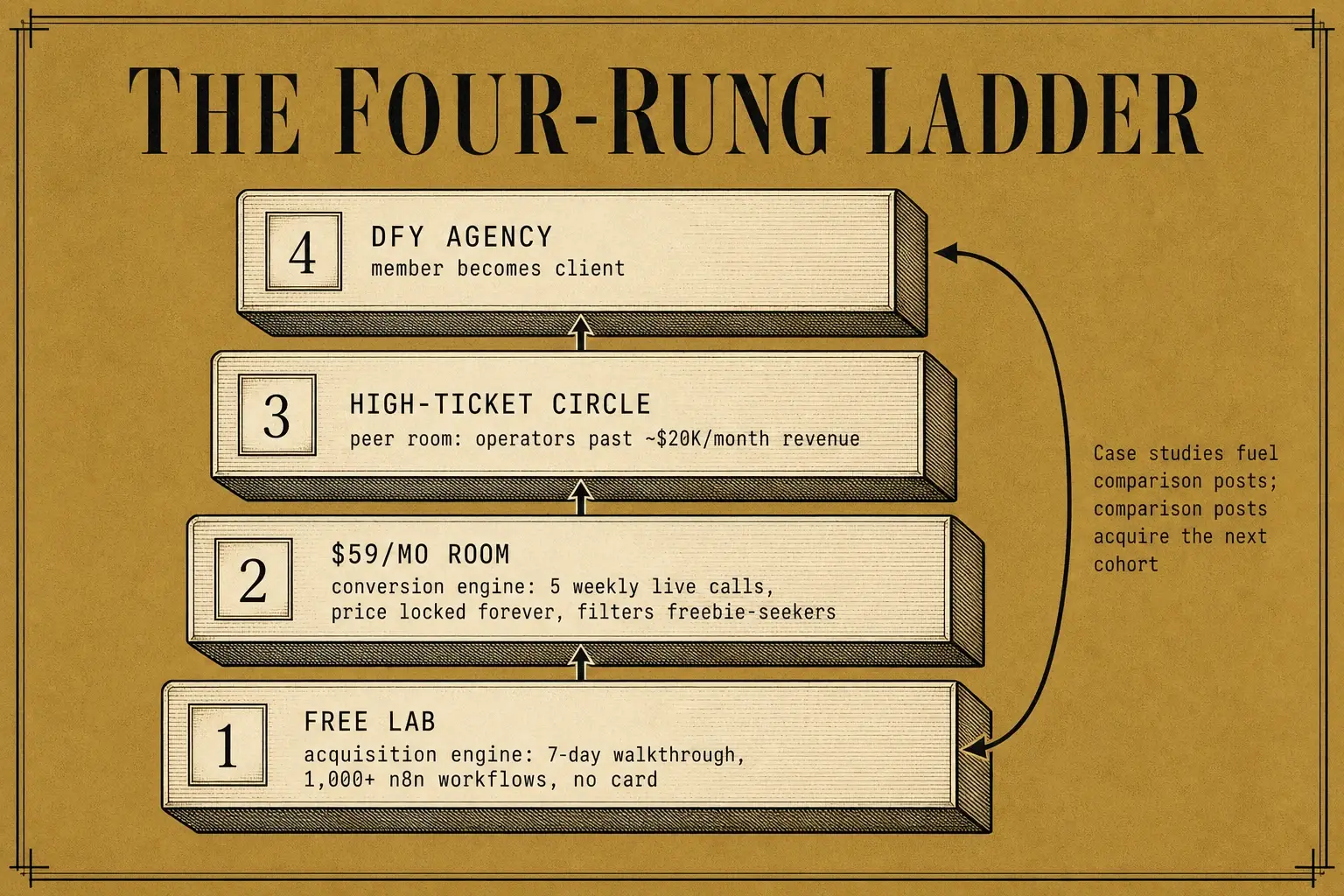
The ladder has four rungs:
- The free lab. The acquisition engine (its contents are the lead magnet from the conversion chapter above). Members are told not to upgrade until they've "deployed at least one workflow successfully" and "feel limited by the free lab." Its job isn't to teach everything. It's to prove the format works for this person and build the daily-visit habit.
- The $59/mo room ("locked forever"). The conversion engine. The price is engineered: low enough to recover from a single client, high enough to filter freebie-seekers. "Locked forever" doubles as a trust signal and a contrast anchor against the $99–$199 "standard."
- The high-ticket circle. For operators past ~$20K/month who need a smaller, peer-level room. Not a beginner product.
- The done-for-you agency. The member becomes a client. This closes the loop: the agency produces case studies, the case studies feed the comparison posts, and the comparison posts acquire the next cohort. The community is the marketing department.
Inside, a high-retention room runs five layers, each doing one job:
- the Community Feed (daily coaching, Q&A, wins, the heartbeat)
- the Classroom (the searchable asset vault)
- the Calendar (live calls and workshops)
- the DM Layer (partnerships and JVs)
- the Members Directory (networking by industry)
Two mechanisms make retention compound:
- The Twin Guarantee. A 7-day no-questions refund (fit) plus a 30-day ROI guarantee (results). The ROI half is conditional on implementation: to qualify, you must actually deploy a workflow, which quietly turns the guarantee into a covert onboarding mechanism. The operator wins both branches: either you get ROI and stay, or you never implemented and the guarantee is void. "The guarantee filters out the tourists naturally."
- Gamification as an economic lever. A point per like, bonuses for heavily-engaged posts, and the top three weekly contributors drawing cash from a member bonus pool. For the most active members the subscription effectively goes negative, and it rewards exactly the behavior (posting wins, asking specific questions, helping others) that makes the room valuable for everyone else.
CH.10
The five failure modes of paid communities
This diagnostic is useful even if you never touch a single funnel, which is exactly what makes it the honest one. Memorize it. It's the lens you run over any paid community or course before you pay:
- Leader vanishes after week two.
- Bonus theatre. Recycled PDFs masquerading as value.
- Call-cadence collapse. Weekly → monthly → on-request.
- Content treadmill. Videos keep dropping, members never ship.
- Price hike. Doubling after three months.
The tell is almost too neat: the best marketing is architected to appear immune to all five.
flowchart LR
    L["Daily livestreams"] --> F1["#1 Leader vanishes"]
    L --> F3["#3 Call-cadence collapse"]
    P["Locked-forever price"] --> F5["#5 Price hike"]
    W["Done-for-you workflows"] --> F4["#4 Content treadmill"]
    G["Implementation-gated guarantee"] --> F2["#2 Bonus theatre"]
Daily livestreams answer #1 and #3, the locked-forever price answers #5, the done-for-you workflows answer #4, the implementation-gated guarantee answers #2. Whether a given community actually resists them is unverifiable, but the diagnostic itself is sound, and its mere existence is what makes the other, self-serving rubrics look engineered by contrast. A creator who can produce one genuinely neutral framework can also produce six rigged ones. Don't let the honest one buy your trust in the rest.
CH.11
Where do honest people disagree, and who's right?
Three real disputes, with the call on each.
Free vs paid community
Free advocates say you can learn AI for zero. Paid advocates say free is the most expensive option in real terms. The tiebreaker is your hourly rate. A true beginner with more time than money should start free. But if your time is worth $50/hr and you burn 8 hours a week sorting signal from noise in a free Discord, that's $1,600/mo in opportunity cost, and a $59/mo room that saves those hours nets you over $1,500/mo. Verdict: free is the right on-ramp and a trap as a destination for anyone whose time already has a price.
High-ticket mastermind vs high-frequency subscription
The $10K/yr mastermind argues its ~30 annual touchpoints are higher-impact. The subscription argues 260+ touchpoints a year at a couple of dollars each crush a mastermind's hundreds-per-touchpoint. Verdict: the mastermind wins for exactly one persona, the founder already at $20K+/mo who needs a peer group at scale. The subscription wins for everyone else, because high-ticket rooms lack the daily implementation help you need when tools break weekly.
"Bonus buffet" vs "one channel"
These communities dump 25+ launch kits on new members, while the advice inside those same communities is "pick exactly one channel and one distribution method to start." Verdict: treat the bonus stack as a library, not a curriculum. Pick the single kit that maps to your biggest revenue gap, deploy it, and ignore the rest until you have a win to scale.
CH.12
The 7-day pressure test: verify before you pay
Don't trust the sales page. The moment you join anything, run a structured test and decide on the data, not the marketing. Most rooms have a refund window. Use it as a trial, not a courtesy.
- Day 1: the vault. Open it, pick one template, try to deploy it in 2 hours. Can't? The "done-for-you" claim is hype.
- Day 2: expert access. Attend a live call, ask a specific implementation question. If the host dodges or punts to a moderator, "expert access" is hype.
- Day 3: support latency. Post a hard question in Q&A. Response over 24 hours? "Daily support" is hype.
- Day 4: liveness. Read the last 30 days of the feed. No members posting deploys and wins? "Active community" is hype.
- Day 5: findability. Shortlist 3 workflows. Clear use-case tags, or are you scrolling chat history? Untagged means unusable.
- Day 6: operator density. DM 3 members. Ask if they've closed a client or shipped a build. If none have, "operator-dense" is hype.
- Day 7: decide. Keep or refund, on the evidence.
Run the same discipline on the individual claim types:
- Income claims: demand specificity. "£600 a day" is meaningless. "£600 a day from affiliate commissions on a faceless YouTube channel in niche X, running 8 months, on this exact stack" is checkable. Ask for the second version in Q&A. Hand-waving means aspirational.
- Time savings: build your own baseline. Before believing "30 minutes per article versus 6 hours manually," time yourself on one manual article, then time the AI-assisted version including prompting, editing, and fact-checking. Your real number will rarely match the marketed one.
- Tool comparisons: insist on head-to-head benchmarks with identical inputs. A claim shaped like "model A held the thread through eleven sub-steps before drifting, model B dropped it at six, same inputs" (the format to demand, not a specific result quoted here) beats "model A is better for writing" every time.
CH.13
What does the funnel actually sell at the end?
The whole apparatus is academic unless it terminates in something a client pays for, and the through-line is that the AI is invisible to the client. They buy an outcome on a cadence at a price, not a technology. The actual offer menu (retainers, launch sprints, intel reports, setup builds, and how to price them) is its own subject, worked out in the productized-offer pillar. What matters for reading a creator is simpler: every revenue claim you evaluate ultimately rests on whether they can deliver a client outcome repeatably, or whether the only thing being sold is the course about selling it. If their public proof is all funnel and no delivered outcome, you have your answer.
CH.14
The honest verdict, and the opening it leaves
There is real value in these rooms, and none of the headline numbers can be checked, and that gap is the whole opening for anyone whose work can be. Pretending the value isn't real would be its own kind of dishonesty:
- the live coaching cadence
- the tested workflow architectures
- the founder's specificity about running an actual agency
At $59/mo against five weekly calls and daily Q&A, the cost per access hour is genuinely low. The free tier is a legitimate on-ramp, not a trap. The paid tier is a real accelerator, for the right person: an action-oriented operator with some business context, not an absolute beginner chasing passive income.
But the income figures (the testimonials, the vault valuations, the projected ROI) are directionally possible for committed implementers and not typical outcomes. The "£600/day" avatar operator is an outlier, not a median. The reusable IP is real but thin per post, concentrated in maybe fifteen-to-twenty of any creator's ninety-plus posts. Everything wrapped around it is marketing scaffolding, not evidence:
- the revenue claims
- the invented multiplier rubrics
- the branded SKUs
- the stacked-value anchors
- the "objective comparison" sales pages
And that scaffolding is the opening. The structural weakness of this entire model is that none of the numbers can be checked. The edge is content velocity plus a tight $59/mo funnel, not deep verifiable authority. An operator whose work is checkable (sourced metrics, public-safe builds, reproducible benchmarks, results a stranger can audit) is positioned against exactly the credibility gap the whole funnel papers over. The number that matters most appears on no sales page: how many hours a week will you actually build, ship, and iterate? Every other figure in this ecosystem, theirs and yours, is downstream of that one.
The 4 skills behind this note
- Sign in to open
Audit competitors
Audit the FAILURES and SUCCESSES of competitors in our field (AI content publishing + automation) into rank...
- Sign in to open
Mine YouTube
Gather the best RECENT YouTube videos on a topic
- Sign in to open
Mine X/Twitter intel
Gather X (Twitter) intelligence on our topics (AI automation / AI agents / build-in-public / X-growth / mon...
- Sign in to open
Deep-research prompt
Turn a topic the user names into an optimized DEEP-RESEARCH PROMPT for Perplexity Pro (or ChatGPT Deep Rese...